
This page is a translation of the original French text. It may contain errors; the French version is the reference text: Gouverneurs 2026 : État par État
Le Millénaire’s in-depth note on the gubernatorial elections of November 3, 2026
In Georgia, Democrat Jon Ossoff has a 95% chance of keeping his Senate seat. Yet Keisha Lance Bottoms, of the same party, has only 33.4% in the governor’s race, with the same polls on both sides. Thirty-six governorships are up on November 3, nineteen of them without an incumbent. William Thay, Sean Scull and Augustin Bataille review them, county by county, all the way to what they say about the 2028 presidential election.
Little change
Our model expects 22.7 Democratic governors out of the 48 seats it computes, between 20 and 25 in 90% of simulations: roughly the current balance. The most likely outcome is a swap, Iowa to the Democrats with Rob Sand, Kansas to the Republicans with Ty Masterson.
Ticket splitting
Voters do not vote the same way from one contest to the next. In Georgia, Jon Ossoff runs 14.0 points ahead of his party’s candidate for governor; in New Hampshire, the gap between the two races exceeds 16 points. Three Republicans hold on through their own name in Democratic or swing states.
The 2028 talent pool
The governors elected on November 3 will be in office during the 2028 presidential election. They will weigh on it through their states’ election rules, in Nebraska as in Alaska, and through their own candidacies, more than through endorsements.
Foreword
So which governorships could change hands on November 3? And why do Georgia, New Hampshire and Iowa split their vote between Senate and governor?
Of the 36 seats up, each party is defending 18. Republicans currently run 26 states, Democrats 24. Tony Evers, Kim Reynolds and Tim Walz have chosen not to run again in Wisconsin, Iowa and Minnesota, fifteen governors are term-limited and Rhode Island’s incumbent was defeated in the primary: that brings us to 19 races without an incumbent.
Unless otherwise stated, the figures come from the October 31, 2026 update of the Le Millénaire forecast (governors model, simulator and “Polling errors” tool). The note starts from the current balance, then turns to the powers of governors. Next come the settled races and the competitive ones, county by county. It closes on the 2028 presidential election.
The current balance
The model counts 48 seats: the 34 races it probabilizes and the 14 seats not up, taken as they stand. Alaska, which uses ranked-choice voting with four candidates, and Maine, where an independent is running, are kept separate. Within this scope, Democrats hold 23 seats. After the election, they would have 22.7, between 22 and 24 in half of the simulations, between 20 and 25 in 90% of them.
Of their 17 probabilized seats, Democrats would lose 2.5 on average, first in Kansas, Wisconsin, Oregon, Colorado and Michigan. They would gain 2.1 of the 17 Republican seats, mainly in Iowa, Nevada and Georgia. With a Democrat elected in Alaska and Maine, as the polls suggest, the expected total would rise to 24.7 Democratic governors out of 50.
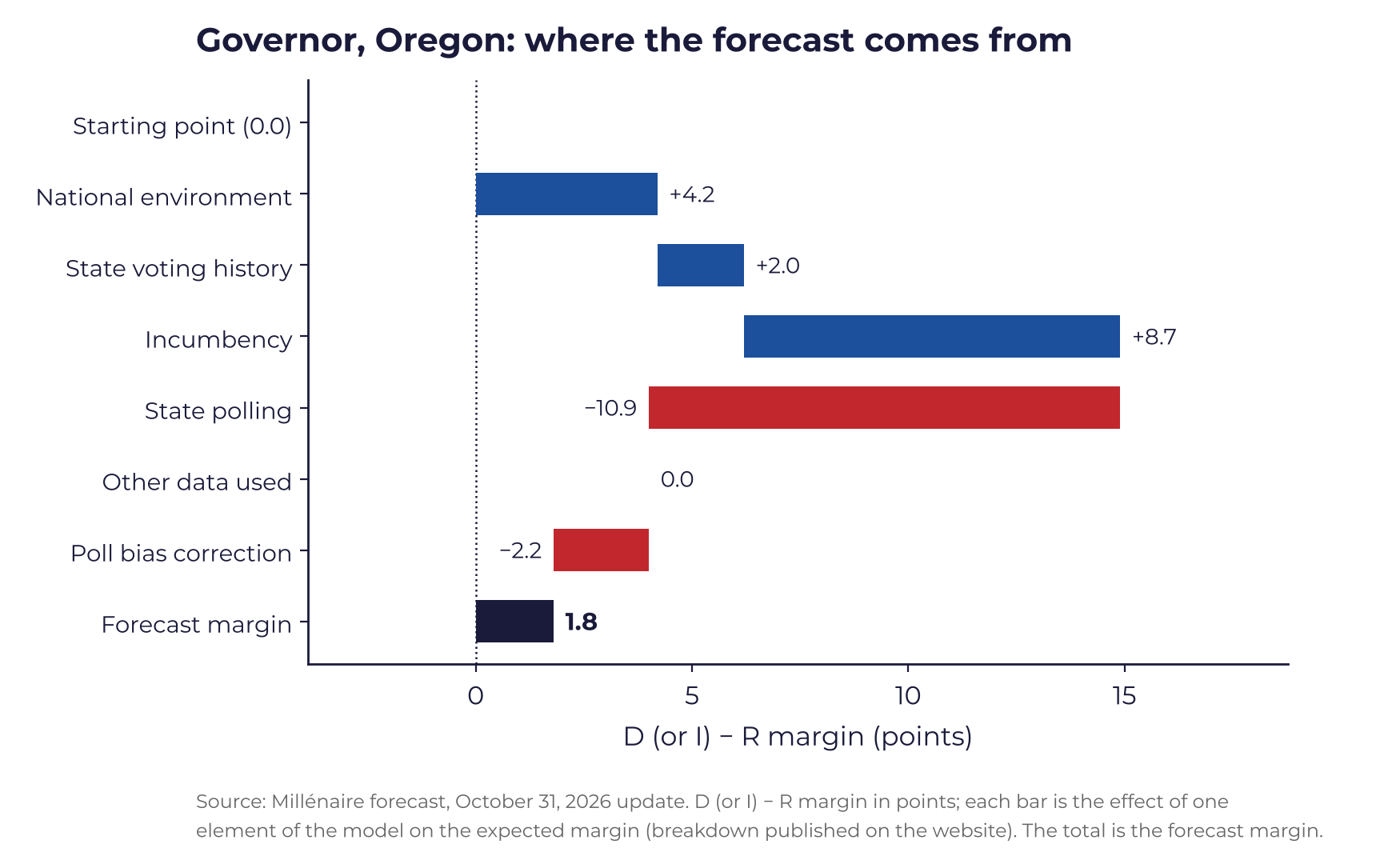
In the general case, the polling average carries the most weight: only the latest wave from each pollster published in the last 45 days counts, adjusted for house effects and for polls commissioned by one side, then reduced by 2.4 points for the Democrats. The rest comes from a structure based on the 2024 presidential election, the generic ballot and an incumbency bonus of 8.7 points. In Colorado, Hawaii and Wyoming, no poll has been published.
What governors change
Redistricting. The maps of Texas, Florida, Tennessee and Louisiana, signed by their governors, are in force, as are those of California and Utah, which favor Democrats. The veto also matters: Joe Lombardo has issued 162 in Nevada, and Kelly Ayotte used 32 against her own Republican majority in New Hampshire in 2026.
Election rules. Tom Tiffany devoted more than three minutes, in Wisconsin’s only debate, to his vote against certifying the 2020 election. In Nebraska, Jim Pillen wants to abolish the split allocation of electoral votes that allows Omaha to deliver a Democratic vote in the presidential election. In Alaska, Ballot Measure 2 would repeal ranked-choice voting and the open primary.
Abortion and immigration. Keisha Lance Bottoms is fighting the six-week ban in Georgia; Tom Tiffany supports a twenty-week limit in Wisconsin. In Maine, Hannah Pingree defends the law limiting cooperation with ICE; in New York, Bruce Blakeman targets Kathy Hochul over “sanctuaries.”
The new issues. Two subjects come up in nearly every competitive race: data centers, whose electricity and water consumption is a source of concern, and state and local taxation. Zach Lahn in Iowa and Andy Biggs in Arizona promise to eliminate the income tax; in Kansas, Texas and Florida, there is talk of capping property taxes.
The trend since August
The climate improved for Democrats over the fall: recalculated day by day, the expected number of Democratic governors went from 20.7 on August 1 to 22.7 on October 31. In Iowa, Rob Sand’s chances have risen from 40.9% to 65.8%, and they also increased in Arizona, Michigan and Minnesota; they fell in Florida, New Hampshire and Georgia.
The result remains highly sensitive to polling error: an error comparable to that of 2020 would bring Democrats back below 20 governors out of 48, and a 3-point error in their favor would lift them above 25. Governors are also linked to Congress: in the simulations where Democrats win the House, the expected number of Democratic governors rises to 23.7; it falls to 19.4 in those where they lose it.
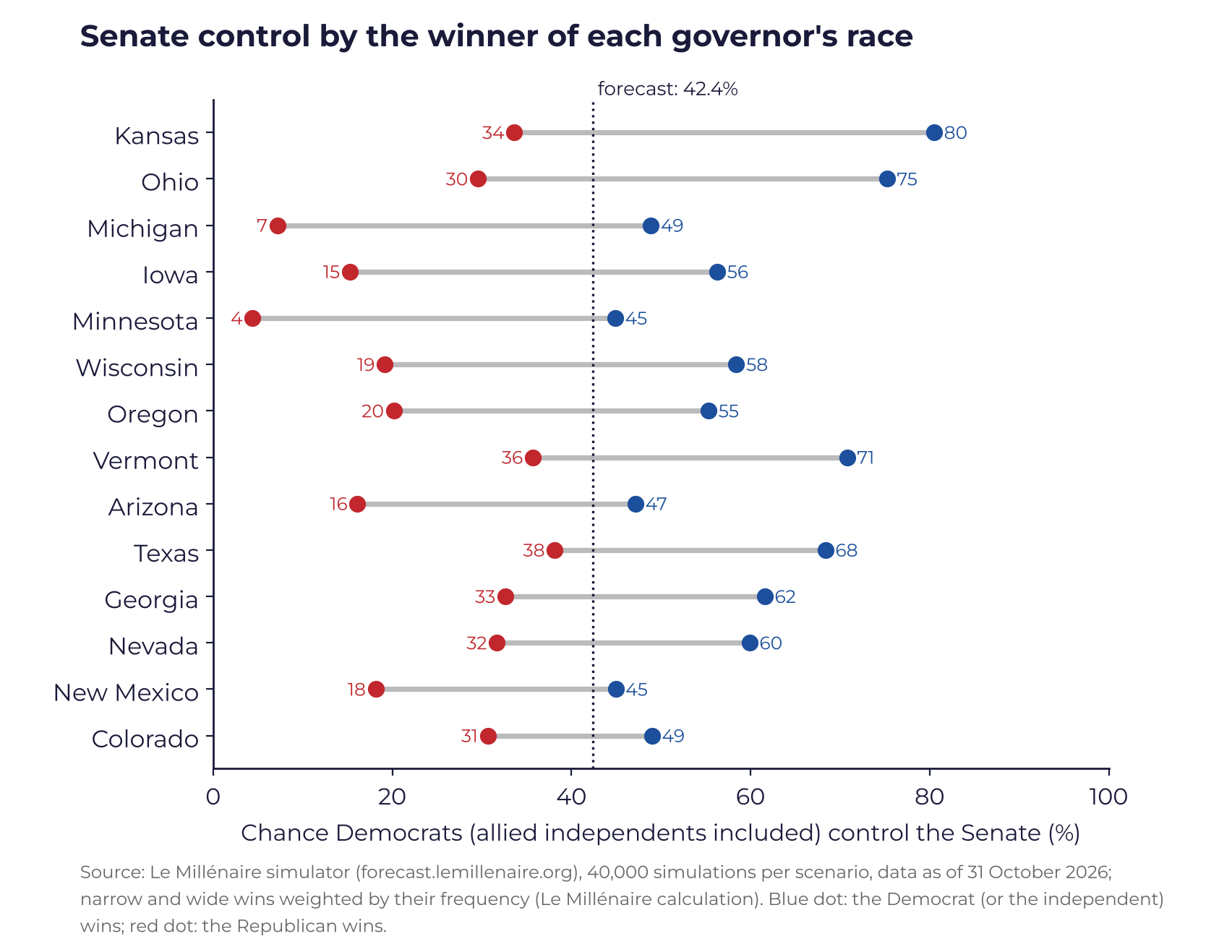
A win by Cindy Holscher in Kansas would raise Democratic chances in the Senate from 42.4% to 80.5%, one by Amy Acton in Ohio to 75.2%, one by Gina Hinojosa in Texas to 68.4%. A Democratic defeat in Michigan or Minnesota would, on the contrary, drop them below 8%. Where the model has the Democrat losing, a win would point to a polling error against that party across the whole country.
The settled races
According to our model, seventeen of the 36 races are settled, with one of the two candidates above a 95% chance: nine lean toward the Democrats and eight toward the Republicans.
Larry Rhoden in South Dakota, Sarah Huckabee Sanders in Arkansas and Brad Little in Idaho are defending their seats in states Donald Trump won by 29 to 37 points. Five term-limited Republican governors are leaving their seats open in deeply Republican states, and two U.S. senators are running to succeed them, Marsha Blackburn in Tennessee and Tommy Tuberville in Alabama.
On the Democratic side, Wes Moore in Maryland, Maura Healey in Massachusetts, Ned Lamont in Connecticut, JB Pritzker in Illinois and Josh Green in Hawaii are reelected in advance according to the model. In California, Xavier Becerra leads Steve Hilton by 24.2 points in the average of ten pollsters to succeed Gavin Newsom. In New York and Pennsylvania, Kathy Hochul and Josh Shapiro are near-certain winners; it is above all their margin that will serve as a national indicator. Shapiro has a projected lead of 20.0 points in a state Trump won by 1.7 points.
Follow the forecast until November 3
The figures in this note come from Le Millénaire’s forecast: 200,000 simulations of the election, updated every day until the vote. There you will find each party’s chances, the projection for every race and the simulator, which lets you set the winner of one race and recalculate the rest of the map.
Wisconsin: David Crowley vs. Tom Tiffany
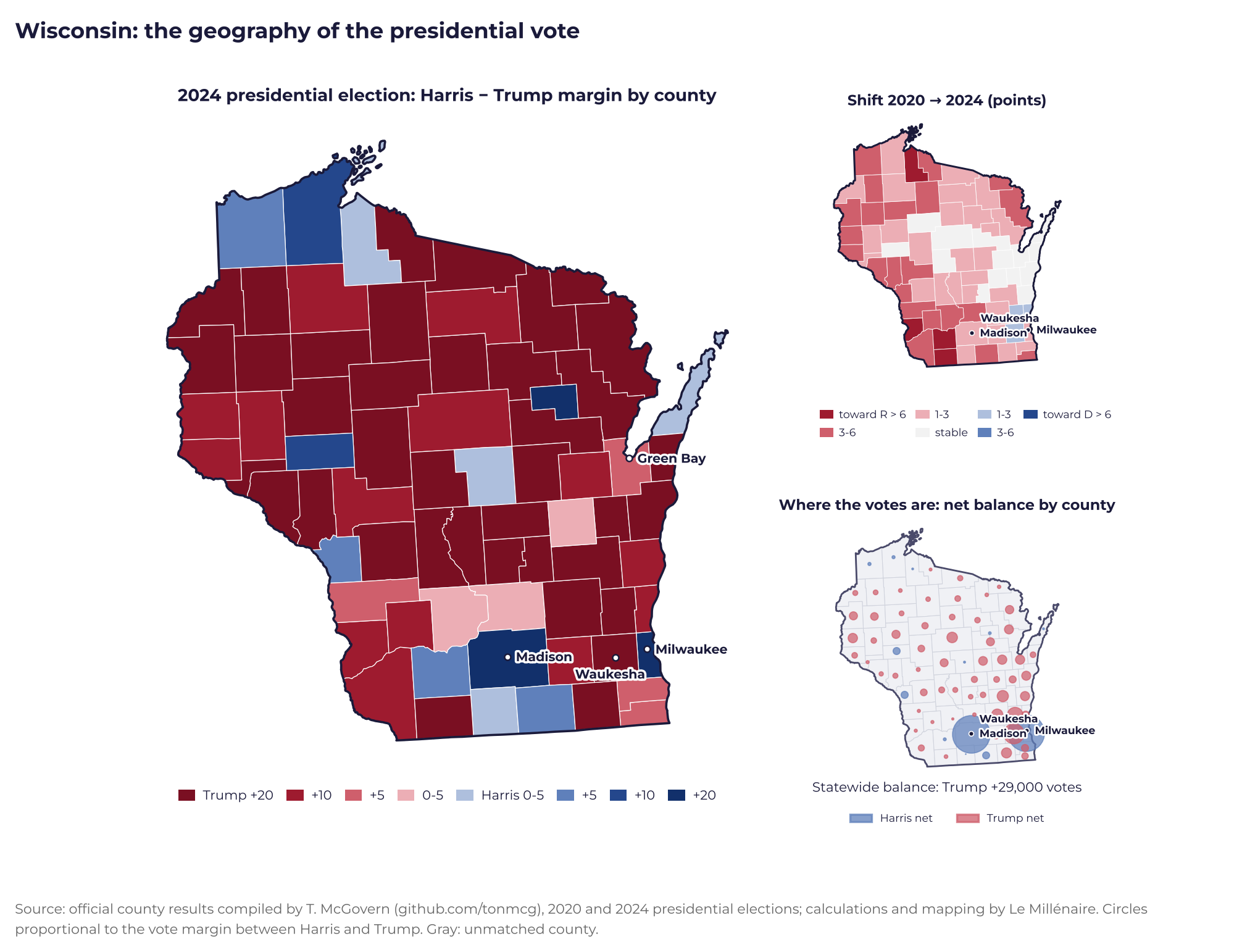
The closest governor’s race in the country is in Wisconsin, where David Crowley has a 59.1% chance for a projected lead of 1.2 points. The polls put him ahead, but the state’s structure almost entirely neutralizes that lead. Five of the last seven presidential elections there were decided by less than one point.
Tony Evers is not running again. Milwaukee County Executive, Crowley beat the Democratic Socialists of America candidate, Francesca Hong, by a hair, and would be the state’s first Black governor. Tom Tiffany is estimated to have received more than 90% of his contributions from three billionaires. He sidesteps the question of his support for Trump, at 38% approval in the state, and breaks with him on data centers; Republicans nickname his opponent “Data Center David.”
Our analysis. Tiffany is lining up $53 million in advertising against $35 million, in a state Trump won by 0.86 points. On November 3, watch turnout in Milwaukee first, then Waukesha and Ozaukee. Crowley must narrow the gap in Kenosha, Racine and Brown to win.
Ohio: Amy Acton vs. Vivek Ramaswamy
Amy Acton leads in most polls published since September 1, and Cook and Sabato both rate the race “Lean Democratic.” Yet our projection gives Republican Vivek Ramaswamy a 72.2% chance, with a 3.1-point lead. Nowhere is the gap between the model and the two analysts sharper.
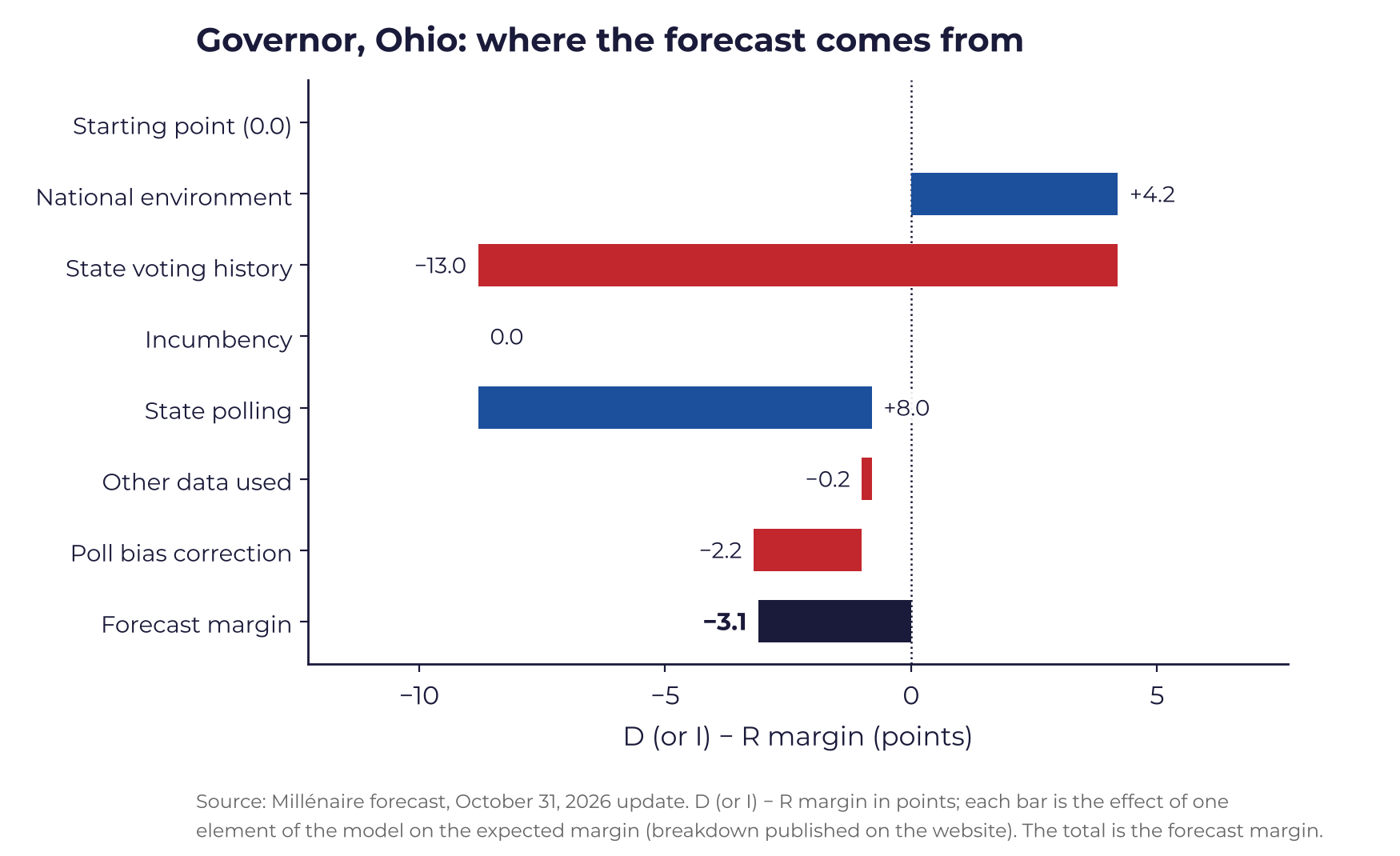
The end of the campaign was dominated by a Ramaswamy ad in which Acton’s biological mother accuses her daughter of lying about her childhood; Mike DeWine called it “deeply troubling.” In the final week, Acton’s lead is narrowing: 7 points with Marist, 2 with Fox News, just one with Verasight. We keep only one wave per pollster, with the most recent ones carrying more weight, before adjusting for house effects and historical polling error. The model also starts from Ohio’s track record: in 2018, Republicans there had been underestimated by about 6 points.
Our analysis. To win, Acton must do better than Harris in Franklin (+28.4 in 2024) and Cuyahoga (+31.5), and gain ground in Delaware County, an affluent suburb of Columbus.
Iowa: Rob Sand vs. Zach Lahn
In a state Trump won by 13.2 points, Rob Sand, the state auditor, leads in every poll published since September against Zach Lahn, a farmer backed by the MAHA movement and the surprise winner of the Republican primary. The projection gives him a 65.8% chance and a 2.2-point lead.
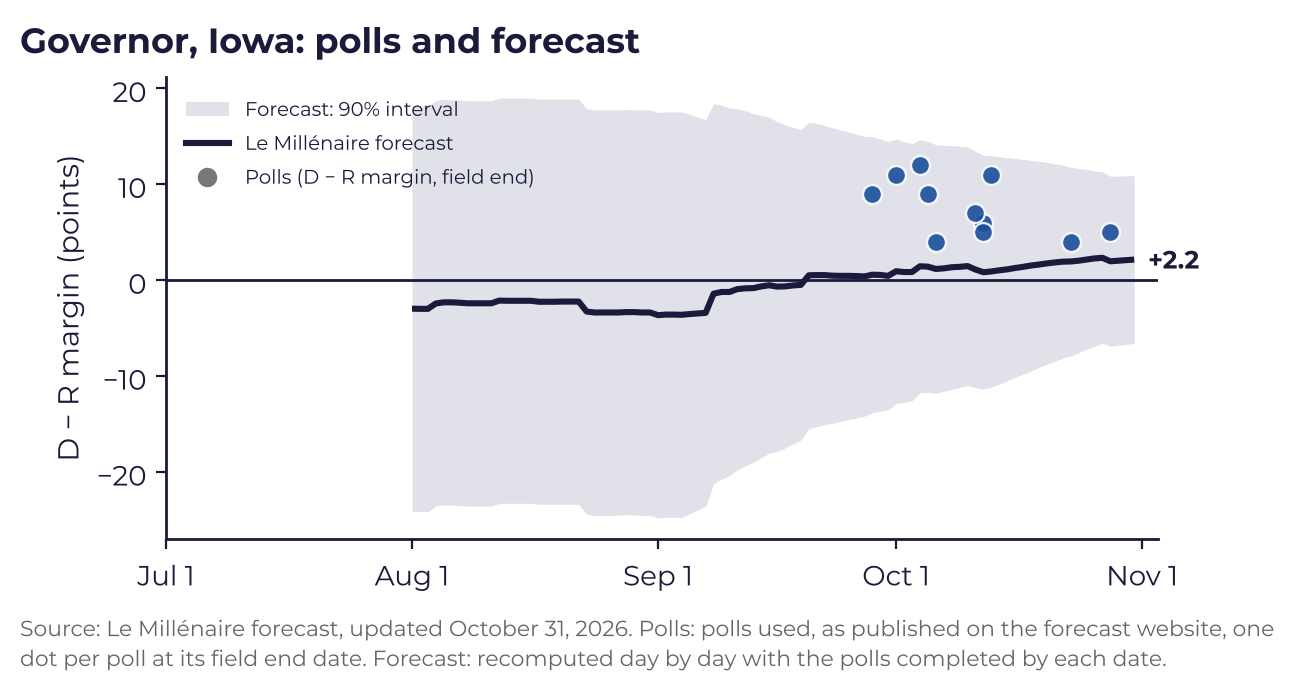
The adjustments take nearly four points off the raw average, and the structure pulls hard toward Lahn. No race has cost as much in the state’s history. The Senate contest leans the other way: in Marist’s October poll, Sand had 52% to 45% and Josh Turek 48% to 45%; some Ashley Hinson voters will have to vote for Sand.
Our analysis. Scott, Dubuque and Black Hawk will tell on election night whether Sand is running ahead of Turek. His projected margin of 2.2 points remains below the national polling errors of 2016, 2020 and 2024.
at least, from his personal fortune: that is what Republican Rick Jackson has put into the campaign for governor of Georgia, where the model puts him ahead of Keisha Lance Bottoms.
Georgia: Keisha Lance Bottoms vs. Rick Jackson
Jon Ossoff is a strong favorite for the Senate. In the governor’s race, however, our model puts Republican Rick Jackson ahead: polls most often show him leading or tied, narrowly, and the state’s structure reinforces his advantage. Two polls released since September 1 put Bottoms ahead, by one and three points.
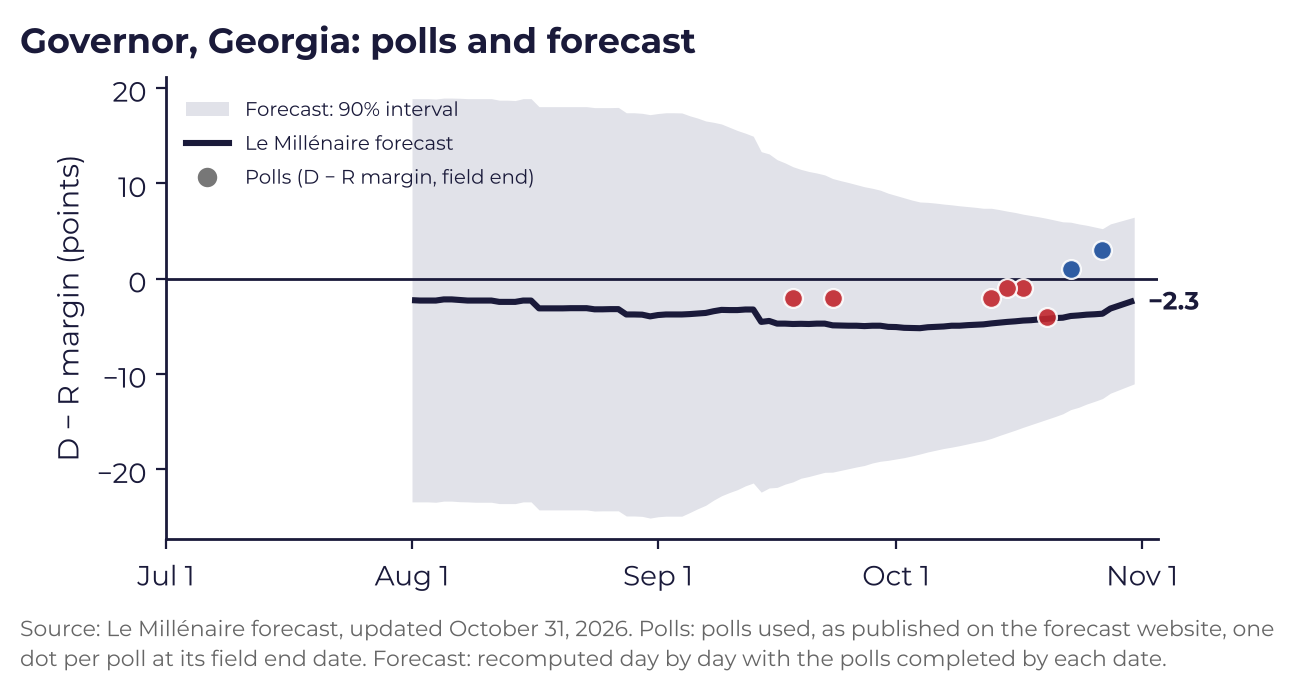
A health care billionaire, Jackson is self-funding most of his campaign. He beat Burt Jones, whom Donald Trump backed, in the primary, and prefers to appear alongside Brian Kemp, who is far more popular than the president in Georgia. A former mayor of Atlanta, Bottoms wants to expand Medicaid and lift the six-week abortion ban. Our reading is more favorable to Jackson than that of the markets and the race ratings, which probably factor in Democratic enthusiasm and the record early vote.
Our analysis. Cobb (+14.9 for Harris) and Gwinnett (+16.5) set the threshold Bottoms will need to reach on election night.
Oregon and Nevada: possible surprises
Oregon. In a state Harris won by 14.3 points, which has not elected a Republican governor since 1982, the polls put incumbent Tina Kotek level with Christine Drazan. Kotek is unpopular, criticized over homelessness, housing and education. She retains a 63.0% chance and a 1.8-point lead, thanks to the state’s structure. She needs to win back Marion, hold Clackamas and Deschutes, and keep the Green candidate Brett Smith under 5%.
Nevada. Joe Lombardo is the only incumbent Republican governor in a swing state, with 162 vetoes to his name. The few polls now show him tied with Aaron Ford, and the state’s structure gives him the edge: Ford has only a 38.1% chance. This is the race where the direction of the error is most uncertain. Ford needs to clearly exceed Harris’s 2.6-point lead in Clark and gain ground in Washoe.
Michigan, Arizona, Kansas and Texas
Michigan. Jocelyn Benson leads in all sixteen polls against John James, in a state Trump won in 2024: an 84.4% chance. A Benson defeat would all but wreck Democratic hopes in the Senate. The first thing to watch will be the margin in Wayne compared with Harris’s 29.0 points.
Arizona. Incumbent Katie Hobbs leads in every poll, by 5 to 17 points, against Andy Biggs, who divides his own camp: according to HighGround, 25 to 30% of Republican voters do not support him. She needs to retake the lead in Maricopa, which Trump had won by 3.5 points.
Kansas. Laura Kelly cannot run again. Ty Masterson, president of the state Senate, is the favorite against Cindy Holscher (81.1%), and independent pollsters have nearly all shown him ahead since September. This is the only Democratic-held governorship where Republicans are clear favorites.
Texas. Greg Abbott has only a 3.5-point lead in our polling average, but an 85.8% chance, because he is the incumbent in a state Trump won by 13.7 points. Nearly every poll released since October 15 shows him ahead, most often by 2 to 5 points. Talarico wins the Senate race in 94.3% of the simulations in which Hinojosa wins narrowly, and still has a 73.2% chance in those where Abbott wins narrowly.

The incumbency advantage remains the best protection against a national wave. The Democrats of 2026, for their part, have only the climate and their candidates.
What the governors say about 2028
The seven swing states of the presidential election currently have five Democratic governors and two Republicans. Democrats would hold at least five in 69.9% of cases and all seven in 5.4%, with Wisconsin separating the status quo from a loss. In Wisconsin and Michigan, Tom Tiffany and John James have had to explain themselves on 2020; in Georgia and Nevada, the two Republican favorites have kept their distance from Donald Trump.
Election rules will also be at stake. A reelected Jim Pillen would revive for 2028 his plan to end the splitting of electoral votes in Nebraska; in Alaska, Measure 2 will decide the fate of ranked-choice voting; in Texas, Florida, Tennessee and Louisiana, the redistricting launched by Republican governors will remain in force, unless decided otherwise.
Hidalgo, Webb and Starr, on the Texas border, then Miami-Dade will be the first counties to watch. If Gina Hinojosa, David Jolly, Deb Haaland and Katie Hobbs win back ground there, Democrats will be able to treat 2024 as a protest vote; if not, the realignment is taking hold. Phil Scott, Kelly Ayotte and Joe Lombardo, Republican incumbents who govern at a distance from their party in Democratic or swing states, have chances of 62 to 98%.
Brazil was a reminder this month that the support of governors is not enough to win a presidential election: Flávio Bolsonaro had the backing of 12 governors-elect, and Lula beat him in the runoff. In the United States, those elected on November 3 will weigh on 2028 through their states’ election rules and through their own candidacies, more than through endorsements.
Le Millénaire’s four Midterms 2026 notes
Midterms 2026: The Keys to the Vote
The general note: what is at stake on November 3, how the forecast works and six tipping mechanisms.
Read the note →House of Representatives 2026: District by District
The 53 districts that decide the majority, from Pennsylvania’s 8th to the Rio Grande Valley.
Read the note →Senate 2026: Race by Race
The fifteen competitive races and the Democrats’ path to the 51st seat.
Read the note →Governors 2026: State by State
The 36 offices at stake, from Wisconsin to Ohio, and what they say about 2028.
You are reading this noteThay W., Scull S., Bataille A., “Governors 2026: State by State”, Le Millénaire Note, November 1, 2026, lemillenaire.org.
Browse the note
William Thay, Sean Scull and Augustin Bataille
President of Le Millénaire; United States specialist at Le Millénaire; Analyst at Le Millénaire.
William ThayRequest an interview
For an interview with William Thay, Sean Scull or Augustin Bataille about this note: presse@lemillenaire.org
Contact the press officeKeep our studies going
Your donations and memberships fund Le Millénaire’s next notes.
Support us JoinReceive Le Millénaire’s next briefing notes
Read also
All studies 21 octobre 2026Midterm 2026 : vers la fin du mouvement MAGA ?
 17 avril 2026Sean Scull pour Nouvelle Revue Politique : « Négocier ou escalader : ce que révèle la politique erratique de Trump en Iran »
 30 mars 2026Quand les démocrates se cherchent leur Trump
 5 février 2026Sean Scull pour Valeurs Actuelles : « Mais que va faire Donald Trump jusqu’à la fin de son mandat ? »
