
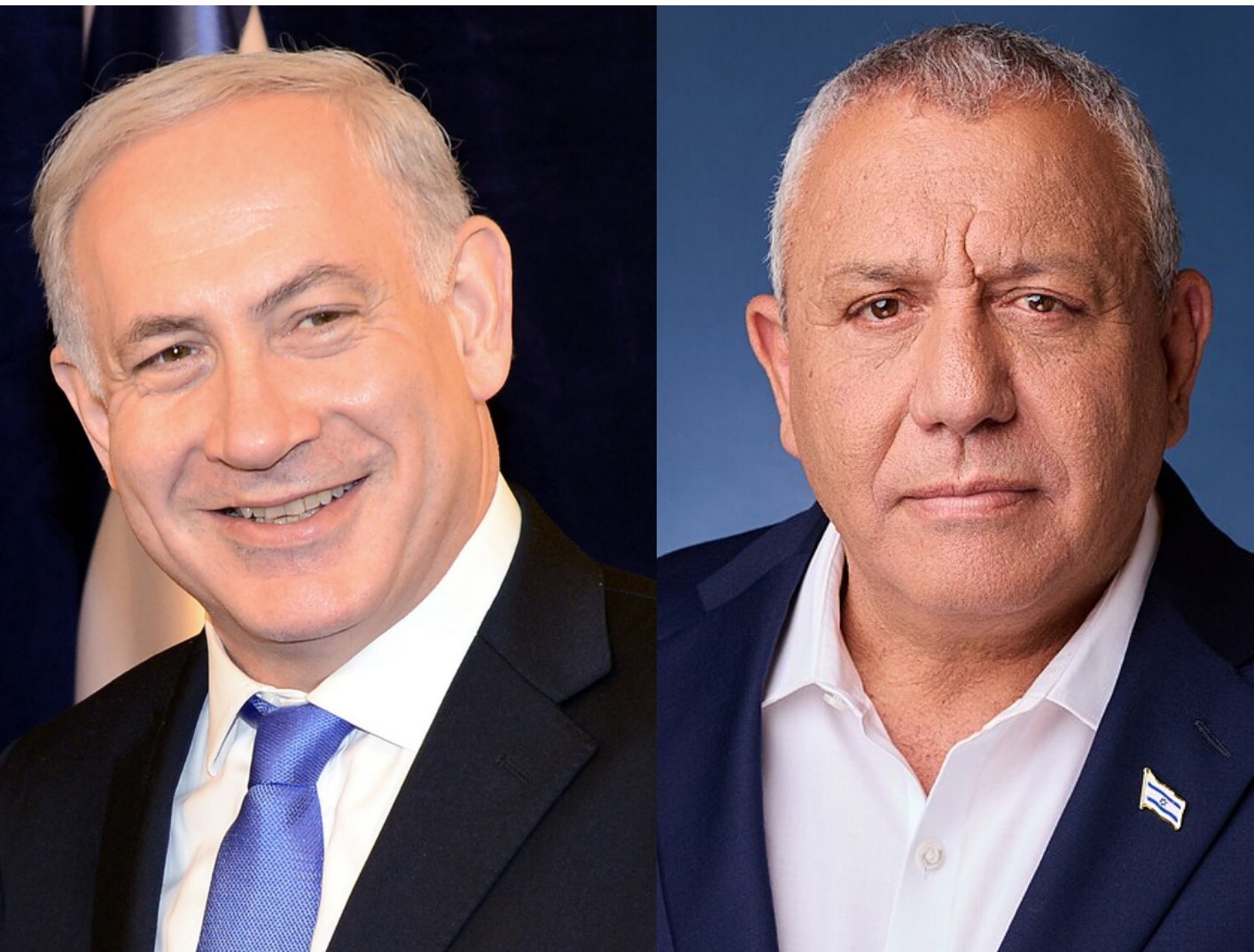
This is a translation of the original French text, which may contain errors; the French version is the reference text: Israël, dans le camp des ingouvernables ? Comment Netanyahou a déjoué les sondages
Legislative elections in Israel: the electoral and political analysis of the 27 October 2026 vote
On 23 October, no polling institute gave Likud more than 21 seats. At the 28 October count, our projection gives it 27, six more than Yashar!, Gadi Eisenkot’s list, which the latest polls had placed first. But the Netanyahu bloc falls from 64 to 53 seats, and its opponents, on 48, are even further from 61. Drawing on the exit polls, our projection of the count and the results by locality and by neighbourhood, Antranig Kevorkian, William Thay and Matthieu Hocque explain how Netanyahu beat the polls and why Israel is joining the ranks of the ungovernables.
The finding
Likud finishes first with 27 seats in our projection, six more than Yashar!. But the Netanyahu bloc goes from 64 to 53 seats and loses its majority, without its opponents, on 48, coming close to one.
The cause
Turnout in Arab localities, up from 53.8% to 78.8%, and the collapse of Shas, from 11 to 6 seats. In Jewish localities, the Netanyahu bloc falls back by about three points, almost everywhere.
The consequence
Nobody has 61 seats. The anti-Netanyahu camp cannot govern without the Arab lists it has ruled out, and Netanyahu remains Prime Minister as long as no government is sworn in.
Foreword
On election night, each camp had its own reading of the results. On 28 October, at 03:14, Benjamin Netanyahu took the stage at the Likud rally in Jerusalem and proclaimed that Likud remained “the largest party in Israel”. At around 01:00, in Tel Aviv, Naftali Bennett had for his part announced: “Netanyahu has lost, and the 7 October government is going home!” The count then shifted the trend. At the Central Elections Committee’s 14:32 count, Likud passed one million votes. Our projection gives it 27 seats, six more than Yashar!, Gadi Eisenkot’s list, which the last three surveys had placed first. In votes, his camp remains ahead, on 43.3% against 40.9% for its opponents.
Netanyahu campaigned three years after the Hamas attack of 7 October 2023, with two years of war in Gaza behind him, a war against Iran at the end of the winter, a corruption trial still under way and ultra-Orthodox allies who had themselves triggered a political crisis over conscription. Likud nevertheless finishes first, and by a wide margin. His bloc, however, goes from 64 to 53 seats and loses its majority. Shas collapses, and Arab localities voted more than at any election since 2019. But his opponents, with 48 seats, are even further from 61, and they cannot govern without the Arab lists, an option they ruled out throughout the campaign. Our forecast of 24 October already produced a parliament without a majority in 69% of simulations, and a majority for the anti-Netanyahu bloc in only 7%.
How did Netanyahu, whom almost every poll placed behind Eisenkot, make Likud the largest party in Israel with a six-seat lead? And what can he do with a victory that does not give him a majority with his traditional allies? This report looks back at the night of 27 October, the campaign, the result and turnout, then at the map of the vote, from Bnei Brak to the working-class neighbourhoods of south Tel Aviv, before examining the paths to a government. At the time of writing, about 84% of the expected votes had been counted: the seats cited are those of our projection, and the official results will be published on 4 November.
The result of 27 October
Three stories at 22:00. Depending on the institute, the Eisenkot coalition could be put at 62 seats or at 49 two days apart: this is why we sought to neutralise the weight of the polls in our analysis. When the polls closed, six channels published their exit poll. Kan 11, Channel 12 and Channel 13 put the anti-Netanyahu camp ahead, far from 61 seats; Channel 14 gave 60 seats to the Netanyahu camp; i24 News and Channel 16 were in between. Likud came first in all six polls, with 24 to 30 seats, ahead of Yashar!, with 19 to 23, and no channel gave anyone a majority.
Interactive chart unavailable in this browser: see the report, table 1, p. 6.
Revisions during the night. Kan 11 first raised the Joint List, at around 23:00, then Likud. Channel 12 and Channel 13 raised Likud by two to three seats. By the end of the night, the three main channels all gave it 27 seats, after starting at 24 or 25. Channel 14 also revised its estimate: one of its versions gave 62 seats to the Netanyahu camp, before it “came back down” to 60 seats at 02:54.
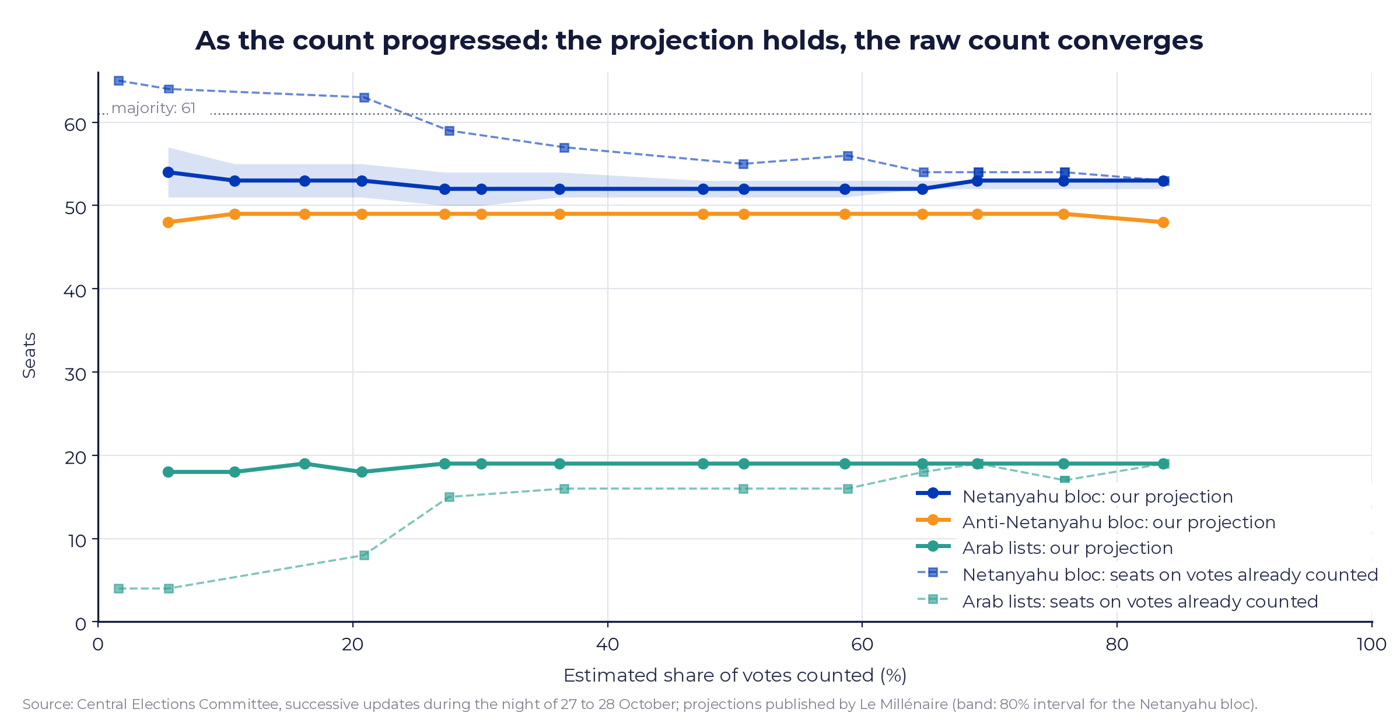
The count: 65 seats at 2%, 53 at 84%. The first results from the Central Elections Committee arrived shortly after midnight, with 15 polling stations and 2,670 votes. Small Jewish localities reported first, then the large cities of the centre; Arab localities came last, before the outside envelopes. At 2% of the votes, the seats calculated on the count alone gave 65 seats to the Netanyahu camp, and Ra’am, on 2.75%, was below the threshold. At 04:47, Ra’am crossed the threshold with 3.67%, and the raw count gradually converged on the projection: 55 seats at the halfway mark, 54 at three quarters and 53 at 84%.
A stable projection. Our projection moved much less than the raw count. It compared each counted locality with its own 2022 vote, then applied the same gap to what remained to be counted. The result: 53 seats for the Netanyahu camp at 16% of the votes, and still 53 at 84%.
Record turnout. Turnout exceeded that of 2022 at every hour of the day. At 16:00, it reached 55.7%, unheard of at that hour since 1973 according to the Committee as cited by Walla. At the close, the Committee estimated it at 77.7%, envelopes included, the highest level since 1999. The gap with 2022, less than one point at 10:00, reached eight points at 16:00.
Interactive chart unavailable in this browser: see the report, table 3, p. 9.
The counting-order bias. In Israel, the localities that count quickly tend to vote for the Netanyahu camp: the Likud vote is a historic, rooted and family vote, and the ultra-Orthodox vote is also cast late for religious reasons. This time, the bias was stronger than usual, because Arab localities, which count late, had voted much more than in 2022. The comments at 02:00 about a return of the Netanyahu majority were therefore down to the order of the count. Nobody had 61 seats in the 22:00 polls, and that was right; but Kan 11, Channel 12 and Channel 13 put Likud two to three seats too low, and the Arab lists at 17 or 18.
What remains to be counted. At 14:32, the Committee had counted 4,875,751 ballots in 11,168 polling stations, whereas the final 2022 file had 12,545. Ordinary polling stations are therefore still missing, especially in Arab localities, as are all the double envelopes: soldiers, diplomats, prisoners, patients, voters who voted far from home. In 2022, these envelopes had given 49.6% of the votes to the Netanyahu camp, slightly more than its 48.4% nationally, and barely 5% to the Arab lists, which had won 10.7% across the country. In 2022, it was indeed on the envelopes that United Torah Judaism lost a seat to Yisrael Beytenu.
Down to a single seat. Overall, our projection gives 43.3% of the votes to the Netanyahu camp, 40.9% to the anti-Netanyahu camp and 14.8% to the Arab lists. The seats that may change hands are known: Likud’s 27th, Yashar!’s 22nd, the 12th of the Joint List and of Beyahad, the Democrats’ 9th and Yisrael Beytenu’s 8th. None of them tips the majority: in less than 1% of our 4,000 simulations of the remaining count does either camp reach 61 seats. But the combination of the Netanyahu bloc with Yisrael Beytenu reaches exactly 61 seats: one seat fewer for either of them, and it no longer exists.
Understanding the 27 October vote
A Knesset that ran its full term. The 25th Knesset was elected on 1 November 2022. On 29 December that year, Benjamin Netanyahu formed with the ultra-Orthodox parties and the far right a government that the Times of Israel describes as “the most hard-line in the country’s history”. It combined two weaknesses: centre-right parties allied with a far right holding different views on security, justice and the rule of law, and ultra-Orthodox parties, some of which reject the Zionist project for religious reasons. This second point would raise one of the major issues of the campaign: the equality of citizens with regard to military service.
Unprecedented crises. Nine months after its formation, the Hamas attack of 7 October 2023 killed more than 1,200 people. There followed two years of war in Gaza, a ceasefire on 10 October 2025, then the return, on 26 January 2026, of the remains of the last hostage. At the end of the winter, Israel and the United States went to war against Iran, until the ceasefire of 7 April. Meanwhile, the Prime Minister’s trial remained pending: Netanyahu asked President Isaac Herzog for a pardon in November 2025, and on 26 April 2026 the President let it be known that he would only rule once the chances of an agreement between the parties had been exhausted.
Conscription brings down the Knesset. In May 2026, United Torah Judaism announced that it wanted to dissolve the Knesset, in the absence of a law enshrining the exemption of yeshiva students. “We no longer have confidence in Netanyahu”, said Rabbi Dov Lando. The dissolution was voted on the night of 16 to 17 July, by 62 votes to 0, and the election remained set on its legal date, 27 October. There has never been a commission of inquiry into 7 October: the bill, passed at first reading in July, was abandoned with the dissolution.
A reshaped political landscape. On 16 September 2025, former Chief of Staff Gadi Eisenkot launched Yashar!. On 26 April 2026, Naftali Bennett and Yair Lapid announced a joint list led by Bennett, Beyahad. On 19 August, Hadash, Ta’al and Balad re-formed the Joint List, without Ra’am. On the right, Ofer Winter launched Amcha Yisrael on 25 August, and Bezalel Smotrich joined forces with Moshe Feiglin on 1 September. When nominations closed, on 8 September, 38 lists had been filed. Ra’am placed a Jewish candidate, Yoav Segalovitz, in second position; Shas and United Torah Judaism fielded no women.
Lists under threat, one withdrawal. On 23 September, the Central Elections Committee, at Likud’s request, disqualified the Joint List and Ra’am, a decision that the Supreme Court overturned on 2 October. On 19 October, Benny Gantz withdrew Blue and White from the race, without endorsing anyone. For the surplus-vote agreements, which allow two lists to pool their surplus votes, everyone stayed within their own camp, and Likud, which signed with Religious Zionism-Zehut, refused to do so with Otzma Yehudit.
Identity, the real theme of the campaign. Contrary to what was widely heard in the West, the debate was not primarily about Netanyahu’s personal responsibility for 7 October. Above all, 7 October raised the question of identity, for the three components of Israeli society. Among the ultra-Orthodox, 14 to 15% of the population, security fears became a voting factor. Among Zionist Jews, 65% of the population, it accelerated the perception that peace with the Palestinians is impossible, so much so that the Zionist opposition contests the conduct of the war in Gaza rather than its principle. Among Arab Israelis, 20% of the population, it deepened the rift with the State, but it became apparent that taking part in the democratic process could constitute a blocking minority.
Red lines that rule out almost every majority. On 27 September, Eisenkot, Bennett, Lapid, Golan and Lieberman signed a non-aggression pact. Eisenkot ruled out Mansour Abbas from his government and refused to serve under Netanyahu, “even in rotation”; Bennett wanted to govern with Zionist parties only; Lieberman wanted neither Arab parties nor ultra-Orthodox parties. On the Arab side, Mansour Abbas said he was ready to join a coalition, and Yousef Jabareen offered a “safety net” without participation. The anti-Netanyahu camp therefore had only one path: 61 seats without either of them.
The last polls. The last surveys, published on Friday 23 October, all placed Yashar! first, with 22 to 23 seats, ahead of Likud, with 19 to 21. None gave 61 seats to anyone: 52 to 56 for the anti-Netanyahu camp, 50 for the Netanyahu camp, 14 to 16 for the Arab lists. Kan 11 and Channel 12 gave 44% for Eisenkot and 38% for Netanyahu as preferred Prime Minister. The 27 September pact ruled out the Arab parties, and Lieberman the ultra-Orthodox: more than a quarter of the seats in the new Knesset. The question of what would follow the election was therefore posed even before the vote.
The result: Israel among the ungovernables?
Structural instability. Israel combines a particularly unstable electoral system, full single-round proportional representation, and a highly fragmented political landscape, divided among four major blocs: the nationalist right allied with the far right, the secular centre and the left, the ultra-Orthodox and the Arab parties. It is the most unstable combination possible, which makes Israel an XXL Fourth Republic, and the 27 October vote has accentuated this phenomenon.
Likud first, Shas in free fall. At the 14:32 count, Likud has 1,006,722 votes, 20.7% of the votes counted. It is the leading list, far ahead of Yashar!. Our projection gives it 27 seats; it had 32. Shas falls from 11 to 6 seats, so the two pillars of the Netanyahu governments lose 10 seats between them.
Interactive chart unavailable in this browser: see the report, tables 11 and 28, pp. 24 and 49.
The opposing camp. Yashar! establishes itself with 21 seats at its very first election. Beyahad has 11, whereas Yesh Atid alone had 24 in 2022. Yair Golan’s Democrats have 8, double Labor’s 2022 total, but Meretz had then been eliminated. On the Arab side, the reunited Joint List wins 12 seats and Ra’am 7: together, the Arab lists reach 19 seats, beyond the record of 15 that the Joint List had set in 2020.
In votes, a smaller shift than in seats. In the localities already counted, compared with their own 2022 vote, the Netanyahu camp loses four and a half points, from 48.3% to 43.7%. The anti-Netanyahu camp gains two and a half and the Arab lists nearly four. In seats, the Netanyahu camp loses 11 seats, the opposing camp gains 2 and the Arab lists 9.
Interactive chart unavailable in this browser: see the report, tables 10, 12 and 29.
The threshold and the surplus-vote agreements. The 3.25% threshold eliminates two lists that mattered in the polls: the Reservists of Yoaz Hendel and Yaron Zelekha, on 2.6%, and Ofer Winter’s Amcha Yisrael, on 1.6%. In total, 253,870 votes, 5.2%, are left without a seat, but they are split between the two camps and do not make the difference, whereas in 2022 the elimination of Meretz and Balad had contributed to the 64-seat majority. Seats are allocated by the Bader-Ofer method, a variant of the d’Hondt method: on the projected shares, the five surplus-vote agreements shift only one seat, from Beyahad to the Joint List, thanks to the agreement with Ra’am.
Netanyahu is eight seats short, his opponents thirteen. In Jewish localities, the Netanyahu camp concedes to its opponents roughly what it loses, but this brings them only two seats: the Reservists’ 2.6% goes below the threshold, and it is the Arab lists, with more voters turning out and united this time on a list that crosses the threshold, that take 9 seats. Likud, for its part, does much better than expected: 27 seats, six more than the best polls of 23 October. Otzma Yehudit and Religious Zionism-Zehut, running separately, have 13 between them, one fewer than four years ago. After 7 October, the war and a trial still under way, it is Likud that holds up best in its camp.
of turnout in Arab localities between 2022 and 2026: with an almost unchanged vote, they give the Arab lists 9 more seats and deprive the Netanyahu camp of its majority.
Turnout, a key to the election
Arab localities vote more than ultra-Orthodox cities. Over the five elections from 2019 to 2022, turnout in Arab-majority localities had fluctuated between 44.5% and 66%, and in ultra-Orthodox cities between 72.7% and 76.7%. On 27 October, for the first time in the period, Arab localities voted more. Three factors may explain this: the ultra-Orthodox, relatively spared by 7 October, were less concerned by the issues at stake; they are a younger population, 57% under the age of 20, and therefore more prone to abstain; and rabbinical mobilisation is weaker than before, in a community that is less homogeneous than some claim.
It was all decided in the afternoon. At the 12:49 count, Arab localities had the lowest turnout in the country, 24.7%. Between 16:45 and 18:43, they gained 15 points, then another 11 by 20:41, and at 23:05 they reached 78.8%, 25 points more than in 2022. In Jewish localities, the increase was four to six points, and among the ultra-Orthodox turnout simply returned to its 2022 level.
Interactive chart unavailable in this browser: see the report, table 15, p. 28.
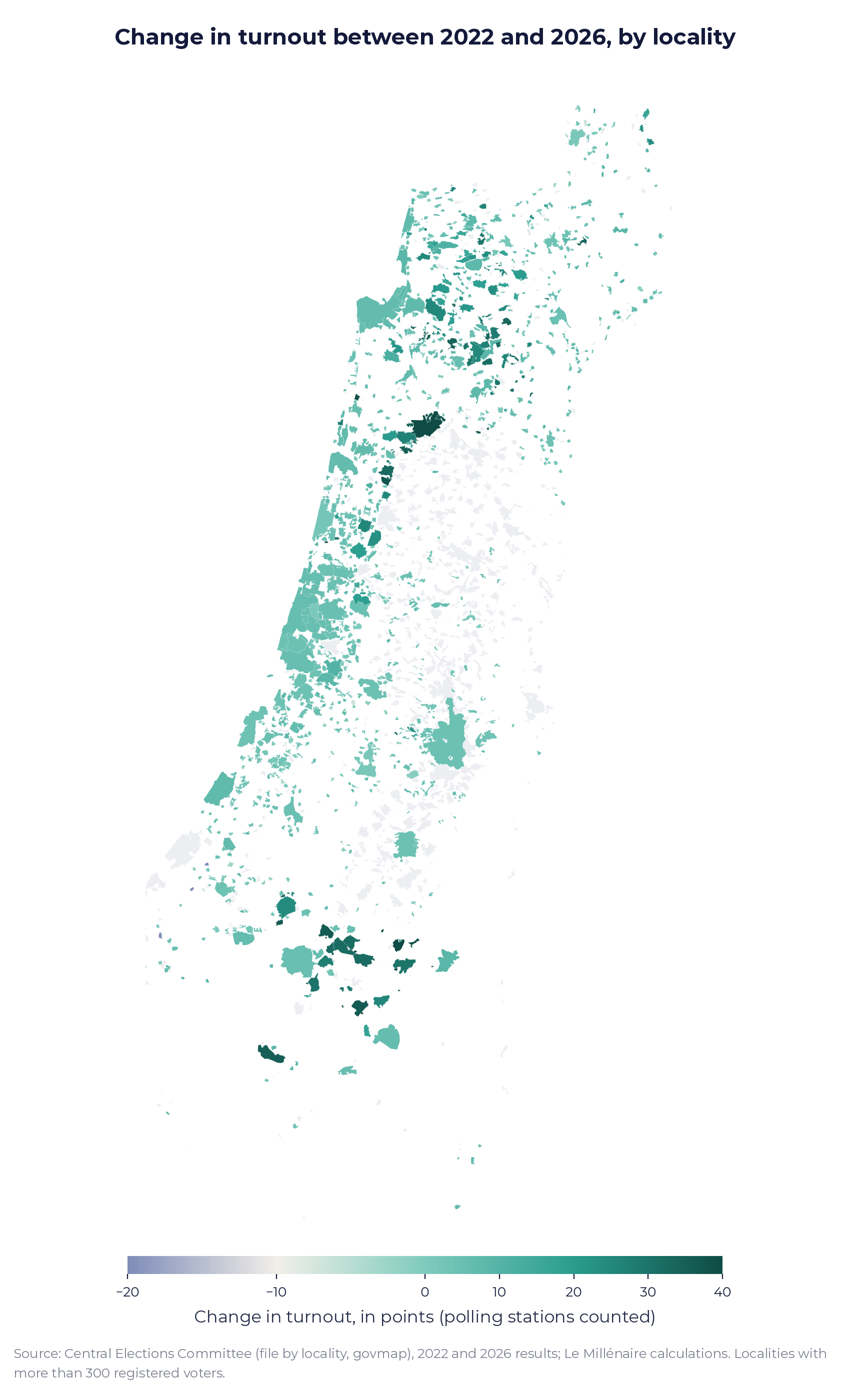
Twenty localities, twenty increases. The twenty largest Arab localities all rise, by about 19 to 42 points. Umm al-Fahm, which turned out at 38.3% in 2022, turns out at 79.9%. In the polling stations already counted on 28 October, Arab localities have 657,819 voters, far more than the 450,077 in the whole of the 2022 election.
Interactive chart unavailable in this browser: see the report, table 16, p. 30.
An almost unchanged vote. In Arab localities, the Arab lists have 94.8% of the votes against 93.1% in 2022: what changed is the number of people who came out to vote. Reunited with Hadash and Ta’al, the Joint List wins 56.0% of the votes in these localities, barely more than the 55.1% of Hadash-Ta’al and Balad four years ago, and Ra’am goes from 38.0% to 38.8%. On the map, the two lists hardly overlap: in the Negev, Ra’am takes 88.7% of the votes going to the Arab lists, with its Bedouin strongholds of Rahat and Tel Sheva; in Galilee and in the Triangle, the Joint List prevails, with one exception, Kafr Qasim, where Ra’am wins 72.7%.
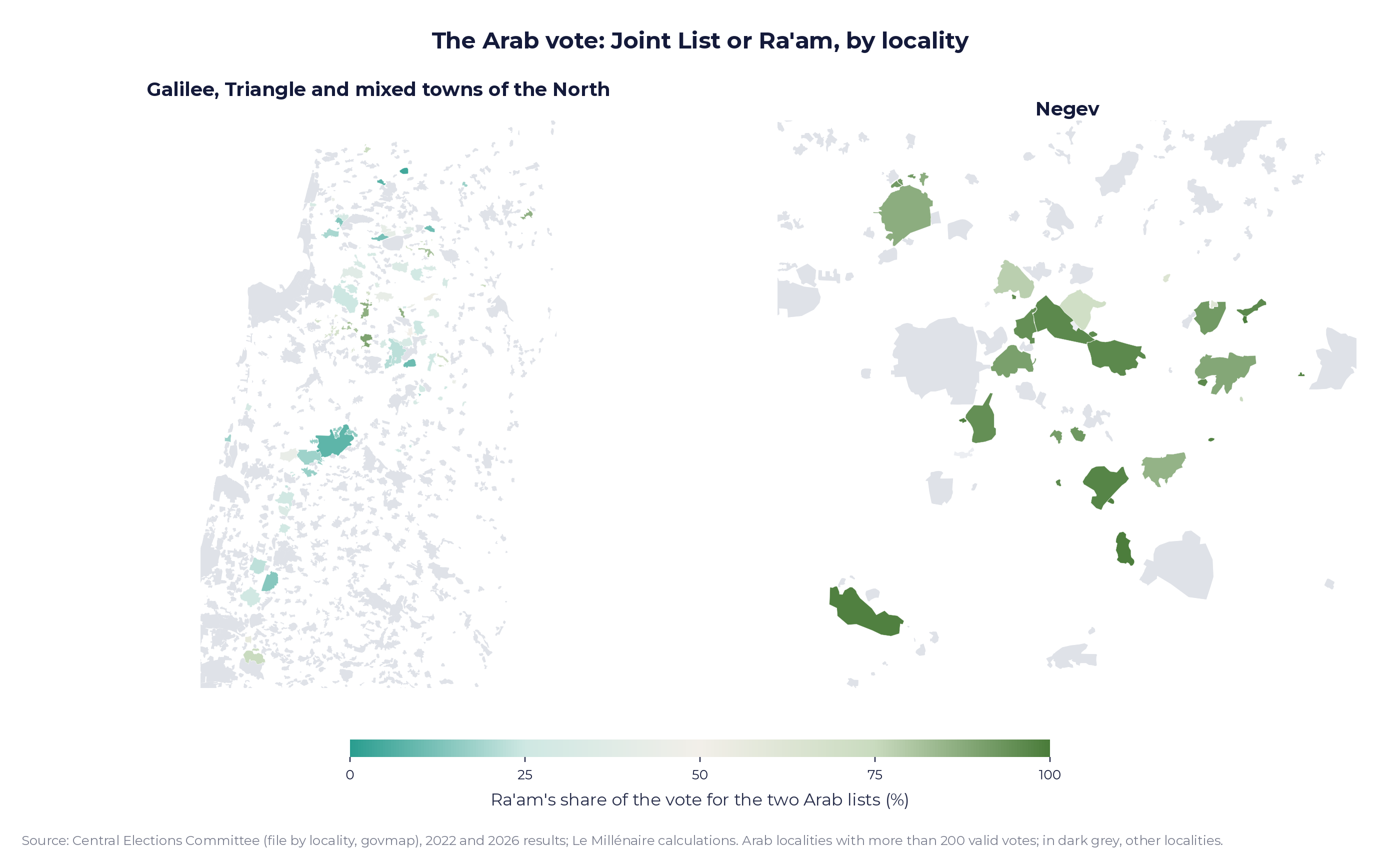
Why such a vote? The figures do not say, and the Israeli press puts forward reasons that may add up. Zvi Zarhia, in Calcalist, points to the explosion of crime in Arab society, which makes voting a form of self-defence, the fear of seeing Itamar Ben Gvir remain Minister of National Security, and the surplus-vote agreement between the two lists. Marzouq Halabi, quoted by The New Arab, sees it as “a purely defensive vote”. The data by locality show only that the increase affects Umm al-Fahm, a Joint List stronghold, just as much as Rahat, a Ra’am stronghold. With an almost unchanged vote, it gives seats to the Arab lists and takes as many away from the two Jewish camps.
The 27 October vote, locality by locality
Explore the results of the country’s 1,209 localities and 2,409 neighbourhoods or sectors: leading bloc, score of each list, turnout and changes since 2022. This interactive version is based on the Central Elections Committee file of 29 October, once all ordinary polling stations had been counted; the figures in the report, based on the file of 28 October at 15:10, may therefore differ slightly.
What are the results of the vote?
Three Israels, the same map as in 2022. Looking at who comes first in each locality, the 2026 map closely resembles that of 2022. The anti-Netanyahu camp holds Tel Aviv, Haifa, their affluent suburbs and the kibbutzim of Galilee. The Netanyahu camp keeps Jerusalem, the development towns of the South and the North, the ultra-Orthodox cities and the West Bank settlements. The Arab lists come first in Galilee, in the Triangle and among the Bedouin of the Negev.
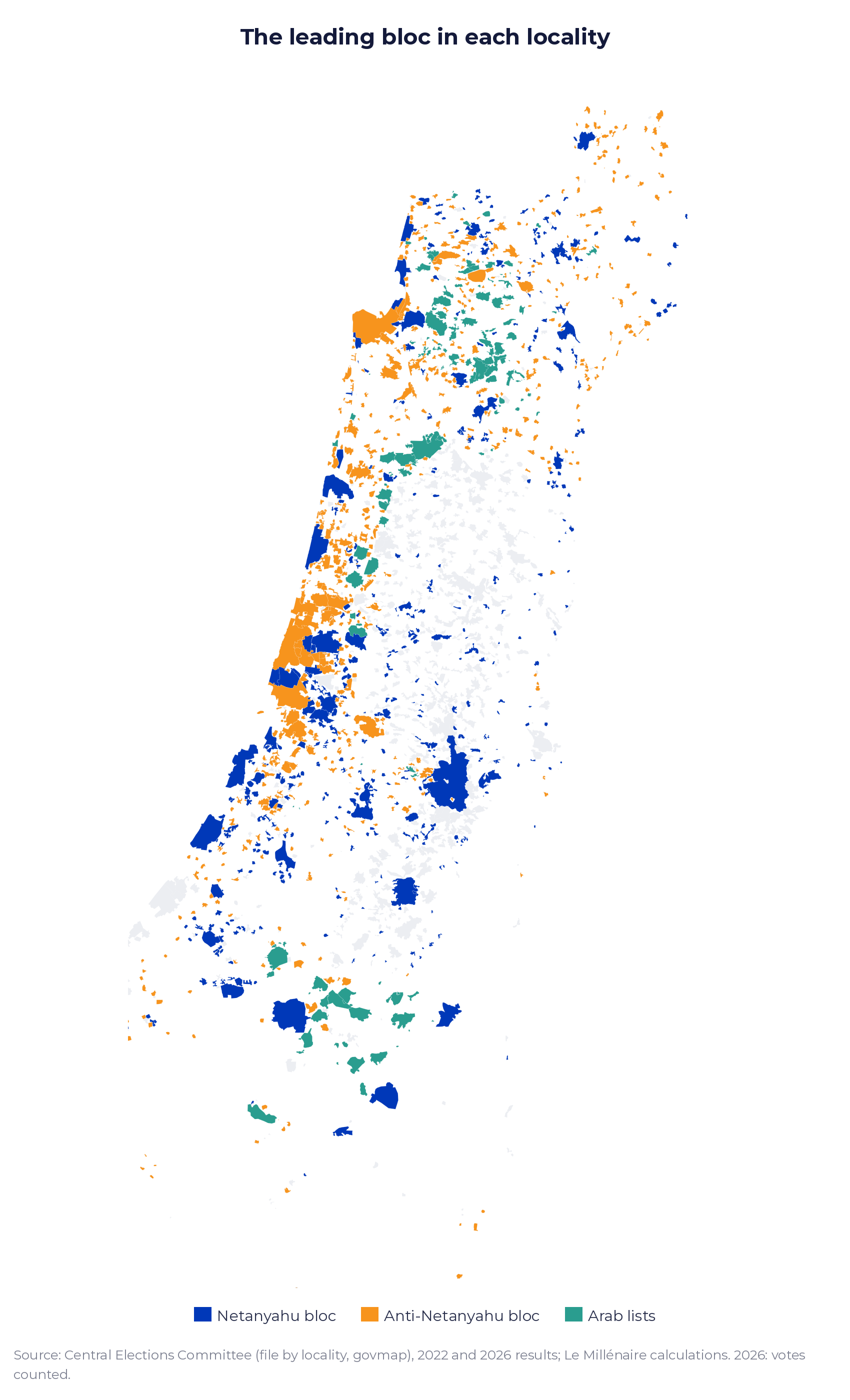
What changes is the level. In the 901 Jewish and mixed localities with more than 200 valid votes in both 2022 and 2026, the Netanyahu bloc falls back in 61% of cases; weighted by the number of votes, it loses 3.3 points. The decline is the same everywhere, to within a few tenths: 3.1 points in its strongholds, 3.7 in mixed localities, 2.9 in the opposing strongholds and 3.3 among the ultra-Orthodox. The anti-Netanyahu camp gains four to five points in mixed localities and in its strongholds.
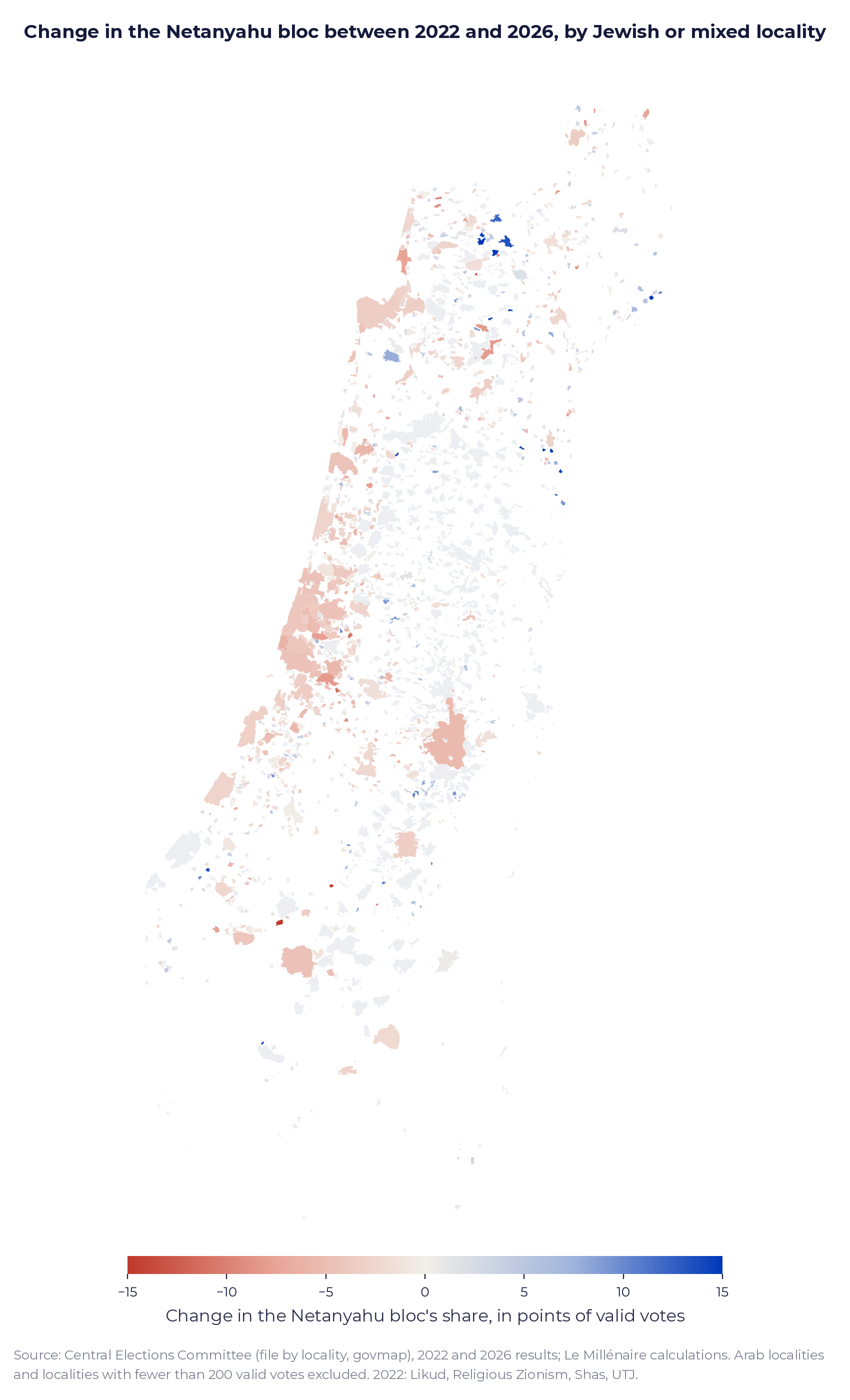
The big cities: 20 declines out of 20. The country’s twenty largest cities all move in the same direction. The Netanyahu bloc falls by 6.1 points in Bat Yam, 5.4 in Jerusalem and 5.1 in Ramat Gan; in Ra’anana and Modiin, it loses only 1.1 and 1.6 points. The anti-Netanyahu camp gains everywhere, and it is in Ramat Gan, Bat Yam and Petah Tikva that it gains the most. Turnout rises in all the large Jewish cities, but by around 5 points, against twenty-five in Arab localities.
Interactive chart unavailable in this browser: see the report, table 18, p. 36.
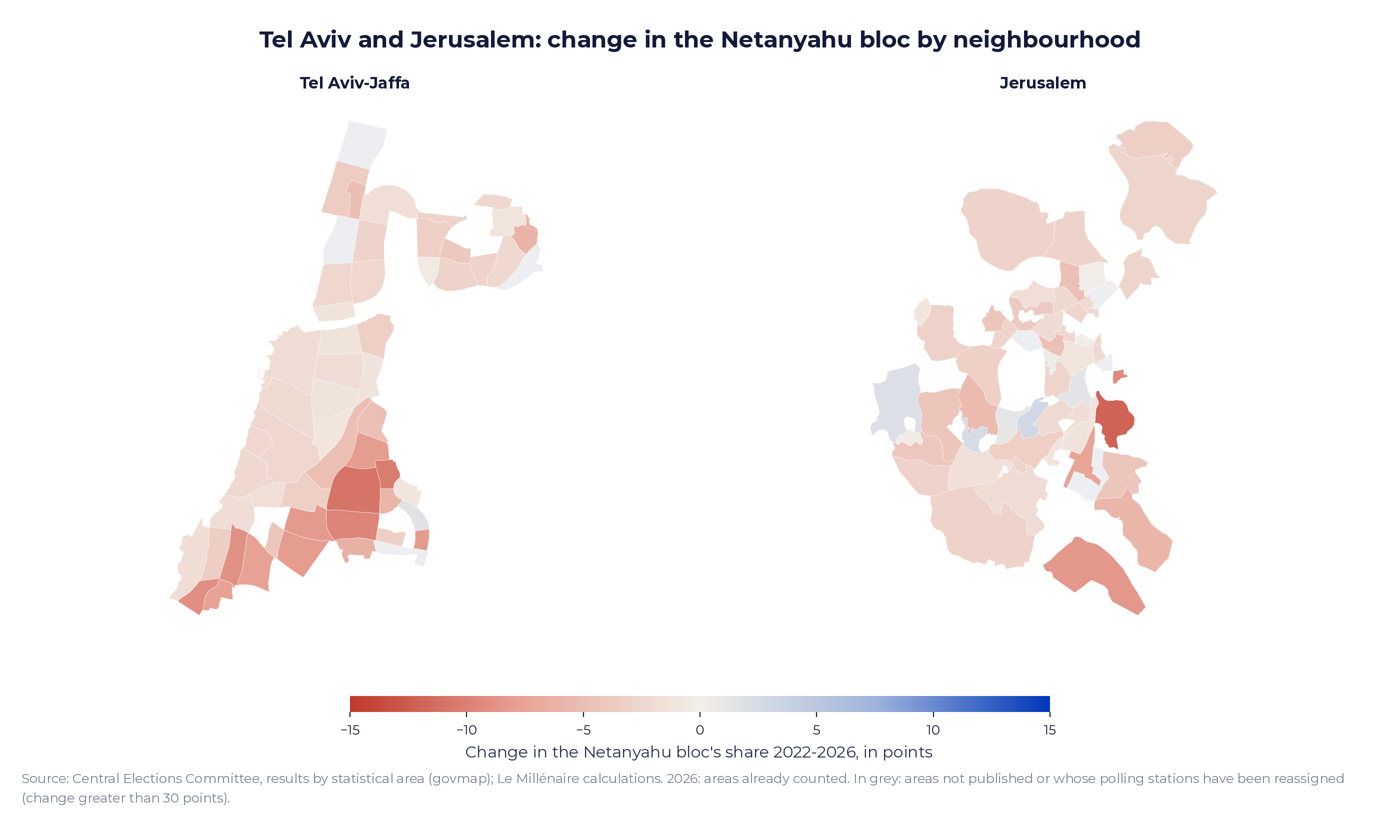
Tel Aviv and Jerusalem, neighbourhood by neighbourhood. In Tel Aviv, the sharpest declines are in the working-class neighbourhoods of the south and east, which voted heavily for the Netanyahu camp: Yad Eliyahu, Tel Haim, HaTikva, Shapira, where it loses eight to eleven points. Yad Eliyahu and HaTikva have voted Likud since 1977. In the affluent north, it was already very weak and barely moves. In Jerusalem, the sharpest decline is in Givat Hananya, near Abu Tor, at 12 points, and it exceeds eight points in the Jewish Quarter of the Old City and in Har Homa. The count was not finished in Tel Aviv on 28 October, and the comparison by neighbourhood depends on how polling stations are assigned, which may have changed since 2022.
Each list has its stronghold. Likud achieves its best score in Dimona, a development town in the Negev, with 52.4%. Yashar! achieves its best in Isfiya, a Druze locality on Mount Carmel, and Yisrael Beytenu in Peki’in, another Druze locality in Galilee. Religious Zionism-Zehut dominates in Talmon, in the West Bank, Otzma Yehudit in Kfar Chabad, United Torah Judaism in Modiin Illit, the Joint List in Umm al-Fahm and Ra’am in Abu Qureinat, with 96.8%.
A sharper decline among the less well-off. In 2026 as in 2022, the lower a Jewish locality sits on the Central Bureau of Statistics socio-economic index, the more it votes Netanyahu: above 75% in the two least well-off clusters, below 25% in the two most affluent. What has changed is the scale of the decline: 4.4 points in cluster 1 and 5.1 in cluster 2, against less than three points in the three most affluent clusters.
In each camp, one list dominates. Yashar! leads the anti-Netanyahu camp everywhere: 30.6% of the votes in its strongholds, a fifth in mixed localities, a tenth in the opposing strongholds. The Democrats win 16.8% in anti-Netanyahu strongholds and 2.4% among their opponents; the Reservists peak at 3.9%, with no stronghold that could have carried them above the threshold. In the Netanyahu camp, Likud keeps 31.8% in its strongholds, against 32.9% in 2022. Shas, on the other hand, loses between a quarter and more than a third of its votes: it falls from 29.3% to 22.3% among the ultra-Orthodox and from 13.9% to 9.1% in the Netanyahu camp strongholds.
The religious right splits without shrinking. In 2022, Itamar Ben Gvir and Bezalel Smotrich ran together under the name Religious Zionism, with 11.4% of the votes in the counted localities. In 2026, running separately and joined on the same electorate by Amcha Yisrael, they total 13.6%: 6.4% for Otzma Yehudit, 5.4% for Religious Zionism-Zehut and 1.8% for Amcha Yisrael, lost below the threshold.
The ultra-Orthodox: mobilisation intact, a scattered vote. In the ultra-Orthodox cities, people voted about as much as in 2022, and yet the Netanyahu bloc there goes from 96.7% to 93.4%. The lost votes do not go to the other camp, but to small ultra-Orthodox lists that remain below the threshold, Tseva Shahor with 2.1% and Moti Leitner’s Haredi Public with 1.2%. Taken one by one, none of these movements deprives the outgoing camp of its 61 seats. It is their sum, together with the Arab mobilisation, that does.
Forming a government: mission impossible?
A timetable that may run until spring. In Israel, no result confers power by itself. The official results are presented to the President of the State eight days after the election, on 4 November; he consults the elected lists and tasks a member of the Knesset with forming the government. If every deadline runs its full course, first person tasked with forming the government, second person tasked, then a request by 61 members, we reach the very beginning of March 2027 before a possible dissolution, and throughout that time Benjamin Netanyahu would remain Prime Minister, in charge of day-to-day affairs.
Eight combinations, none obvious. The combination closest to the outgoing bloc brings together the Netanyahu bloc and Yisrael Beytenu. It reaches exactly 61 seats in our projection, and in only one simulation out of two. Avigdor Lieberman, a former minister under Netanyahu, has however demanded that his partners refuse any rotation with him, and he rules out the ultra-Orthodox parties, which are at the heart of this majority. On election night, he even called on Likud members to “rebel”.
Interactive chart unavailable in this browser: see the report, table 26, p. 44.
On the other side, majorities ruled out. The only combination that clearly exceeds 61 seats brings together the anti-Netanyahu camp and the two Arab lists, with 67 seats, and it is also the one that most of its components have ruled out. With Ra’am alone, there are only 55 seats. That leaves national unity: Likud, Yashar! and Beyahad together have 59 seats, and 61 is reached by replacing Beyahad with Shas and United Torah Judaism. But Eisenkot has promised not to serve under Netanyahu, “even in rotation”, and Bennett not to sit with him “in any configuration”.
The minority government door. To be sworn in, an Israeli government does not need 61 votes, but more votes in favour than against: in June 2021, that of Naftali Bennett and Yair Lapid was approved by 60 votes to 59, with one abstention. With our projected seats, an anti-Netanyahu camp government supported by Ra’am would win by 55 votes to 53 if the Joint List abstained: this is the “safety net” that Yousef Jabareen proposed during the campaign. For Netanyahu, the arithmetic is harder: facing 67 opponents, he would need at least 15 of them to abstain, for example Yisrael Beytenu and Ra’am, to win by 53 votes to 52.
The day after the election. On the morning of the 28th, nobody had yet said publicly whom they would recommend to the President. Netanyahu called for a “strong, national, right-wing government”, Eisenkot for a “Zionist conscription government”. Mansour Abbas said he had been approached by both blocs, and Yousef Jabareen declared: “We are a political force that cannot be ignored”. It is Isaac Herzog who will designate the person tasked with forming the government, and it is also he who must rule on Netanyahu’s request for a pardon.
Three scenarios. The first is a lasting absence of a coalition agreement, which would make new elections possible and leave Netanyahu handling day-to-day affairs during the negotiations. The second is a national unity or minority government led by Netanyahu, made possible by members of Eisenkot’s coalition rallying to it on a case-by-case basis: his coalition is more compact and his party more dominant within it, which gives him more room for manoeuvre. The third is a minority government led by Eisenkot, supported without participation by all the Arab parties, with two limits: will Eisenkot’s voters accept a coalition under the watch of the Arab parties, and will Arab voters accept a government that will not profoundly change Israeli policy in the West Bank and Gaza?
Netanyahu starts with a lead. Likud is by far the largest group in the Knesset, and as long as no government is sworn in, Netanyahu remains Prime Minister. He is 8 seats short, and those who could give them to him, Lieberman with his 8 seats or Bennett and Lapid with their 11, campaigned on his departure. His opponents reach 67 with the two Arab lists, but Eisenkot and Bennett have ruled out governing with them. The forecast predicted the absence of a majority; it could not predict what Eisenkot, Bennett, Lieberman and Abbas will do.
Four years ago, Arab localities turned out at 53.8%, and Netanyahu got his majority. This time, they turned out at 78.8%, and they took it away from him.
Conclusion: our model anticipated the results
The biggest gap concerns Likud. On 23 October, the last three polls gave Likud 20 seats on average; our projection gives it 27. The error on the camps is smaller than it appears, because the underestimation of Likud is partly offset by the overestimation of its allies. The fact remains that the order of the two Jewish camps was reversed: the polls put the anti-Netanyahu camp ahead, our projection puts the Netanyahu camp ahead, by five seats. Zvi Zarhia sees it in Calcalist as “a severe indictment of the polling institutes”.
Why such an error? We have no means of explaining it, only two observations: turnout exceeded that of 2022 by seven points, and by twenty-five in Arab localities, and the gap is concentrated on Likud, at the expense of its allies and of Beyahad. A last-minute swing, a less declared vote, a turnout effect: all of this remains to be verified.
Our forecast of 24 October. Frozen on the evening of 24 October, it gave 55 seats to the Netanyahu camp, from 45 to 67 in nine simulations out of ten, 51 to the anti-Netanyahu camp and 14 to the Arab lists. In 69% of cases, no coalition compatible with the parties’ statements reached 61 seats. On the outcome, we were right, and the two Jewish camps are within the published intervals. Not the Arab lists: with 19 seats, they exceed our upper bound by one seat, and this is our main error, the same as that of the polls on which the model was based. List by list, the eleven lists entering the Knesset are all within their interval, and six win exactly the number of seats forecast.
Interactive chart unavailable in this browser: see the report, table 29, p. 50.
A lesson for our next models. On election night, the model recalibrated on the exit polls remained too low on the Arab lists, at 16 seats, because it found almost no pre-election simulation giving them more than 18. The projection built on the count, locality by locality, corrected the gap from the first percentages. Between 2019 and 2022, turnout in Arab localities had ranged from 44.5% to 66%; it reached 78.8% on 27 October. In our next Israeli models, it will have its own uncertainty.
What Netanyahu achieved. He campaigned three years after 7 October, with a trial under way and polls that put him behind Eisenkot. His ability to impose a cordon sanitaire on the Arab parties helped remobilise the Likud electorate and made Eisenkot’s coalition options difficult. Likud finishes first with 27 seats, six ahead of Yashar!, and his camp remains ahead in votes, on 43.3% against 40.9%. What costs him the majority are the five seats lost by Shas, as by Likud, and the Arab turnout, up 25 points.
What now? His opponents are further away still: with 48 seats, the anti-Netanyahu camp gains only two on 2022, and it can only govern with the support or abstention of the Arab lists it ruled out throughout the campaign. Netanyahu, for his part, would need the support or abstention of parties that have demanded his departure. On 4 November, Isaac Herzog will receive the official results. Without a government, the Knesset would be dissolved in early March 2027, for the seventh election since April 2019. The man whom Bennett declared beaten during the night remains at the head of Israel’s largest party, and at the head of the government as long as no one replaces him.
Israel, in the camp of the ungovernable? How Netanyahu defied the polls
50 pages.
Kevorkian A., Thay W., Hocque M., “Israel, in the camp of the ungovernable? How Netanyahu defied the polls”, Le Millénaire Report, 29 October 2026, lemillenaire.org.
Browse the report
Antranig Kevorkian and William Thay and Matthieu Hocque
International Analyst, Le Millénaire ; President, Le Millénaire ; Director General, Le Millénaire.
Antranig Kevorkian William Thay Matthieu HocqueRequest an interview
For an interview with Antranig Kevorkian, William Thay or Matthieu Hocque about this report: presse@lemillenaire.org
Contact the press officeKeep our studies alive
Your donations and memberships fund Le Millénaire’s next papers.
Support us JoinReceive Le Millénaire’s next papers
Read also
All studies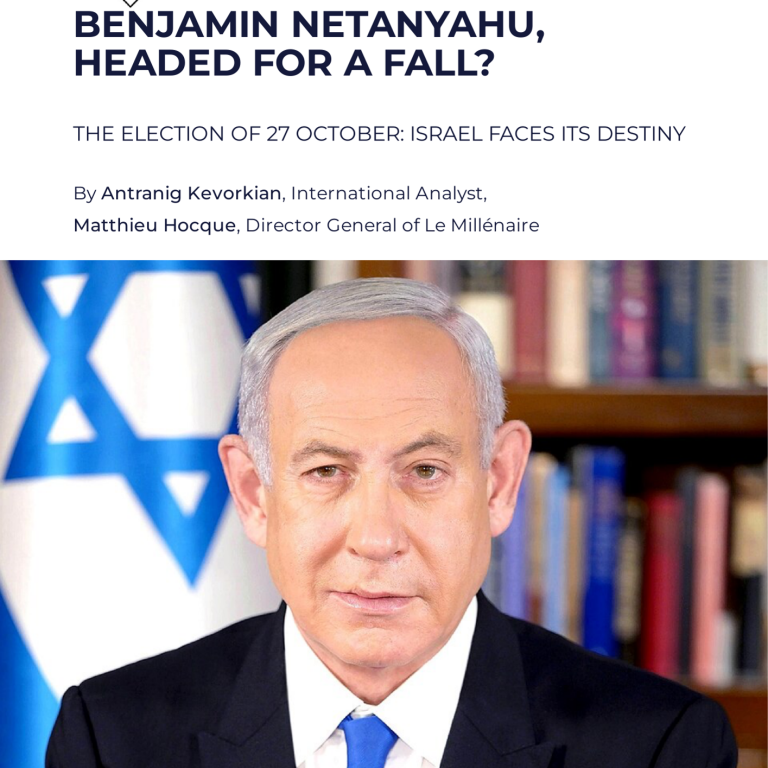 11 October 2026Benjamin Netanyahu, Headed for a Fall?
 26 October 2026How did Lula turn the impossible into reality?
 27 octobre 2026Matthieu Hocque et Antranig Kevorkian pour le JDD : « Législatives en Israël : pourquoi la défaite de Netanyahou n’aura pas lieu »
 26 octobre 2026Entretien de Matthieu Hocque et Antranig Kevorkian pour Atlantico : « Élections en Israël : pourquoi Benyamin Netanyahou a 93 % de chances de rester au pouvoir, même sans majorité »
Photo credit: Benjamin Netanyahu 2012, U.S. Department of State, via Wikimedia Commons, public domain; Gadi Eisenkot 2 (cropped, WD), Yahav Trudler (Yahav Studio), via Wikimedia Commons, licensed under CC BY-SA 3.0.
