
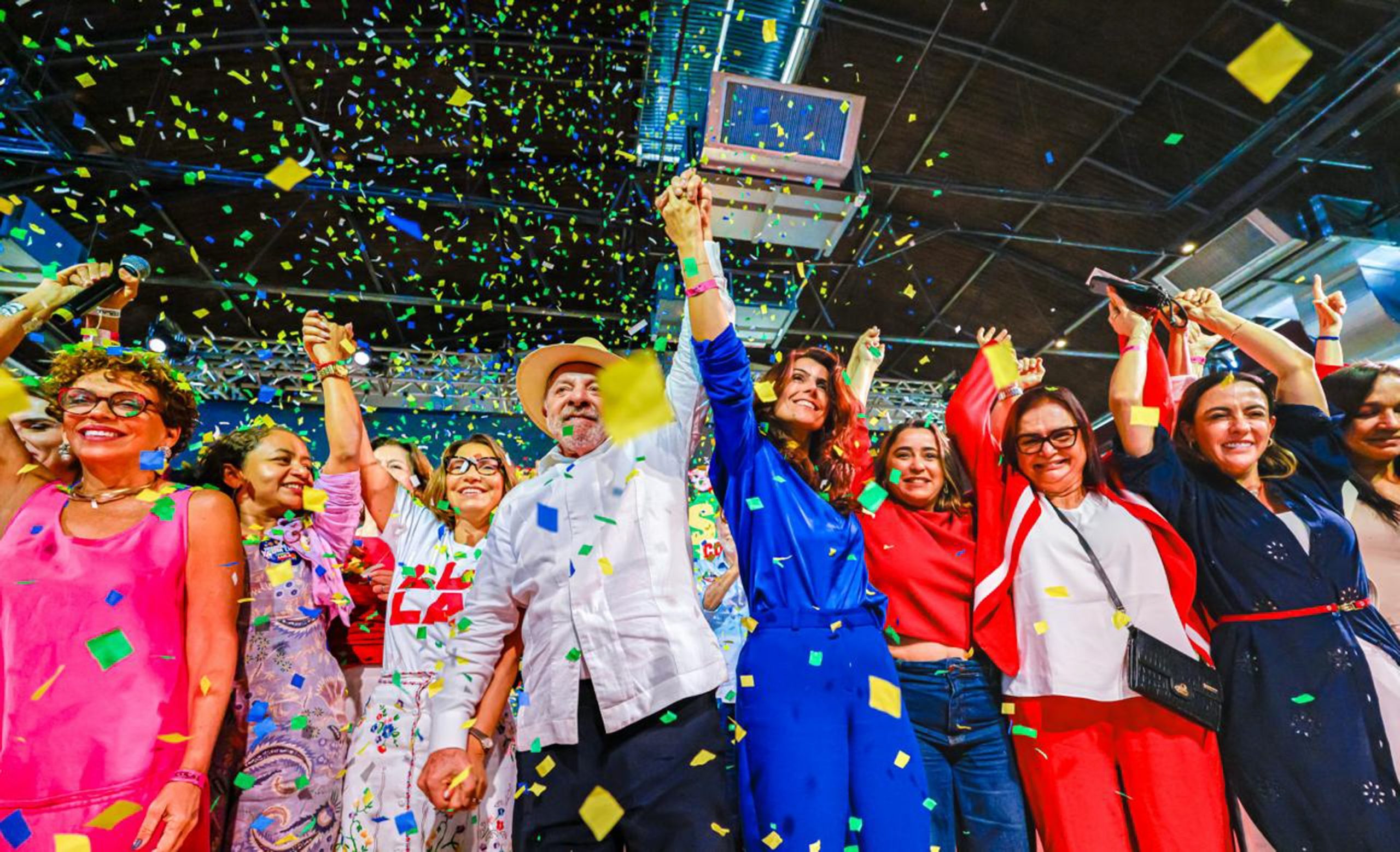
This is a translation of the original French text, which may contain errors; the French version is the reference text: Comment Lula a transformé l’impossible en réalité ?
Elections in Brazil: the electoral and political analysis of Lula’s feat
Trailing by 2.22 million votes in the first round, Lula was re-elected on 25 October with 51.79% of valid votes and a lead of 4.43 million votes, a first since the return of democracy in 1985. Drawing on the results of the 5,570 municipalities, the 2022 census and the Brazilian press, the report explains this reversal: the return to the polls of abstainers, vote transfers unfavourable to Flávio Bolsonaro and the swing of Minas Gerais and the city of Rio de Janeiro.
The finding
Trailing in the first round, Lula is re-elected with 51.79% of the vote and a lead of 4.43 million votes. Since 1985, the runner-up in the first round had never won the run-off.
The cause
The return to the polls of voters in the Nordeste and the urban peripheries, the disobedience of some centrist voters towards their candidates, and the swing of Minas Gerais and the city of Rio de Janeiro.
The consequence
The polls and Le Millénaire’s model underestimated Lula by about 2.7 points. His fourth term begins facing a Congress further to the right and an opponent who is calling for the election to be annulled.
Foreword
On the evening of 4 October, Lula said he was “convinced of winning in the first round”. Yet he had just finished second, with 45.16% of the vote against 47.03% for Flávio Bolsonaro, 2.22 million votes behind, even though the polling institutes still placed him ahead the day before. Three weeks later, Brazilians chose him, with 51.79% of valid votes and 64.26 million votes, against 59.83 million for Flávio Bolsonaro. According to the Associated Press, since 1985 and the return of democracy, Brazil had never seen the runner-up in the first round win the run-off.
Neither Le Millénaire nor the polling institutes had predicted this result. Between the two rounds, no published survey showed Lula winning. The last Datafolha poll, conducted on 23 and 24 October, gave 51% of valid votes to Flávio Bolsonaro, and Le Millénaire’s forecast on the evening of 24 October gave Lula only 49.1% of the vote and a 34% chance. The polls were therefore wrong twice in three weeks: they overestimated Lula in the first round, then underestimated him in the run-off.
The report seeks to understand how an incumbent president trailing in the first round, facing an opponent backed by most of the eliminated candidates, was able to win with a lead of 4.43 million votes. It draws on the official results of the country’s 5,570 municipalities, compared with those of 2022 and cross-referenced with the IBGE’s 2022 census, as well as on the Brazilian press for the campaign. The results cited are those of the Superior Electoral Court (TSE); Le Millénaire’s estimates are presented as such.
The first round: a surprise on the right
Two finalists, 92.2% of the vote. Twelve candidates stood. Flávio Bolsonaro came first with 56.10 million votes, or 47.03% of valid votes, ahead of Lula, who received 53.88 million votes and 45.16%. The two finalists gathered 92.2% of the vote, compared with 91.6% for Lula and Jair Bolsonaro in the first round of 2022: the polarisation established in 2018 is not easing. Augusto Cury (Avante) obtained 2.89%, Renan Santos (Missão) 2.24%, Ronaldo Caiado (PSD) 2.18% and Romeu Zema (Novo) 0.27%. Turnout reached only 78.9%: abstention affected 21.08% of registered voters, or 33.5 million people, its highest level since 1998. Among those over 70, who are exempt from compulsory voting, it approached 50%.
A polling error reminiscent of 2018 and 2022. The day before, the last three published polls put Lula ahead in valid votes: 45% against 42% for Datafolha, 46% against 45% for Quaest and 47.8% against 42.1% for MDA. On the gap between the two candidates, the error ranges from 2.9 points for Quaest to 7.6 points for MDA. Le Millénaire’s forecast, frozen on the evening of 3 October, placed Lula at 44.4% and Flávio Bolsonaro at 41.2%. Accurate to within 0.8 points for Lula, it underestimated Flávio Bolsonaro by 5.8 points, while the next four candidates all did less well than expected. The report puts forward two explanations, a last-minute tactical vote or right-wing voters being less likely to respond to surveys, without being able to decide between them.
A map in two blocs. Lula came first in 12 states: the 9 of the Nordeste, Pará, Amazonas and Amapá, the latter with a lead of only 225 votes. Flávio Bolsonaro took the other 15, including São Paulo (51.9% against 38.2%), Minas Gerais (48.2% against 43.3%) and Rio de Janeiro (53.0% against 39.4%). He came first in 2,908 municipalities, Lula in 2,663. The Nordeste gave 63.8% of the vote to Lula, but about 300,000 fewer votes than in the first round of 2022.
Three very different eliminated electorates. Augusto Cury, Renan Santos and Ronaldo Caiado together gathered 8.7 million votes, nearly four times the gap between the two finalists. Augusto Cury achieved his best scores in the working-class towns surrounding the metropolises of the South-East and in the North: 5.3% in Conselheiro Lafaiete, 4.8% in Santa Luzia and Ibirité, 4.5% in Manaus. Renan Santos is the candidate of the highly educated cities of the South and South-East: his share has a correlation of 0.64 with the average length of schooling in the municipalities. Ronaldo Caiado obtained 12.3% in Goiás, the state he governs, 4.8% in the Federal District, and less than 3% everywhere else.
A strengthened right in Congress. On the same day, Tarcísio de Freitas was re-elected governor of São Paulo in the first round against Fernando Haddad, with about 62.7% of the vote. In the Senate, the Liberal Party (PL) of the Bolsonaro family rose to 28 seats out of 81, and the right holds a simple majority there with the PP, Republicanos and Novo. For Lula, the first round is doubly unfavourable: he is trailing in the presidential election, and the Congress elected on the same day will be less favourable to him than the previous one.
The run-off campaign: two strategies
Lula chooses confrontation. From the evening of 4 October, Lula spoke of a campaign that would now be played out “between two candidates only”, directly attacked Flávio Bolsonaro and called on those who had not voted to do so. According to internal sources cited by Bloomberg Línea, his team acknowledged overconfidence and a misreading of the electorate. Having taken part in no debate in the first round, he let himself be persuaded by Edinho Silva, president of the PT, to face his opponent head to head.
Two targets: the Nordeste and abstainers. On 5 October, the campaign set itself two objectives: widen the lead in the Nordeste and reduce abstention. The “March for Democracy” on 11 October on Avenida Paulista, in front of a million participants according to the organisers, was aimed first and foremost at abstainers and the over-70s. In Minas Gerais, where the PT no longer had a candidate in the run-off of the gubernatorial election, Lula travelled there himself, to Juiz de Fora and then to Ipatinga on 16 October.
Every lever of the state. On 16 October, the end of the “6×1” schedule was enacted: 40 hours of work per week instead of 44, two days of rest instead of one. On 21 October, Lula sent Congress a constitutional amendment making public transport free at weekends, for about 11.2 billion reais, and enacted a law wiping out part of the debts of some 3.6 million micro-entrepreneurs. Added to this was the 15% increase in Bolsa Família, decided on 17 September and paid in October. The economist Marco Mendes, of Insper, denounced the absence of “any budgetary rigour”. The report agrees with him on the substance, while noting that the operation bore fruit at the ballot box.
Sovereignty and social networks. Lula presented Flávio Bolsonaro as a danger to democracy and warned that with him, it would be the United States running Brazil. At the Band debate, he questioned him on Donald Trump’s tariffs and on the “Escudo das Américas”. The WhatsApp channel “Lula’s Army”, run by the deputy André Janones, grew from 3.7 million subscribers on 12 October to 7 million on the 21st.
Flávio Bolsonaro bets on endorsements. Romeu Zema and Michel Temer rallied behind him on 5 October. The next day, Ronaldo Caiado announced his support in a personal capacity, whereas in mid-September he was still treating the two finalists as equally bad. The União Progressista federation required its members to vote for him, Augusto Cury rallied on 8 October with an eight-point programme, and only Renan Santos gave no voting instruction. By 16 October, 12 elected governors were backing him, including those of São Paulo, Minas Gerais and Rio de Janeiro. For the report, this support without genuine enthusiasm may have produced smaller vote transfers than expected and under-mobilisation.
The illusion of a lead. He campaigned on security, food prices, his ties with the White House and the amnesty for his father. The polls all showed him winning: AtlasIntel at 52.8% of valid votes in early October, Datafolha at 51% in mid-October, Quaest around 50.6%. On 13 October, he had to defend himself against being “de salto alto”, the Brazilian expression for overconfidence, while the press was already discussing the sharing out of ministries. His rally on 18 October on Avenida Paulista drew 71,900 people according to the Political Debate Monitor.
What worked, what failed. The day after the vote, allies of Flávio Bolsonaro pointed to overconfidence, the allocation of ministries before victory and a “dull” run-off. For Le Millénaire, the results confirm the effectiveness of two of Lula’s choices: targeting abstainers and the Nordeste, and the effort made in Minas Gerais, the only state to change sides between the two rounds. Conversely, they show that the endorsements did not produce the expected effects: in Ronaldo Caiado’s Goiás, Lula gained 9.3 points between the two rounds. The specific effect of the debates, the purchasing-power measures and social networks, which all played out at the same time, cannot be measured.
A come-from-behind victory
The PT’s best score since 2010. With 51.79% of valid votes, Lula achieved the PT’s best score in a run-off since 2010, when Dilma Rousseff had obtained 56.1%. He did better than in 2022, when he had narrowly won against Jair Bolsonaro with 50.90%. His lead rose from 2.14 million to 4.43 million votes. In 2018, Fernando Haddad, the candidate standing in place of a Lula declared ineligible, had peaked at 44.9%.
A reservoir of 14.10 million votes. In the run-off, every vote gained comes from the voters of eliminated candidates, from first-round abstainers or from those who had cast blank or spoilt ballots. The eliminated candidates had gathered 9.32 million votes. On 25 October, there were 2.96 million more voters and 1.82 million fewer blank and spoilt ballots than in the first round. Lula captured 10.38 million of these 14.10 million votes, or 74%, Flávio Bolsonaro only 3.72 million. With a lead of 2.22 million votes, the PL candidate only needed to capture 42% of them to stay ahead: he obtained only 26%.
Turnout, the key to the run-off. Abstention fell from 21.08% to 19.22% of registered voters, its lowest level in twenty years according to TSE records. Blank ballots fell from 1.84% to 1.12% of voters, spoilt ballots from 2.93% to 2.12%. Turnout rose by 1.9 points in the Nordeste, 2.4 in the South-East and 2.3 in the South. The North was the exception, from 80.6% to 78.8%, with falls in Amapá, Roraima and Acre that the report cannot explain. Lula nevertheless finished there at 50.01%, with a lead of 1,079 votes out of more than 10 million valid votes. The decline in blank and spoilt ballots affected 5,240 municipalities out of 5,571.
of the 14.10 million votes available between the two rounds went to Lula, whereas Flávio Bolsonaro only needed to capture 42% of them to stay ahead.
The map of victory
Two Brazils. Lula crushed the Nordeste, with 69.4% of the vote and a lead of 13.65 million votes, won the North by a whisker and Minas Gerais. Flávio Bolsonaro won in the South (62.6%), in the Centre-West (60.0%) and in the rest of the South-East, including São Paulo and Rio de Janeiro. Lula won 13 states and 2,875 municipalities out of 5,571, Flávio Bolsonaro the other 14 states, Federal District included, and 2,696 municipalities. Lula won as many states as in 2022, but Amapá went to Lula and Tocantins to Flávio Bolsonaro.
A shifting map. At national level, Lula gained 0.9 points compared with 2022, but he fell back in 78% of municipalities: his gains were made where the most voters live. 279 municipalities he had won in 2022 went to Flávio Bolsonaro, and only 31 went the other way. But the 279 municipalities lost have 2.2 million registered voters, the 31 won 7.2 million, including 5.0 million for the city of Rio de Janeiro alone. The losses are mainly small rural municipalities in Rio Grande do Sul, Minas Gerais, Paraná and Goiás; the gains, suburban towns such as Ananindeua, Macapá, São Vicente, Santa Luzia or Alvorada.
The revenge of the cities. The 173 municipalities with more than 100,000 valid votes earned Lula an additional lead of 2.85 million votes compared with 2022, while the 4,555 municipalities with fewer than 20,000 valid votes cost him 0.83 million. Lula lost 3.1 points in municipalities with fewer than 5,000 valid votes and gained 3.0 in the 18 municipalities with more than 500,000. Of the 27 state capitals, 26 voted more for him than in 2022. At the other end, the towns of the agricultural frontier moved away: Balsas (-6.7 points), Itaituba (-6.3), Rio Verde (-4.1).
São Paulo, the defeat that paid off. Flávio Bolsonaro won the state with 53.8% of the vote. But Lula rose there from 38.2% to 46.2% between the two rounds, and his opponent’s lead melted from 3.42 million to 2.02 million votes, about a fifth of the national swing. The state capital gave 55.5% to Lula, compared with 53.5% in 2022.
Minas Gerais, the state that decided the election. Since at least 2006, the national winner has always carried Minas Gerais. Trailing by 588,612 votes on 4 October, Lula won on the 25th with 50.43% and a lead of 109,313 votes: it is the only state to change sides between the two rounds. Belo Horizonte went from 41.4% to 49.2% for Lula, and Santa Luzia, Ibirité and Ribeirão das Neves swung, the first two being among Augusto Cury’s best municipalities.
Rio, the Nordeste and Goiás. In the city of Rio de Janeiro, Flávio Bolsonaro led by 137,837 votes in the first round; Lula won in the run-off with a lead of 113,193 votes and 51.5% of the vote. In the Nordeste, turnout climbed from 81.6% to 83.5% and Lula’s regional lead rose from 11.10 to 13.65 million votes, or 38% of the national swing. In Ronaldo Caiado’s Goiás, Lula gained 9.3 points between the two rounds, from 31.1% to 40.3%. In the South, he fell back outside the metropolitan areas, and Rio Grande do Sul has 65 municipalities lost since 2022.
Lula’s re-election in figures
Lula’s score, as a % of valid votes
How to read: Lula obtained 51.79% in the 2026 run-off, compared with 45.16% in the first round and 50.90% in the 2022 run-off.
Votes available between the two rounds and how they were shared, in millions
How to read: out of a reservoir of 14.10 million votes, Lula captured 10.38 million (74%), Flávio Bolsonaro 3.72 million (26%).
Change in Lula’s score between 2022 and 2026 by size of municipality, in points
How to read: in the 18 municipalities with more than 500,000 valid votes, Lula gained 3.0 points compared with 2022; he lost 3.1 in municipalities with fewer than 5,000 valid votes.
Share of eliminated candidates’ voters transferred to Lula, in %
How to read: the polls used in the model attributed 36% of Augusto Cury’s voters to Lula; the estimate based on the municipalities, very probably inflated by the method, gives nearly 100%.
Share of the vote Lula would have needed among late voters to account for his lead, in %
How to read: if 1% of voters had voted after 5 pm, Lula would have needed to receive 223% of their votes for the extension to explain his lead, which is impossible.
Who voted for Lula: what the municipalities tell us
A stable social geography. In the absence of an exit poll, the report cross-references the results of the 5,570 municipalities with the 2022 census: it describes territories, not individuals. Lula remains first and foremost the candidate of poor, Black and mixed-race municipalities. The correlation is +0.63 with the share of Black and mixed-race people, -0.68 with the literacy rate and -0.56 with GDP per capita. He obtained 70% of the vote among the fifth of voters living in the poorest municipalities, 47% in the richest fifth, and 62.7% in the least evangelical municipalities against 45.2% in the most evangelical.
The effect of education level. Since 2022, Lula has gained all the more where the municipality is urban and its inhabitants have had long years of education. In the fifth of voters where average schooling is shortest (7.2 years), he fell back by 2.2 points; in the fifth where it is longest (11.1 years), he gained 2.6 points. Against all expectations, he also gained 1.4 points in the most evangelical municipalities.
With comparable profiles. In a regression with state fixed effects across 5,568 municipalities, one additional year of average schooling goes with an additional 1.34 points of progress for Lula since 2022, while GDP per capita works in the opposite direction. The report sees in this a phenomenon familiar in France as in the United States, that of a left which wins the highly educated metropolises and loses rural areas, with the difference that in Brazil, this new electorate adds to Lula’s working-class base in the Nordeste. It remains cautious: education level may also reflect access to information or the nature of jobs in large cities.
What the polls said. According to the Datafolha poll published on 23 October, Lula was winning among women (53%), Catholics (59%) and households earning up to two minimum wages (58%), Flávio Bolsonaro among men (54%) and evangelicals (73%). If the result contradicted this survey, it is probably because the voters most favourable to Lula, people of modest means in the Nordeste and the suburbs, turned out to vote in greater numbers than expected.
Understanding the reversal
Instructions that were not followed. Three of the four eliminated candidates called for a vote for Flávio Bolsonaro, the fourth said nothing. Together they accounted for 9.1 million votes, four times the PL candidate’s lead. The polls used in Le Millénaire’s model attributed to Lula on average 36% of Augusto Cury’s voters, 31% of Ronaldo Caiado’s and 12% of Renan Santos’s; the Quaest survey of 17 to 20 October already gave 48% of Cury’s voters to Lula. Le Millénaire’s estimates based on the municipalities show a transfer of nearly 100% of Cury’s voters to Lula, very probably inflated by the method, and about a third for Caiado’s. For Renan Santos, the results are too unstable to draw a conclusion. These are orders of magnitude, not measurements.
The awakening of absent voters. In the first round, 38.9 million registered voters had not cast a valid vote, through abstention, blank ballots or spoilt ballots. According to Le Millénaire’s two methods, about 14% of them voted for Lula in the run-off, and practically none for Flávio Bolsonaro. This represents around 5.5 million votes, roughly half of Lula’s gain between the two rounds. This is precisely what the polls measured worst, and it was the target Lula had set himself on 5 October.
The extension of voting. On 25 October, in mid-afternoon, Lula’s campaign brought the matter before the Supreme Federal Court: buses were not running in Salvador, Feira de Santana and Lauro de Freitas. At around 5 pm, Justice Cristiano Zanin ordered voting to be extended until 7 pm throughout the country. As most ballot boxes were already closed, the TSE limited the extension to polling stations still open at 5 pm. Neither the number of polling stations concerned nor the number of voters is yet known, and Flávio Bolsonaro is calling for the election to be annulled.
What the figures say. The report does not rule on the legal regularity of the decision, but does the calculation. Even if all the ballots cast after 5 pm had gone to Lula, more than 4,430,191 of them would have been needed to reverse the result, or 3.45% of the country’s voters, about one voter in 29, in polling stations most of which were already closed. If 1% of voters had voted during the extension, Lula would have had to obtain 223% of their votes. In Salvador, turnout rose from 79.9% to 84.2%, but Bahia as a whole had only 368,446 more voters than in the first round. Lula gained between the two rounds in all 27 states, by 4.5 to 9.3 points, and in 5,567 municipalities out of 5,571.
In Brazil, in October 2026, it was not the distribution of voters between the two camps that decided the election, it was the number of those who turned out to vote.
What the polls did not see, and conclusion
An error of level, not of map. Between the two rounds, the published polls almost all put Flávio Bolsonaro ahead, generally between 50 and 53% of valid votes: the error on the gap reached 5 to 6 points. Le Millénaire’s forecast placed Lula at 49.1%, with an 80% interval between 46.4% and 51.8%, and a 34% chance. Lula did better than the projection in all 27 states, from 1.5 points in Rondônia to 3.7 points in Rio de Janeiro, but the geography was right: the projection reconstructed municipality by municipality has a correlation of 0.99 with the result. On election night, from 35% of votes counted, the needle of Le Millénaire’s Electoral Observatory estimated Lula at 51.7%; it ended at 51.84%, against an official result of 51.79%.
Two lessons. Having the result within one’s interval is not worth a good forecast when the centre of the projection is on the wrong side of 50%. And in a country where voting is compulsory without any real penalty, a few points of turnout gained in three weeks can decide an election: Le Millénaire’s models, which treated abstention as a stable given, will have to take it into account.
Lula’s feat. Lula was not re-elected by the same Brazil as in 2022. He gained in the cities, above all the most highly educated, and among first-round abstainers, and fell back in the Brazil of soya and livestock farming. Three things made his victory, and the polls underestimated all three: the return to the polls of his voters in the Nordeste and the urban peripheries, the disobedience of some centrist voters towards their candidates, and the swing of Minas Gerais and the city of Rio de Janeiro. This is almost word for word what his campaign had decided on 5 October: go after the abstainers, focus the effort on the Nordeste and Minas Gerais, accept the debates.
A fourth term under strain. This term begins with an opponent calling for the election to be annulled and a Congress further to the right than the previous one. The right will have to find itself a leader, and a Metrópoles columnist already names Tarcísio de Freitas as the big winner in his camp. For Paris and Brussels, Lula remains a familiar interlocutor, while the agreement with Mercosur has still not been ratified. The report concludes that it was not the distribution of voters between the two camps that decided the election, but the number of those who turned out to vote.
Thay W., Clairé P., “How did Lula turn the impossible into reality?”, Le Millénaire Report, 26 October 2026, lemillenaire.org.
Browse the report
William Thay and Pierre Clairé
President of Le Millénaire ; Deputy Director of Studies, Le Millénaire.
William Thay Pierre ClairéRequest an interview
For an interview with William Thay or Pierre Clairé about this report: presse@lemillenaire.org
Contact the press officeKeep our studies going
Your donations and memberships fund Le Millénaire’s next notes.
Support us JoinReceive Le Millénaire’s next briefing notes
Read also
All studies 1 October 2026Elections in Brazil: towards a new swing?
 23 October 2026Article in Les Échos: “Lula-Bolsonaro match: the three states to watch in Brazil’s presidential election”
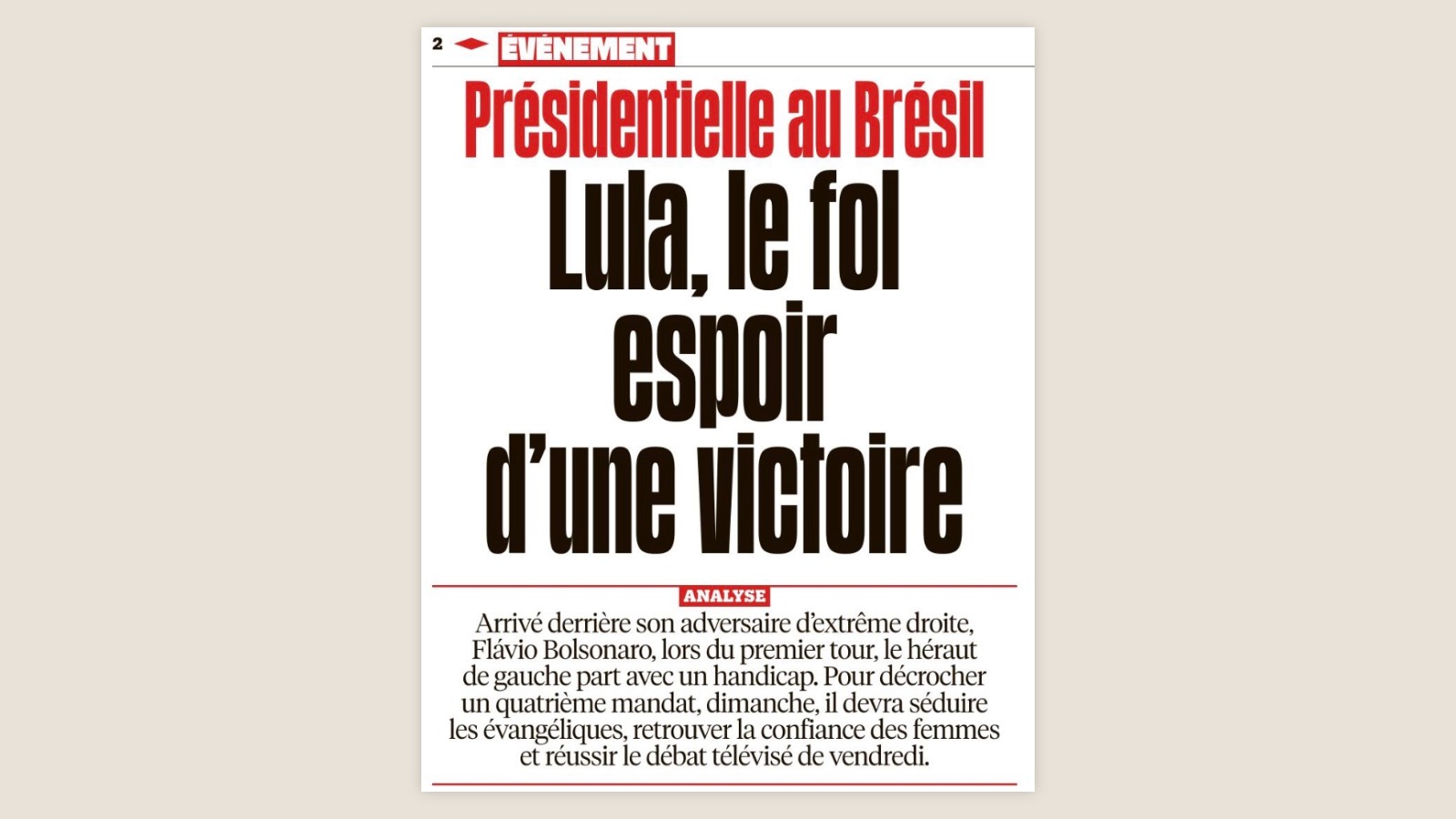 21 October 2026Article in Libération: “Presidential election in Brazil: Lula, the wild hope of a victory”
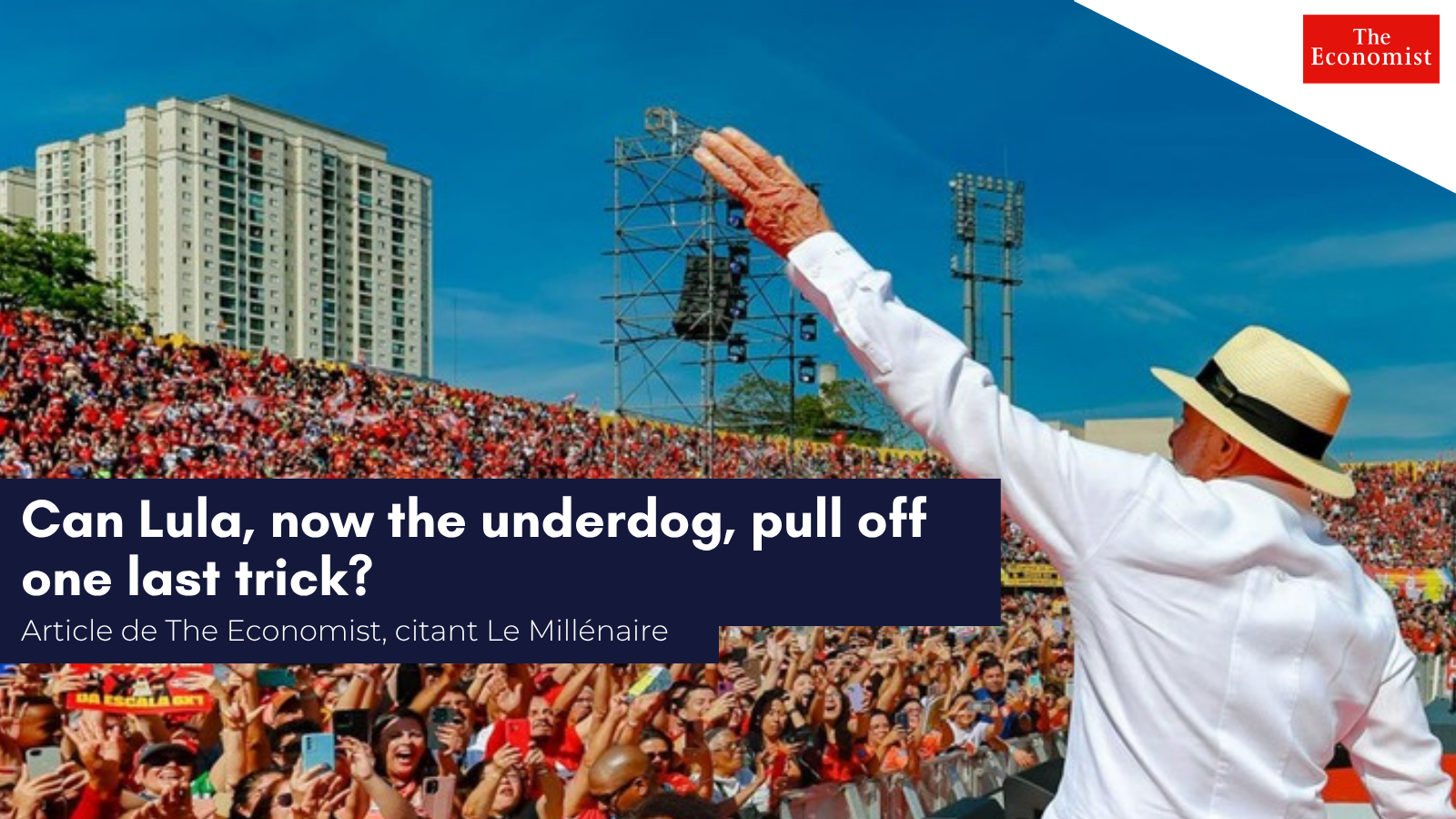 21 October 2026Article in The Economist: “Can Lula, now the underdog, pull off one last trick?”
Photo credit: Lula campaigning via Wikimedia Commons, under licence CC BY SA 4.0
