
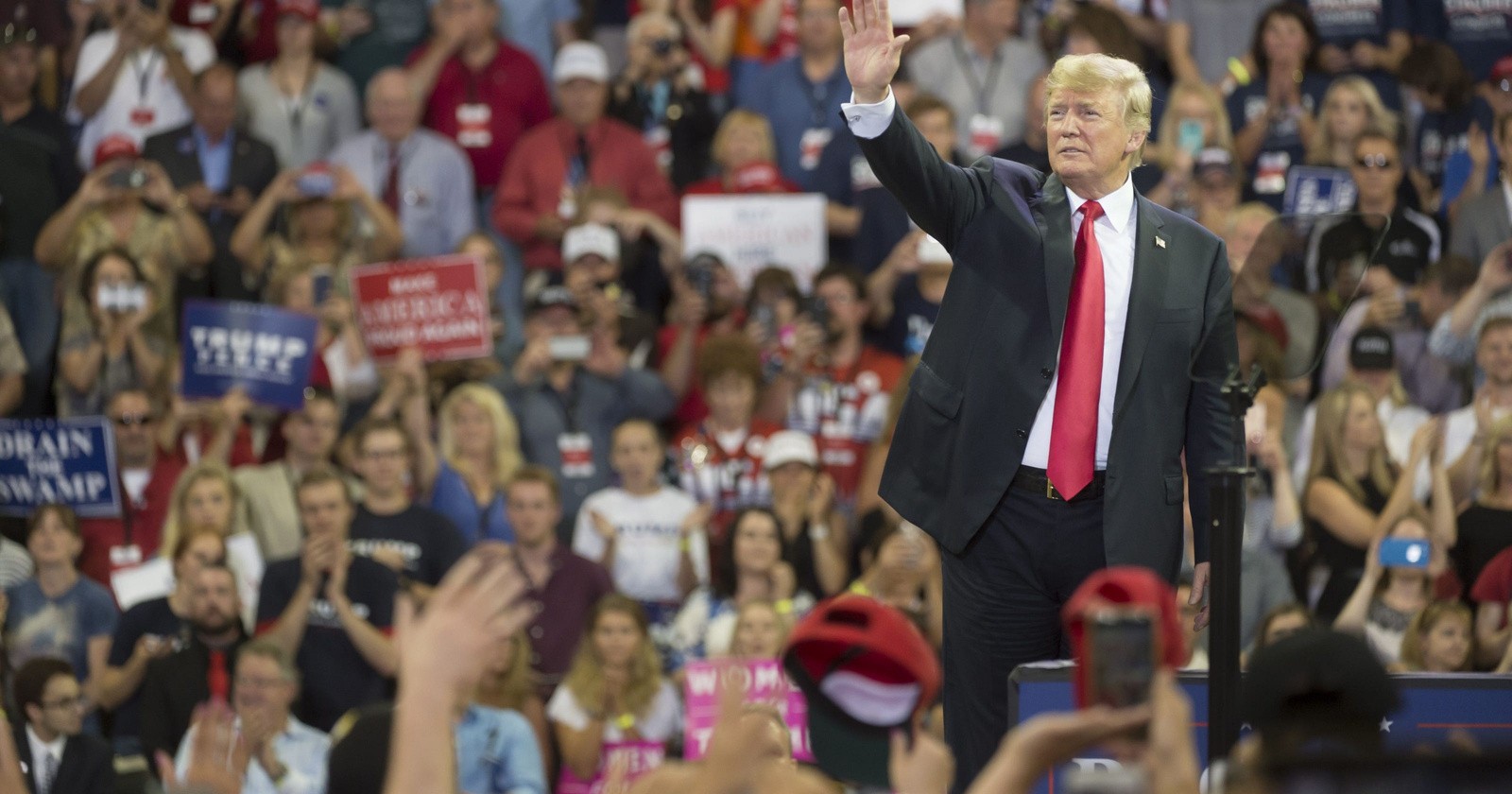
This is a translation of the original French text: Midterm 2026 : vers la fin du mouvement MAGA ?
Midterm elections: Trump headed for a rebound or for the end?
Ahead of the midterm elections of 3 November 2026, this report assesses the first two years of Donald Trump’s second term and analyses the forces at play. Le Millénaire’s model gives the Democrats a 72.8 % chance of retaking the House of Representatives, but only 30.2 % in the Senate.
The finding
Ahead of the midterms of 3 November 2026, Donald Trump’s approval rating has fallen to 37 % and voters now prefer the Democrats on the economy.
The cause
Slowing growth, petrol prices, the war in Iran and ICE’s methods are splitting the coalition that brought him to power in 2024.
The consequence
Le Millénaire’s model gives the Democrats a 72.8 % chance of retaking the House, but only 30.2 % in the Senate, making a divided Congress likely.
Foreword
‘You gotta win the midterms, ’cause if we don’t win the midterms, it’s just going to be, I mean, they’ll find a reason to impeach me’ (Donald Trump, 6 January 2026).
As the words above show, the 47th President of the United States is so aware of how divisive his presidency is that he admits he risks impeachment, the term for the procedure laid down by the US Constitution for bringing charges against a president (Article I for the procedure, Article II, Section 4, for the grounds), if the Republican Party loses the midterms. It would not be the first time, either: Donald Trump is the first American president to have been impeached twice, in 2019 for abuse of power and obstruction of Congress (in the affair of the phone call with Volodymyr Zelensky), and in 2021 for incitement of insurrection following the attack on the Capitol by MAGA activists on 6 January 2021. He was ultimately acquitted in both impeachment trials, because the Democrats never managed to secure the two-thirds majority required in the Senate to convict him.
These midterm elections will therefore be decisive for the rest of Donald Trump’s second presidential term, which ends on 20 January 2029. The midterms are comparable to legislative elections in France. In the United States of America, Congress holds legislative power and currently consists of the 435 members of the House of Representatives (218 Republicans, 214 Democrats, 1 independent and 2 vacant seats) and 100 senators (53 Republicans, 45 Democrats and 2 independents). Its role is to act as a check on the executive (the President and the Vice President). A change in the composition of Congress, which currently has a Republican majority, can shift the balance of power between the branches: this is what is known as a *divided government*. In practical terms, if the Democrats won a majority in Congress, they would be able to block the legislative agenda or launch budget battles, and thus jeopardise Donald Trump’s MAGA political project. It should also be noted that 36 governorships are up for election across the country in these midterms. Although these are local elections whose influence will be felt more at state than at federal level, the governor remains a key figure in American politics, since he or she wields genuine executive power at local level (this varies according to each state’s constitution, but governors broadly oversee state agencies). The Governor of Illinois, Jay Robert Pritzker, for example, stood up to Donald Trump in October 2025 when Illinois went to federal court to block the deployment of the National Guard in Chicago.
Midterm elections have historically been difficult for the party in power. At present, the odds are not all in Trump’s favour: the war in Iran drags on, splitting his electoral base and weighing on Americans’ morale. The warning lights are indeed flashing red. In August 2026, Donald Trump’s approval rating stood at 37 % according to The New York Times, and in a Reuters/Ipsos poll the same month, for the first time in ten years, voters preferred the Democrats to the Republicans on the economy: 37 % felt that the Democratic Party had a better approach to the American economy, compared with 36 % for the Republican Party. As of 20 October 2026, Le Millénaire’s forecasting model therefore gives the Democrats a 72.8 % chance of winning a majority in the House of Representatives, but only 30.2 % in the Senate.
The aim of this report is to analyse the dynamics of the midterm elections in order to understand the strengths and weaknesses of both parties. In the first part, we review the record of the first two years of Donald Trump’s second term. In the second part, we look at the history of midterm elections. In the third part, we analyse the forces at play and the dynamics within the Democratic and Republican parties in the context of the 2026 midterm elections.
By Sean Scull, United States Specialist, Le Millénaire. Augustin Bataille, Analyst, Le Millénaire.
A domestic record in line with Project 2025
A programme largely carried out. According to the Center for Progressive Reform and Governing for Impact, 53 % of the measures in the Heritage Foundation’s Project 2025 had been launched or implemented 12 months after the inauguration, or 283 measures out of 532. Executive Order 14215 of 18 February 2025 places independent agencies under White House control. The allocation of federal funds now goes through the Office of Management and Budget, headed by Russell Vought, one of the architects of Project 2025.
A giant budget law. Signed into law on 4 July 2025, the One Big Beautiful Bill Act makes the 2017 tax cuts permanent and abolishes tax on tips and overtime. It funds a $150 billion increase in immigration and defence budgets through cuts to Medicaid and food assistance. The administration then asked Congress for $1.5 trillion for national defence for fiscal year 2027.
DOGE falls short of its ambitions. Elon Musk aimed to cut $2 trillion in spending. The DOGE website claims around $215 billion in savings, a figure disputed by American civil society. According to the OMB, more than 260,000 federal employees left the administration in 2025, departures that cannot all be attributed to DOGE.
A hard line on immigration. Congress has allocated around $240 billion to the detention and deportation of immigrants, and ICE’s workforce has grown from 10,000 to 22,000 agents. According to the Department of Homeland Security, more than 2.5 million illegal immigrants had left the country by the end of 2025, including so-called voluntary departures. The administration claims negative net migration, a first in at least fifty years.
The tariff turn. ‘Liberation Day’ on 2 April 2025 brought in the largest increase in US tariffs since 1930: a universal 10 % tariff and 25 % on steel, aluminium and cars. Tariffs on China peaked at 145 %. On 20 February 2026, the Supreme Court struck down the universal tariffs, ruling that the President had exceeded the powers granted to him by the 1977 law.
Diplomacy through force
America First, not isolationism. According to the authors, Donald Trump promised an interventionist but realist foreign policy, founded on ‘peace through strength’. He intended to push the Europeans to fund more of NATO so that he could focus on the Chinese threat. He claimed he could end the war in Ukraine in 24 hours.
The Golden Dome. The future missile defence programme is estimated at $175 billion. It would place American weapons in space for the first time by January 2029.
Cartels and Venezuela. As early as 20 January 2025, Executive Order 14157 designated drug cartels and criminal gangs as terrorist organisations. On 3 January 2026, Operation ‘Absolute Resolve’ led to the capture of Nicolás Maduro and his wife Cilia Flores. Both were flown to the United States to stand trial.
The Gaza peace agreement. Sponsored by Washington, it was co-signed at the Sharm el-Sheikh summit on 13 October 2025 by the United States, Egypt, Qatar and Turkey. A Board of Peace created and chaired by Donald Trump oversees reconstruction and the political transition in Gaza.
A war in Iran without public support. In March 2026, 41 % of Americans supported the war against Iran. By comparison, 76 % supported the Iraq War in 2003 and 97 % the entry into the Second World War. According to the authors, only Barack Obama, in Libya in 2011, had likewise failed to rally public opinion behind an intervention.
A fractured coalition
Warning lights flashing red. Donald Trump’s approval rating stood at 37 % as of 20 August 2026 according to The New York Times, and it has not exceeded 40 % since April. At the same point before the 2018 midterms, it stood at 41 % according to Gallup. George W. Bush was at 38 % before the 2006 election, which handed both chambers to the Democrats.
The economy no longer protects him. For the first time in ten years, voters prefer the Democrats (37 %) to the Republicans (36 %) on the economy, according to Reuters/Ipsos. Silver Bulletin puts approval of Trump’s economic policy at 33 % as of 19 August, compared with a peak of 48 % in February 2025. Growth fell back to an annualised 1.8 % in the first half of 2026, and a gallon of petrol reached $4.56 on 21 May.
Young voters drift away. Trump won 46 % of the vote among under-30s in 2024, compared with 36 % in 2020, according to AP VoteCast. In spring 2026, the Yale Youth Poll found that 68 % of 18-22 year olds and 72 % of 23-29 year olds disapprove of his performance. Only 29 % and 28 % of them respectively would vote for a Republican candidate.
The MAGA base divides. MAGA supporters, around half of Republicans, approve of Trump at 95 %. But the war in Iran has turned voices such as Tucker Carlson, Joe Rogan and Marjorie Taylor Greene against him. Among Republicans aged 18 to 44, only 40 % think the attack on Iran was the right decision. Nearly one in four Trump voters thinks the deportation campaign is too aggressive.
The party of the elite. According to a New York Times/Siena poll from September 2026, 43 % of likely voters see the Republicans as ‘elitist’, compared with 33 % for the Democrats. The two parties were almost level in 2022. For the authors, this reversal weakens a president who has built himself since 2016 on an anti-establishment profile.
The United States ahead of the midterms of 3 November
Initial support for US military interventions (%)
How to read: in March 2026, 41 % of Americans supported the war against Iran, compared with 76 % for the Iraq War in 2003.
Presidential approval before the midterms (%)
How to read: as of 20 August 2026, Donald Trump’s approval rating was 37 %, compared with 41 % at the same point in 2018.
Issue voters most want addressed, July 2026 (%)
How to read: 29 % of registered voters spontaneously cite economic issues, including 15 % who cite the cost of living and purchasing power.
Young voters and Donald Trump (%)
How to read: in spring 2026, 72 % of voters aged 23 to 29 disapproved of Donald Trump’s performance.
The nine US political typology groups according to the Pew Research Center (% of adults)
How to read: the Order and Opportunity Left group accounts for 18 % of American adults, the largest of the nine.
To say that America is at a crossroads would be an overstatement; to regard these as midterms like any other would be a failure of judgement.
The midterms, a thorn in the side of the president’s party
An almost constant rule. Since at least 1982, the midterms have cost the president’s party an average of 22 seats in the House and three in the Senate. It has lost at least one chamber seven times in the last 11 elections. On four occasions the opposition came away with control of the whole of Congress.
A different electorate. Turnout falls when there is no presidential election: 66.6 % in 2020, 46 % in 2022. In 2010, it reached only 45 %, compared with more than 63 % in 2008, according to the Census Bureau. Seats won on the momentum of a presidential election then return to their earlier balance.
The price of losing the Senate. Facing a Republican Senate, Barack Obama was unable to secure the confirmation of Merrick Garland, whose nomination was blocked for nearly a year after the death of Antonin Scalia in 2016. According to the authors, the Supreme Court would otherwise have one more liberal justice, and the conservative majority would be reduced to 5 to 4.
Exceptions. In 2002, carried by the rally-round-the-flag effect after 11 September, the GOP took the Senate and held the House. In 1998, with Bill Clinton at 65 % approval, the Democrats gained five seats in the House. In 2022, they lost only nine seats and gained one in the Senate.
The indicator to watch. For the authors, the true measure of a midterm is the opposition’s gain on the Generic Congressional Ballot. The Democrats gained 9.5 points between 2016 and 2018. The Republicans gained only 5.9 points in 2022, compared with nearly 8 between 2012 and 2014.
Gerrymandering, symptom of a carved-up democracy
A by-product of the system. The ten-yearly census is used to redraw districts of around 760,000 inhabitants, and each state draws its own map. In North Carolina, the Republicans won nearly 53 % of the vote in 2024 and 10 of the 14 seats, or 71 % of the delegation. In 2016, the GOP won some 241 of the 435 seats with a lead of barely one point.
The map war. Texas launched a redistricting in 2025 without any new census. Gavin Newsom’s California retaliated by redrawing five seats. After a Supreme Court ruling weakening the Voting Rights Act, the cascade has so far ended in a net gain of nine seats for the GOP.
Two methods. In Louisiana, Governor Jeff Landry suspended House primaries that were already under way, voiding some 42,000 postal ballots. In Virginia, the new map approved by nearly 52 % of voters was struck down by the state Supreme Court. According to the authors, the Republicans impose their maps while the Democrats go through referendums.
A democracy that doubts itself. According to a study published in 2025 in State Politics & Policy Quarterly, the probability of saying one is satisfied with democracy is only 25 % among those most dissatisfied with redistricting, compared with 85 % among the most satisfied. The number of moderate members of Congress has fallen from more than 160 in the early 1970s to around two dozen. The Capitol Police opened nearly 15,000 investigations into threats against elected officials in 2025, compared with 9,500 the previous year.
The weight of money. An individual cannot give more than $3,500 per election to any one candidate. Since the Citizens United ruling, however, Super PACs can raise and spend unlimited sums. MAGA Inc. has more than $400 million at its disposal, and 16 of the country’s 20 richest donors have lined up behind the GOP.
An anxious nation
The economy first. In July 2026, 29 % of registered voters spontaneously named the economy as their priority, including 15 % who cited the cost of living, according to the Pew Research Center. Next came public ethics and institutional reform (9 %), then immigration (7 %). For 2025, the Fed reports that 23 % of renters were late with their rent at least once, six points more than in 2021.
The energy shock. A gallon of petrol averaged $4.36 in September, around $1.19 more than a year earlier (+37.6 %). Petrol alone accounted for more than a third of the monthly price rise in August. For the authors, the war in Iran is the decisive factor.
Farmers hit hard. Soybean exports to China fell from 26.8 million tonnes in 2024 to 7.2 million in 2025, a drop of 73 %. In value terms, they fell from $12.6 billion to $3.1 billion. Iowa, which Trump won by more than 10 points, has become competitive.
Immigration shifts ground. Apprehensions at the south-west border fell to nearly 9,000 in August 2026, compared with nearly 250,000 in December 2023. The debate is now about methods: according to Human Rights Watch, 52 people died in ICE custody in the first 500 days of the term. In April 2026, 54 % of registered voters disapproved of the administration’s handling of immigration.
Health and artificial intelligence. According to the Congressional Budget Office, the 2025 budget law will leave an additional 10 million people without health insurance by 2034. Data centres could account for up to 9 % of the country’s electricity consumption by 2030. The Democrats are seizing on this to call for tighter oversight of AI.
chance that the Democrats win the House of Representatives, but only 30.2 % for the Senate, according to Le Millénaire’s forecasting model as of 20 October 2026.
The key states and the two parties’ strategies
A Senate hard to win. The Republicans hold 53 seats and the Democrats need to gain four, because in the event of a tie Vice President JD Vance would cast the deciding vote. Five of the most closely fought races are in states Trump won in 2024 by double digits: Alaska, Iowa, Kansas, Ohio and Texas.
What drives the close races. The authors identify five factors: redistricting, the candidates’ profiles, demographics, the effects of Trump’s policies and the Democratic momentum. Colorado’s 8th district is nearly 40 % Hispanic. In Kansas, Senator Roger Marshall has distanced himself from the threats targeting Bombardier, which employs more than 1,200 people in the state.
The Republican strategy. The GOP portrays the Democrats as extremists and keeps returning to Joe Biden’s term, which Trump has mentioned nearly 900 times since January 2026. MAGA Inc. reported $415.8 million in cash at the end of August, and Elon Musk had poured $276 million into the midterms as of 12 October. Between January and June 2026, nearly 300 national Republican ads focused on immigration.
A costly promise. At the Dallas convention, the first midterm convention in the party’s history, Trump promised a $5,000 dividend to every adult if the Republicans won both chambers. For 245 million adult Americans, the cost would reach around $1.2 trillion. The federal budget is close to $7 trillion.
Democrats back in the centre. The party has set aside abortion and cultural progressivism in favour of purchasing power: 35 % of voters trust it more on the cost of living, compared with 24 % for the Republicans. Eight of the ten Senate candidates who have raised the most money are Democrats, with $347 million between them. The Senate Leadership Fund has suspended $18 million of planned spending in North Carolina and reserved $8.2 million in Kansas.
Conclusion: the verdict of Le Millénaire’s model
An intermediate scenario. As of 20 October 2026, Le Millénaire’s forecasting model gives the Democrats a 72.8 % chance of winning the House of Representatives. Their chances in the Senate are only 30.2 %.
Two other outcomes. The blue wave may be confirmed and hand the Democrats both chambers. Conversely, the MAGA base and moderates may mobilise and give victory to the Republican Party, in a reverse replay of the 2022 midterms.
A battle for America’s identity. For the authors, the result will shape both parties’ strategies for the 2028 presidential election. It will decide between a Trumpist America committed to its second conservative revolution and a Democratic America wavering between centrism and socialism.
Scull S., Bataille A., “Midterm 2026: The End of the MAGA Movement?”, Le Millénaire Briefing Note, 21 octobre 2026, lemillenaire.org.
Browse the note
Sean Scull and Augustin Bataille
United States Specialist, Le Millénaire ; Analyst, Le Millénaire.
Sean Scull Augustin BatailleRequest an interview
For an interview with Sean Scull or Augustin Bataille about this note: presse@lemillenaire.org
Contact the press officeKeep our research going
Your donations and memberships fund Le Millénaire’s next briefing notes.
Support us Become a memberReceive Le Millénaire’s next briefing notes
Further reading
All studies 21 October 2026Midterm 2026 : vers la fin du mouvement MAGA ?
 10 juin 2026Pierre Clairé, Antranig Kevorkian et Augustin Bataille pour Valeurs Actuelles : « Arménie : l’absence de résultat clair place le premier État chrétien de l’Histoire dans une situation difficile »
 30 mars 2026Quand les démocrates se cherchent leur Trump
 7 janvier 2026Pierre Clairé, Sean Scull et Augustin Bataille pour Causeur : « Venezuela, et si Donald Trump pensait avant tout aux Midterms ? »
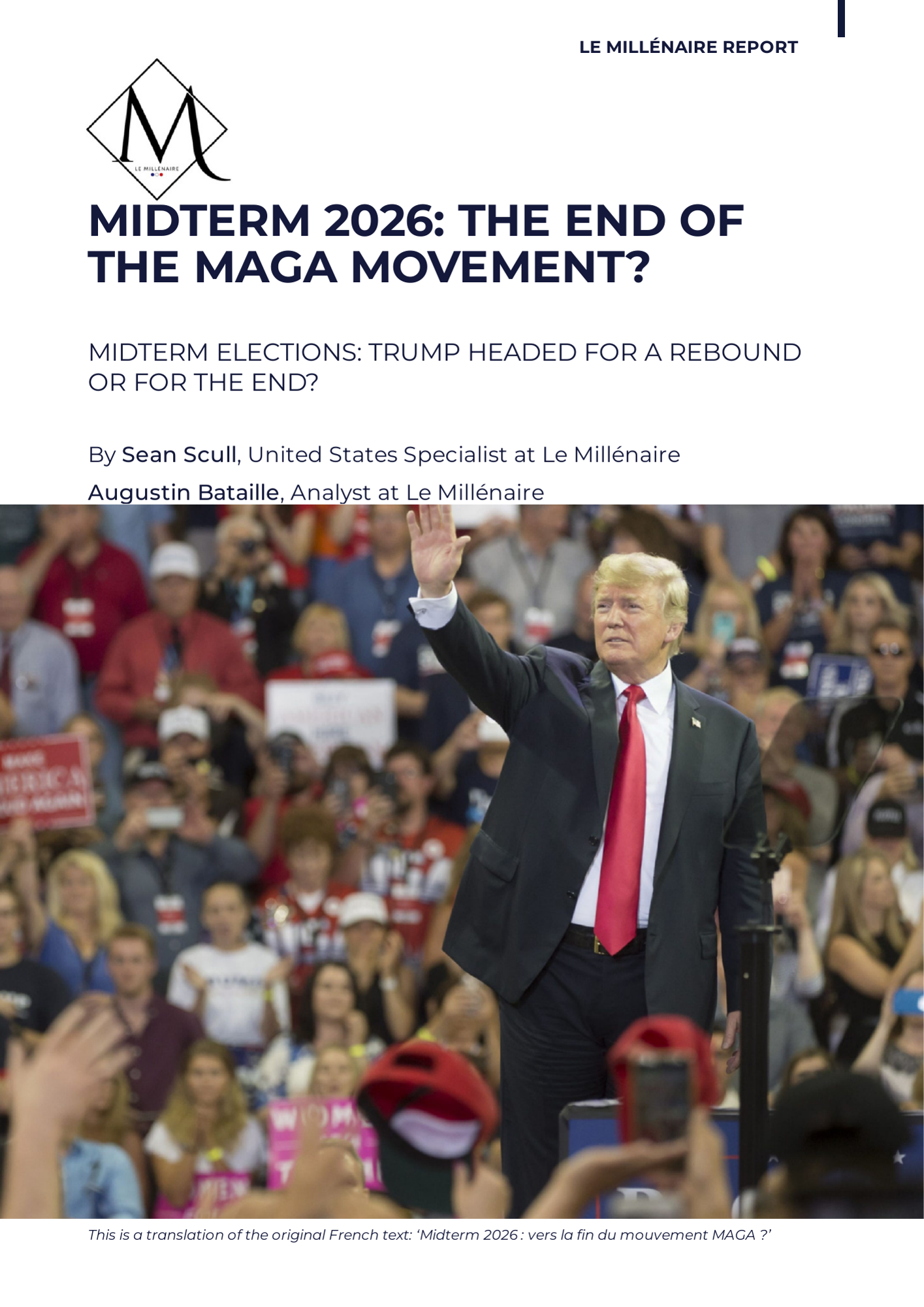
Photo credit: Donald Trump via Wikimedia Commons, licensed under CC BY SA 4.0.
