
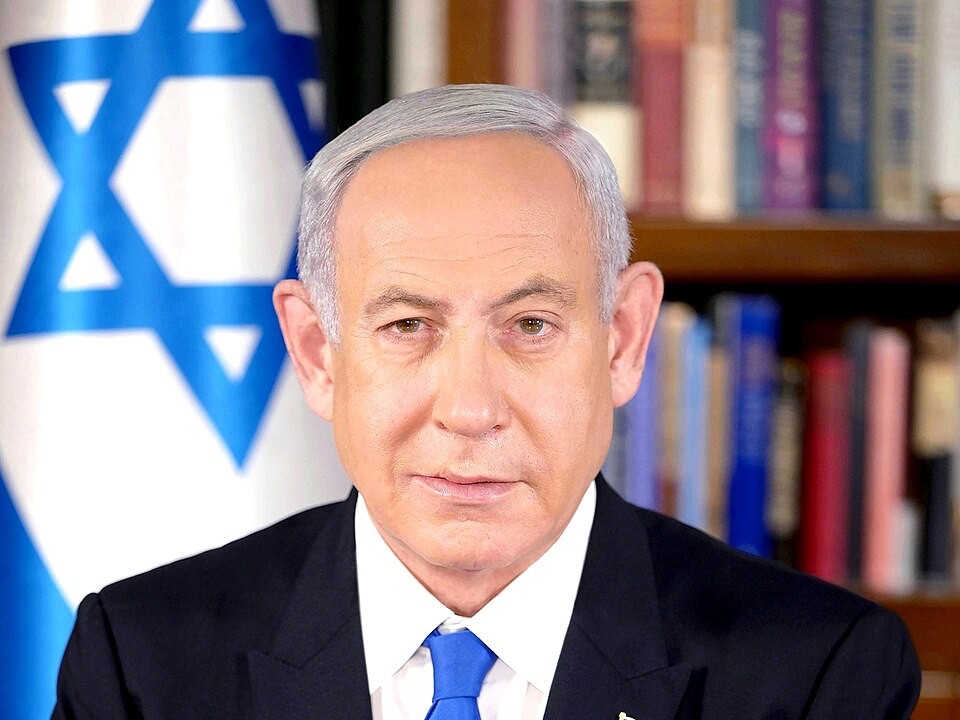
This is a translation of the original French text: Benjamin Netanyahu, vers la chute ?
The election of 27 October: Israel faces its destiny
Ahead of the Israeli general election of 27 October 2026, this report assesses nearly twenty years of Benjamin Netanyahu in power, identifies the ten variables of the vote and sets out Le Millénaire’s scenario: with neither bloc able to win a majority, Netanyahu would remain in power, with a 93 % chance according to the authors.
The finding
Ahead of the general election of 27 October 2026, neither of the two blocs appears able to reach the 61-seat Knesset majority on its own.
The cause
The failure of 7 October, economic strain and the conscription of the ultra-Orthodox are weakening Netanyahu, but the opposition remains divided and refuses to govern with the Arab parties.
The consequence
The most likely scenario is that Netanyahu stays on at the head of a caretaker government, with a 93 % chance according to the authors.
Foreword
On 27 October 2026, Israeli voters will go to the polls to renew the 120 seats of the Knesset in an election that is historic in more ways than one. It is the first national verdict at the ballot box since the security earthquake of 7 October 2023, and it also marks the end of a 25th Knesset that has run its full formal four-year term, a first since 1988. Above all, the vote is shaping up as a binary plebiscite on one central figure: Benjamin Netanyahu.
Having led the country for more than 19 years, the current Prime Minister has broken every longevity record among Western parliamentary democracies, drawing on 3 major sources of political fuel: his rejection of the Oslo process, vindicated by successive security disappointments; his doctrinal shift putting ‘security before peace’; and the liberal transformation of a thriving ‘Start-Up Nation’. Yet this dominance now faces an unprecedented crisis under the combined weight of his legal troubles, the failure of 7 October 2023, the regional quagmire and a cost of living that is suffocating households.
Three years after 7 October 2023, Israel thus stands at a crossroads. On 27 October 2026, the Jewish state is about to hold the most important election of its young existence. 7 October upended the regional situation, notably by pausing the Abraham Accords process of normalisation between Israel and its neighbours and by directly widening the conflict to Iran with the operation of February 2026. But 7 October also changed the domestic Israeli picture, with a debate polarised over the strategy for freeing the hostages and, above all, with the absence of an independent commission on the failure to anticipate the worst massacre in Israel’s history.
We first set out a factual assessment of the ‘Netanyahu years’ (1), then identify the key issues and variables of the election (2), and finally present our scenario for Israel’s political future, informed by our forecasting model (3).
By Antranig Kevorkian, International Analyst, Le Millénaire. Matthieu Hocque, Director General, Le Millénaire.
Exceptional longevity in an unstable country
The region’s only democracy, but a fragile one. According to the Democracy Index of The Economist Intelligence Unit, Israel is a ‘flawed democracy’, but the only one in its region. Its fragility stems from its environment and its institutions. The Knesset’s 120 members are elected by full proportional representation in a single nationwide constituency. The electoral threshold, raised from 1 % to 3.25 % by the 2014 amendment, remains low compared with Germany’s 5 %.
An assembly-based system without a majority. According to the Israel Democracy Institute, the country fluctuates between 7 and 9 major parties. Since 1948, no party has ever won the absolute majority of 61 seats on its own. With no formal constitution and no second chamber, Israel has allowed the Supreme Court, since the United Mizrahi Bank ruling of 1995, to assume the power to strike down Knesset legislation.
A country used to crises. Israel had 26 governments between 1948 and 1996, barely 2 years per cabinet on average. The ‘Dirty Trick’ of March 1990, Shimon Peres’s failed attempt to topple Yitzhak Shamir, led to the direct election of the Prime Minister in 1992. Ariel Sharon’s founding of Kadima in 2005 then fragmented the right.
The Netanyahu phenomenon. Benjamin Netanyahu has spent more than 19 years in total at the head of the government, across three periods: 1996-1999, 2009-2021, and since December 2022. He has outlasted David Ben-Gurion (just over 13 years) and most leaders of post-war parliamentary democracies. For the authors, this longevity rests on his absolute mastery of coalition politics.
The drivers of Benjamin Netanyahu’s success
‘The Oslo process will not work’. For the authors, the 1993 Oslo Accords were a diplomatic breakthrough but a political failure. Netanyahu nonetheless signed the Hebron Protocol on 17 January 1997, handing 80 % of the city to the Palestinian Authority, which the Knesset approved by 87 votes to 17. There he set out his doctrine of reciprocity: ‘If they give, they will get’.
‘Security before peace’. The Second Intifada claimed the lives of more than 1,000 Israelis. The withdrawal from Gaza in 2005 preceded Hamas’s seizure of power in 2007, and the 2006 Lebanon War revealed the strength of Hezbollah. In 2009, Kadima came first with 28 seats to Likud’s 27, but it was the nationalist and religious coalition assembled around Netanyahu that prevailed.
A war leader. 7 October was the gravest security failure in Israel’s history and has drawn sharp criticism of the Prime Minister. But the war also revived a ‘rally-round-the-flag effect’. Netanyahu draws on his security credentials: Iron Dome, in service since 2011, intercepts around 90 % of short-range threats, and cyber defence has received nearly 1.5 billion dollars a year since 2020.
Regional normalisation. After Camp David in 1979 and the peace treaty with Jordan in 1994, the Abraham Accords of 2020 established diplomatic relations between Israel, the United Arab Emirates, Bahrain and Sudan, followed by Morocco.
An unprecedented economic boom. The liberal reforms carried out, notably at the Finance Ministry between 2003 and 2005, accompanied strong growth: according to the World Bank, GDP grew sixfold in 25 years to exceed 600 billion dollars, and GDP per capita rose from around 18,000 dollars in 1996 to more than 54,000 dollars. Israel devotes 5.5 % to more than 6 % of its GDP to R&D, and its high-tech sector employs more than 330,000 people.
Israel ahead of the election of 27 October
Seats won by list in the 2022 general election
How to read: with 23.41 % of the vote, Likud won 32 of the Knesset’s 120 seats.
Turnout in Israeli general elections since 1949 (%)
How to read: turnout fell from 86.9 % in 1949 to 63.5 % in 2006, its lowest point, then rose to 70.6 % in 2022.
Years at the head of government
How to read: Benjamin Netanyahu has spent more than 19 years in total at the head of the Israeli government, longer than Helmut Kohl and Angela Merkel (16 years).
What Israelis think in 2026 (%)
How to read: in June 2026, 92 % of Israelis surveyed felt that Iran had won the war.
Social indicators (%)
How to read: 48.7 % of Arab Israelis cannot cover all their monthly expenses, compared with 22.7 % of Jewish Israelis.
As we can see, Netanyahu is not the favourite, but his chances of remaining head of the government by default are strong.
Persistent weaknesses since 7 October
Diplomatic isolation. Since 7 October, Saudi Arabia has suspended normalisation, and Spain, Ireland, Norway and France have recognised the State of Palestine. Washington and Jerusalem diverge on their war aims against Iran. According to the Jewish Agency, antisemitic acts rose by 340 % in 2024 compared with 2022.
The end of ‘Mr Security’. 7 October is seen as the heaviest political, military and intelligence failure since the founding of the state. It comes as the Prime Minister faces criminal charges, with a trial that opened in May 2020, and depends on a coalition with Itamar Ben-Gvir and Bezalel Smotrich. In 2025, Israel recorded 255 murders, a record outside wartime.
The cost of the war. According to the Governor of the Bank of Israel, the war had cost nearly 120 billion euros by June 2026. The public deficit exceeded 6.6 % to 8 % of GDP in 2025, compared with 4.2 % at the end of 2023, and public debt passed 68 % to 70 % of GDP. Coalition funds allocated to the yeshivas have nonetheless been maintained.
Cost of living and inequality. Inflation has stayed below 3 % since early 2026, but the price level is 23 % to 30 % above the OECD average. Cancellations of property purchases have risen by 41 % since January 2026. The middle class makes up 54.4 % of the population, compared with 62 % in the OECD, and 2 million Israelis live below the poverty line.
27 October, a referendum for or against Netanyahu
An electoral system that fragments. Seats are allocated using the Bader-Ofer method among the lists that clear 3.25 % of the vote. In 2022, the Knesset election counted 4,764,742 valid votes, or 36,227 votes per seat. With 23.41 % of the vote, Likud won 32 seats, not the 28 that simple proportionality would give.
An open election. The list of the 38 parties running was published on 8 September 2026. The latest poll reported by KAN gives 24 seats to Yashar, Gadi Eisenkot’s party, ahead of Likud at around 20. Likud is campaigning on security, Yashar blames the government for 7 October, and Beyahad, Naftali Bennett’s party, champions the unity of the anti-Netanyahu bloc.
The case for a protest vote. No independent state commission of inquiry into 7 October has been set up, even though 75 % of Israelis support one, including 52 % of coalition voters. The authors recall the precedent of Golda Meir: after the Yom Kippur War, her camp fell from 56 to 51 seats and she resigned in April 1974. Between 800,000 and 1 million Israelis live abroad, and 30,000 to 35,000 have signed up to the ‘Fly & Vote’ initiative.
The case for a rally-round-the-flag effect. When hostilities with Iran broke out in March 2026, Likud climbed to as many as 31 seats in projections, before falling after the ceasefire of 8 April. In June, 92 % of Israelis felt that Iran had won the war and 83 % that the country’s security had been weakened. For the authors, a large part of Likud’s electoral base nonetheless remains intact.
chance that Benjamin Netanyahu stays in power after the election, according to the authors’ scenario.
The ten key variables of the vote
Turnout. It reached 78 % to 87 % between 1949 and 1973, fell to 63.5 % in 2006, then fluctuated between 67 % and 72 % between 2009 and 2022, with 70.6 % at the last election. The aftermath of military crises brings demobilisation, while Netanyahu’s campaigns to win power drive turnout up.
Abstention and the diaspora. The Arab electorate, nearly 20 % of all voters, often turns out at under 50 %. According to the authors, high overall turnout combined with Arab abstention works in Netanyahu’s favour. The ‘fly to vote’ momentum could mobilise around 100,000 expatriate voters, worth two to three seats, presumably unfavourable to the Prime Minister.
A referendum for or against Netanyahu. Likud’s core support brings together working-class Sephardi and Mizrahi Jews, the ultra-Orthodox and religious Zionists, with strongholds in Galilee and the Negev. An erosion of 3 or 4 points would be enough to bring down the majority. The opposition, for its part, suffers from the lack of a leading figure and from the memory of the Bennett-Lapid government of 2021.
External variables. The share of Israelis who believe Israel’s security is central for Donald Trump fell from 44 % in May to 28 % in June, according to the IDI. A major terrorist attack, judicial reform, equal conscription for the ultra-Orthodox and the cost of living complete the ten variables identified by the authors.
Can Netanyahu hold on?
No majority for either coalition. According to Le Millénaire’s forecast, the emergence of an Arab party bloc of around 11 to 15 seats forces each coalition to gather 55 % to 60 % of the combined vote, which neither reaches in the polls.
Three possible outcomes. The first is a government of national unity between Netanyahu and Eisenkot. The second is an alliance between Eisenkot and the Arab parties, which the campaign does not favour. Failing that, Netanyahu would remain in a caretaker capacity until new elections: for the authors, this is the most likely scenario.
Conclusion. Taking all the scenarios together, the authors put the chances of Netanyahu staying in power after the election at 93 %, including where he does not, strictly speaking, win the election. As long as the camp for change has not resolved the 61-seat dilemma, the system’s ungovernability will remain, in their view, a factor keeping the Likud leader in power.
The five conditions for Netanyahu to stay in power
Condition 1. All the satellite parties of the right and far right must enter the Knesset. Shas, United Torah Judaism, Otzma Yehudit and Religious Zionism must all clear the 3.25 % threshold. If one fails, the right-wing majority collapses.
Condition 2. An implicit cordon sanitaire around the Arab parties. A debate centred on security forces the centre and the left to rule out any alliance with parties deemed hostile to Israel’s security.
Condition 3. A turnout asymmetry. Arab turnout below 45 % to 50 % lowers the cost in votes of each seat. The Arab lists were nearly disqualified by the Central Elections Committee before being reinstated by the Supreme Court.
Condition 4. Keeping the status quo on conscription. Netanyahu must reassure Shas and United Torah Judaism on the exemption of yeshiva students without provoking a revolt by his secular wing and the reservists.
Condition 5. The opposition’s inability to agree on a single leader. Split between Bennett, Lieberman, Eisenkot, Lapid and Golan, the ‘Anyone but Bibi’ camp is struggling to come together. Since the law prohibits any vacuum of power, Netanyahu would remain at the head of a caretaker government.
Kevorkian A., Hocque M., “Benjamin Netanyahu, Headed for a Fall?”, Le Millénaire Briefing Note, 11 October 2026, lemillenaire.org.
Browse the note
Antranig Kevorkian and Matthieu Hocque
International Analyst, Le Millénaire ; Director General, Le Millénaire.
Antranig Kevorkian Matthieu HocqueRequest an interview
For an interview with Antranig Kevorkian or Matthieu Hocque about this note: presse@lemillenaire.org
Contact the press officeKeep our research going
Your donations and memberships fund Le Millénaire’s next briefing notes.
Support us Become a memberReceive Le Millénaire’s next briefing notes
Further reading
All studies 11 October 2026Benjamin Netanyahu, vers la chute ?
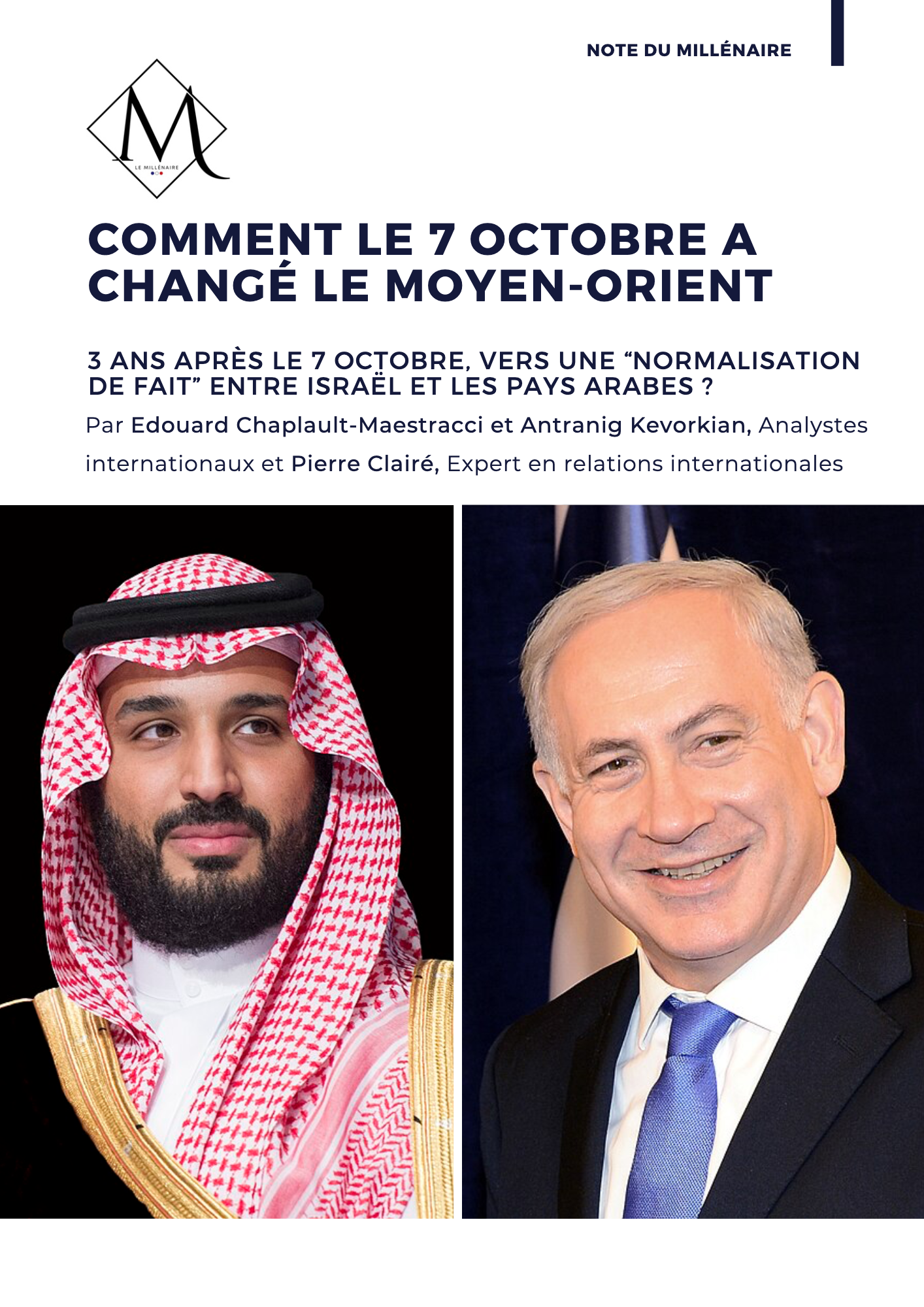 6 octobre 2026Comment le 7 octobre a changé le Moyen-Orient
 10 juin 2026Pierre Clairé, Antranig Kevorkian et Augustin Bataille pour Valeurs Actuelles : « Arménie : l’absence de résultat clair place le premier État chrétien de l’Histoire dans une situation difficile »
 3 juin 2026William Thay et Antranig Kevorkian pour l’AGEFI : « Avec un détroit d’Ormuz atrophié, les Vingt-Sept sous la menace d’une impasse énergétique »
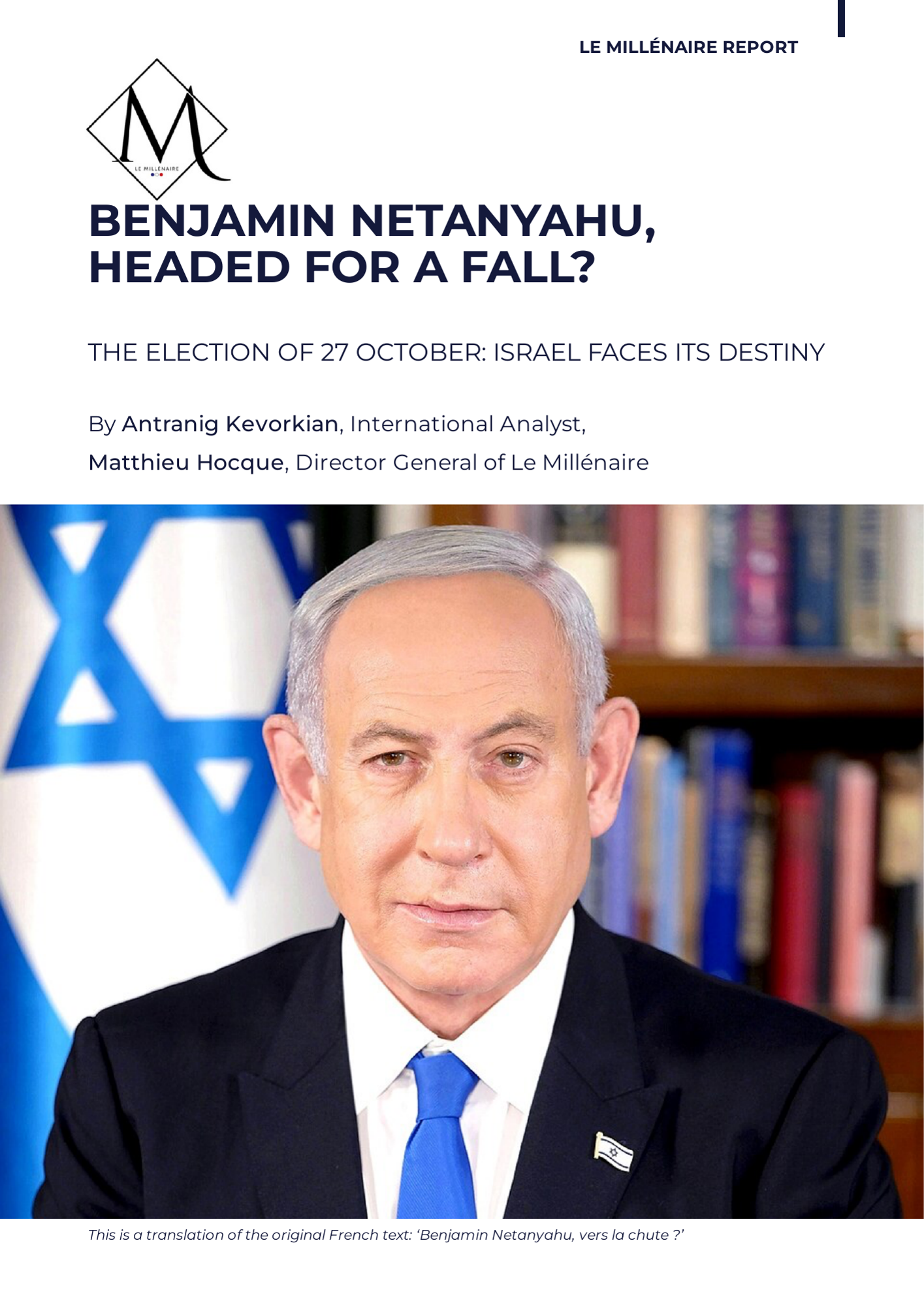
Photo credit: Official portrait of Israel’s 9th Prime Minister, Benjamin Netanyahu, by Avi Ohayon / Government Press Office of Israel, via Wikimedia Commons, licensed under CC BY-SA 3.0.
