
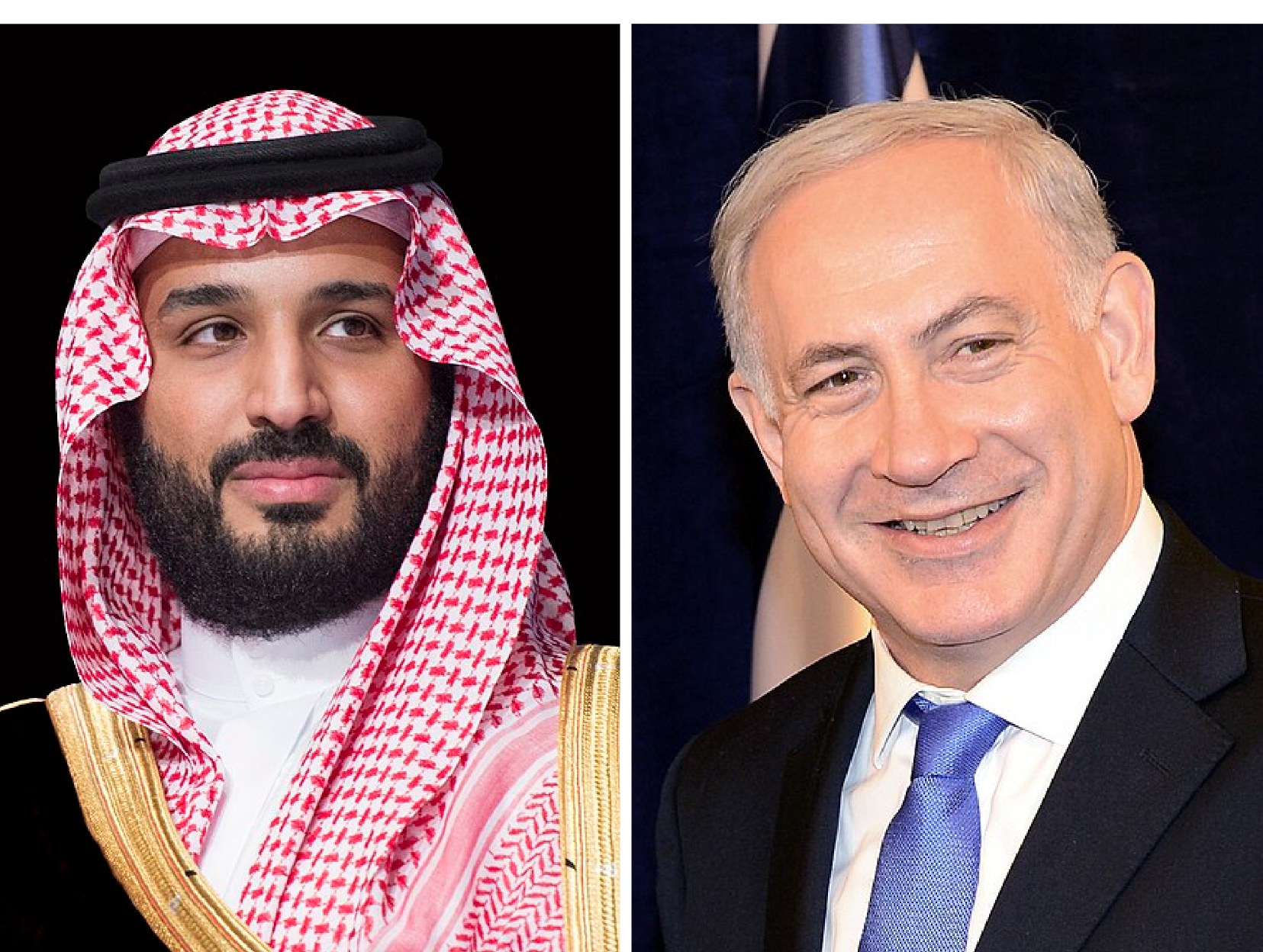
This is a translation of the original French text: Comment le 7 octobre a changé le Moyen-Orient
Three years after 7 October: towards a ‘de facto normalisation’ between Israel and the Arab states?
Three years after 7 October 2023, this briefing note shows how the Hamas attack redrew the lines in the Middle East: Hamas and Hezbollah decapitated, Iran struck, normalisation suspended but the interests of Israel and the Sunni Arab states aligned. It sets out the conditions for a lasting peace and a strategy against Iran’s proxies, its nuclear programme and Daesh.
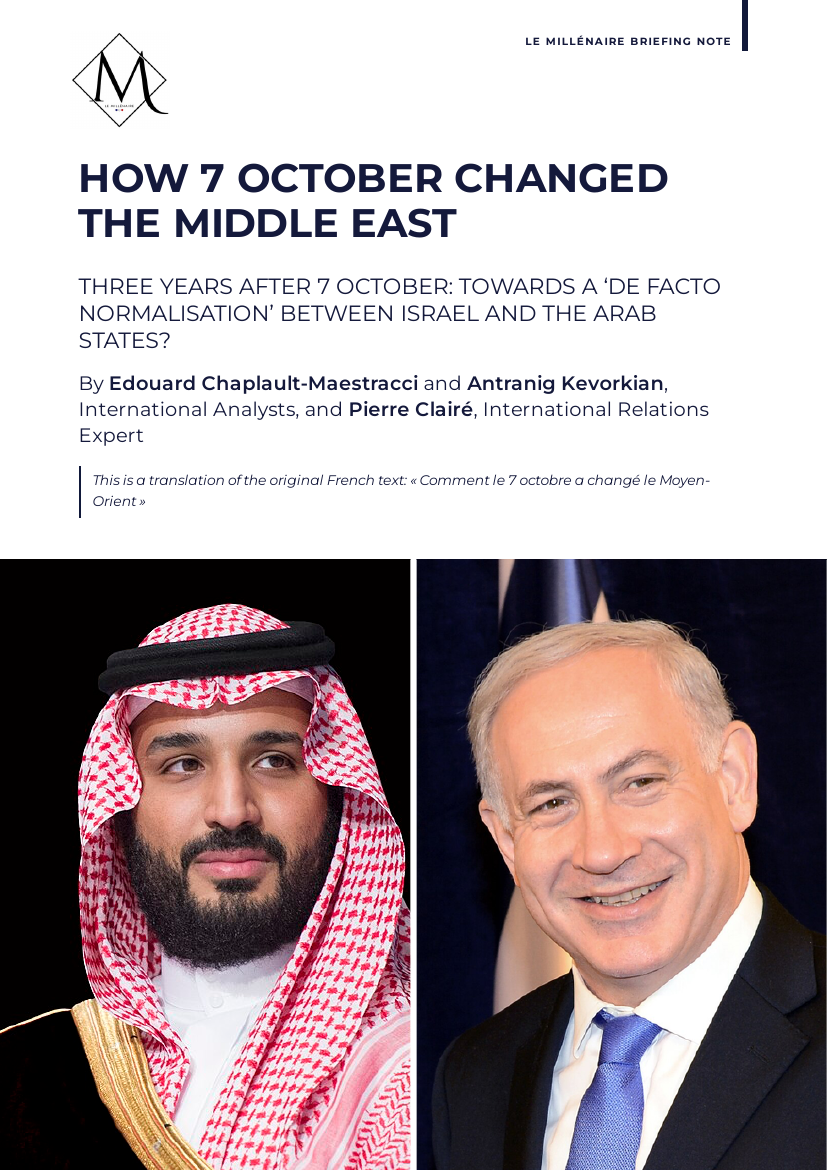
The finding
Three years after 7 October 2023, the balance of power in the Middle East has shifted against Iran and its proxies.
The cause
The Israeli response, followed by the American one, decapitated Hamas and Hezbollah, struck Iran’s nuclear programme and aligned the interests of Israel and the Sunni Arab states.
The consequence
A lasting peace requires sidelining Hamas, reviving normalisation, keeping Iran out of the nuclear club and countering the resurgence of Daesh.
Foreword
Two years ago to the day, Israel suffered the greatest trauma in its history since 1948, when the terrorist group Hamas perpetrated crimes against humanity. The attack triggered not only a war in the Gaza Strip but also a shift in the balance of power across the Middle East. Hamas sought to derail the rapprochement between the Sunni Arab states and Israel. In reality, it aligned the interests of those states by giving them a common enemy: Islamist terrorism, fuelled in particular by Iran’s proxies.
The Middle East holds a place of the first importance in the history of humanity and of civilisations. That it is so often called the ‘cradle of civilisation’ is a reminder that two of civilisation’s essential components first appeared in this region: agriculture and the earliest significant traces of settled life. Research dates the first steps of agriculture to the tenth millennium BC and places them in the ‘Fertile Crescent’, an area particularly well suited to cultivation and settlement because of the fertility of its soils. It was also here, and more precisely in Mesopotamia, that people first put down lasting roots and formed what would later become city-states.
Mesopotamia gave rise to cuneiform writing, so called because of the wedge shape of its signs, which was used from Anatolia to Iran and from Egypt to the Elburz Mountains. It was also the setting for the first trading relationships. Islam, a religion that emerged after Hinduism, Judaism and Christianity, was born at the beginning of the seventh century in the Arabian Peninsula and proved decisive in the rise of the Arab Empire and the spread of its civilisation.
Across the ages, the Middle East has never lost its importance in the global equation, and it matters today more than ever. Just as what happens in North America, and in the United States in particular, shapes the lives of the great majority of the planet’s inhabitants, events in the Middle East resonate considerably worldwide. Whether religious, conflict-related, demographic or cultural, these events receive global media coverage and have equally global consequences. The breathtaking pace of change in communications technology also means that we all now experience the Middle East in real time.
This study sets out to present the developments that rank among the major issues facing the Middle East today. It will of course address the Israeli-Palestinian conflict and its renewed intensity since the terrorist attacks of 7 October, while placing it in the wider context of the ‘shadow war’ that Iran is waging against the State of Israel through regional proxies. These subjects must be both connected and kept distinct. The threat posed by Islamism, in security terms but also politically, will be examined in the light of events in Syria, the transnational network of the Muslim Brotherhood, the record of the ‘war on terror’ and the international coalition against Daesh.
We will try to imagine the future of the Middle East. How can a lasting and fair solution to the Israeli-Palestinian conflict be found? What is the best way to exclude Iran from the nuclear club? How can the ‘Axis of Resistance’ be brought down? What are the best ways to encourage the normalisation of relations between the Arab states and Israel?
Contributions: Pierre Clairé, Deputy Director of Studies, Le Millénaire. Matthieu Hocque, Director General, Le Millénaire.
A divided and complex region
A geopolitical notion. For the authors, the definition of the Middle East long followed the interests of the Western powers rather than geographical criteria. Before the Second World War, France spoke of the Near East to refer to Lebanon and Syria, which were under its mandate. The term Middle East, conceptualised in 1902 by the American strategist Alfred Mahan, later took hold. The note recalls that the Sykes-Picot Agreement of 1916 divided spheres of influence between the British and the French. It did not draw borders.
A conflict at the heart of the tensions. The partition plan adopted by the UN on 29 November 1947 allotted 55 % of the mandate territory to the Jewish state. It passed by 33 votes to 13, with 10 abstentions, and was then rejected by the Arab states. Four Arab-Israeli wars followed, in 1948, 1956, 1967 and 1973, and then two intifadas. On 7 October 2023, 5,000 Hamas terrorists killed 1,200 Israelis and abducted 240. For the note, this conflict is not a war of civilisations. It is a territorial conflict, and neither people should be reduced to a uniform camp.
The religious divide. The region is home to between 350 and 400 million Muslims, 85 to 90 % of whom are Sunni. The note treats the divide between Sunnis and Shias, together with the Israeli-Palestinian conflict, as one of the two keys to understanding the region. Sunni-majority states are the most inclined to draw closer to the West, as the 2020 Abraham Accords show. Iran, the only country where Shiism is the state religion, leads the opposing axis. The authors qualify this picture: Hamas, a Sunni movement, is armed and funded by Tehran, and the Shah’s Iran was aligned with the West.
A powerless Arab League, a retreating America. Founded on 22 March 1945 by six countries, the Arab League now has 22 members. It has never fulfilled its role: Egypt was expelled after its peace with Israel in 1979, and the planned common market never materialised. On the American side, the failure of the interventions in Iraq and Afghanistan sounded the death knell of neoconservatism, according to the note. Donald Trump’s ‘America First’ doctrine is transactional. His Gulf tour in May 2025 reportedly brought in some $2 trillion in investment and pledges.
Israel and the ‘Axis of Resistance’
An Iranian strategy of proxies. Since 1979, the Islamic Republic has made the fight against the United States and Israel its foreign policy priority. To avoid a direct confrontation, it funds, arms and trains movements that share its agenda: Hezbollah in Lebanon, the Houthis in Yemen, the Iraqi Shia militias and Hamas in Gaza. This is the ‘Axis of Resistance’. The note reads the war that began on 7 October through this dual lens. It pits the IDF against Hamas. It is also being fought against Tehran’s regional ambitions.
Hamas weakened. Hamas had around 30,000 fighters before the war. According to documents seized by the IDF, Iran is said to have paid it more than €230 million since 2014. The IDF entered Gaza on 27 October 2023. The movement’s main leaders were killed: Ismail Haniyeh in Tehran, Yahya Sinwar near Rafah, Mohammed Deif, and then Mohammed Sinwar. For the authors, Hamas sought to provoke a deadly response in order to win the media war, exposing the civilians among whom it hides. Challenged by some Gazans and struck as far away as Doha on 9 September 2025, it no longer has any room for manoeuvre.
Hezbollah decapitated. Hezbollah opened fire on Israel the day after 7 October. It then had around 50,000 fighters and is thought to have lost between 2,500 and 4,000 of them. Israel struck more than 1,300 of its targets from 23 September 2024. Hassan Nasrallah was killed on 27 September. The explosion of booby-trapped pagers on 17 September 2024 killed 12 people and wounded more than 2,800. The walkie-talkie blasts the following day killed 20 and wounded 450. The fall of Bashar al-Assad cut off its supply route. Lebanon’s president, Joseph Aoun, is now calling for its disarmament.
The Houthis and the Red Sea. The Houthis are thought to control 60 % of Yemen’s population and to have at least 100,000 fighters, armed in particular by Iran. Most of their fire against Israel is intercepted. The damage they do is above all maritime, since 12 % of maritime trade passes through the Red Sea. Egypt is estimated to be losing around $800 million a month in Suez Canal revenue. After massive American strikes in spring 2025, Washington concluded a bilateral ceasefire with them. That agreement does not protect Israel.
Iran under pressure. Relations between Tehran and Israel turned in 1979. The ‘shadow war’ became direct in April 2024: Iran launched 185 drones, 110 surface-to-surface missiles and 36 cruise missiles, 99 % of which were intercepted according to the IDF. In June 2025, Israel’s Operation ‘Rising Lion’ and then the American Operation ‘Midnight Hammer’ targeted Natanz, Fordow and Isfahan, with 14 GBU-57 bombs. The ‘12-day war’ left more than a thousand dead in Iran and at least 28 in Israel. The Pentagon then estimated that the nuclear programme had been set back by two years at most.
Forces and death tolls in the Middle East since 7 October
Estimated fighters of Iran’s main proxies
How to read: before the war, Hamas had around 30,000 fighters and Hezbollah around 50,000. The Houthis field at least 100,000.
Forces on the ground in Yemen
How to read: a coalition of the recognised government and Saudi and Emirati reinforcements would outnumber the Houthis. The Houthis retain the advantage in equipment and terrain.
Projectiles launched by Iran at Israel, night of 13 to 14 April 2024
How to read: Iran launched 185 drones in its first direct attack on Israel. The IDF reports an interception rate of 99 %.
Death tolls from violence in Syria
How to read: the violence on the Alawite coast in March 2025 left 1,383 dead according to the Syrian Observatory for Human Rights.
The path to a peaceful Middle East is not without difficulties, but it exists.
The Islamist threat, from Syria to the Muslim Brotherhood
Syria after Assad. On 8 December 2024, a coalition led by Hayat Tahrir al-Sham overthrew the regime of Bashar al-Assad in twelve days. The country was emerging from thirteen years of civil war, thought to have claimed 528,500 lives. The population is 70 % dependent on humanitarian aid. The new leader, Ahmed al-Sharaa, a former jihadist who presents himself as reformed, promises to keep the country united. The note doubts that he controls the most radical elements of his coalition. It fears that a new phase of instability could give Daesh fertile ground comparable to that of 2014.
Minorities under threat. In March 2025, violence on the Alawite coast left 1,383 dead according to the Syrian Observatory for Human Rights. In July, in Sweida, clashes between Druze and Bedouin clans left 1,311 dead and 128,000 displaced. Among the victims, 194 people were summarily executed by members of the government forces. Israel, home to 150,000 Druze, bombed military targets in Damascus. For the authors, the centralisation sought by Damascus seems premature. A federal arrangement, leaving security in the hands of the minorities that ask for it, cannot be ruled out.
The Muslim Brotherhood, a transnational political Islamism. Founded in 1928 by Hassan al-Banna, the organisation seeks an Islamic state governed by sharia, to be achieved through the gradual Islamisation of society. It had more than 500,000 members by the end of the 1940s and spread to Syria, Iraq and Palestine, where Hamas emerged from a split in 1987. Egypt, Russia as early as 2003, Saudi Arabia, the United Arab Emirates and Bahrain in 2014, and later Jordan have banned it. Austria listed it in 2021. For the note, France and the other European countries must ban it in turn and designate it a terrorist group.
The risk of infiltration in Syria. The note fears that the organisation will use Syria’s uncertainties to regain influence. It could support armed groups opposed to the unification sought by Damascus. Turkey and Qatar, presented as its main financial backers, could weigh on reconstruction. For the authors, the lifting of sanctions by Washington and Brussels offers another source of funding. It should be used to counter the economic influence of Ankara and Doha.
The road to peace: a Palestinian solution and normalisation
Plans judged inadequate. For the authors, Resolution 181, which remained a dead letter, partly explains the wars that followed. The Cairo plan of March 2025, worth $53 billion over five years, entrusted Gaza to a committee and then to the Palestinian Authority. The note rejects it. It does not settle the fate of Hamas, and the Palestinian Authority suffers from a deep lack of trust. The proposals of Ehud Olmert and Nasser al-Kidwa, which notably offer a choice to some 70,000 West Bank settlers, run into the same obstacle.
The conditions for a lasting peace. The note’s first condition is the return of all the hostages. Hamas and the groups behind 7 October must be excluded from all political life, and their leaders exiled. The Palestinian state must be demilitarised. Its security would rest on a UNIFIL-type force on its borders and on a coalition bringing together the United States and the Arab countries that have normalised their relations with Israel. This coalition would manage the transition until elections are held. Recognition would come only afterwards. For the authors, recognising a Palestinian state with Hamas in power would be a ‘reward for terrorism’.
The Trump plan, amended. According to the note, the plan put forward by Donald Trump meets many of these conditions. The authors add an ad hoc court, modelled on the Nuremberg tribunal, to try members of Hamas. The amnesty provided for in the plan seems to them unacceptable to Israel. They call for any country taking part in reconstruction to have first normalised its relations with Israel. France’s recognition of a Palestinian state on 22 September 2025, without expressly excluding Hamas, was seen by Israel as a betrayal.
Reviving normalisation. Egypt in 1979 and Jordan in 1994 led the way. The Abraham Accords followed in 2020 with the United Arab Emirates, Bahrain and Morocco, and Sudan announced an agreement in 2023. The war in Gaza froze the process: Saudi Arabia rules out any normalisation without a Palestinian state. The note nevertheless sees openings. Lebanon, for now, distinguishes between peace and normalisation. Ahmed al-Sharaa’s Syria is considering a step-by-step rapprochement, starting with a security agreement modelled on the 1974 disengagement on the Golan.
states recognise the State of Palestine. Yet for the authors, it will not exist without the agreement of the United States and Israel.
Neutralising Iran’s proxies, its nuclear programme and Daesh
Disarming Hezbollah, neutralising the Houthis. In the municipal elections of May 2025, the Amal-Hezbollah lists won 102 of the 272 councils at stake in South Lebanon and Nabatieh in the first round. The IDF estimates that it has destroyed 80 to 85 % of Hezbollah’s strike capability. The note makes the state’s monopoly on arms a priority before the 2026 legislative elections, with lasting Western support for the Lebanese army. Against the Houthis, it advocates a coalition backed by Saudi Arabia and the Emirates, large-scale strikes and cutting off their funding, including by putting pressure on Oman.
Iraq and the rearming of the militias. The Iraqi Shia militias, grouped within the Popular Mobilisation Forces, form a ‘state within the state’. The Badr Organisation alone has 20,000 men. From October 2023 to January 2024, more than 140 attacks targeted American or coalition soldiers. Iran continues to arm its proxies: 750 tonnes of missiles and drones bound for the Houthis were seized on 16 July 2025. The Lebanese border, some 400 km long, has more than 130 smuggling routes. The note therefore considers it premature to believe that the ‘Axis of Resistance’ is in decline.
Keeping Iran out of the nuclear club. The 2015 JCPOA capped enrichment at 3.67 % and the stockpile at 300 kilograms, for only fifteen years. On 12 June 2025, the IAEA declared that it could not establish the ‘exclusively peaceful’ nature of the programme. The note first advocates the restoration of sanctions through the snapback mechanism, which has now been achieved. It then wants a treaty with no time limit: an end to all enrichment, the destruction of uranium and ballistic missile stockpiles, and no-notice inspections of any military site. Any breach would trigger intervention by a coalition.
Countering the resurgence of Daesh. Daesh lost its physical caliphate in 2019, after more than 13,000 coalition strikes. It still strikes, as at Crocus Hall in Moscow on 22 March 2024, with 145 victims, and it inspires ‘lone wolves’. The note wants to use the lifting of sanctions on Syria as leverage: monitoring the integration of 3,500 foreign jihadists into the army, protecting minorities, training Syrian units in counter-terrorism with the European Union, re-forming a coalition and opening direct intelligence channels.
How 7 October reshaped the region
An Israeli election shaped by 7 October. Israelis go to the polls on 27 October 2026, in the first legislative elections since the attack. For the note, the debate is about Benjamin Netanyahu’s ministerial responsibility, not his personal responsibility. He can point to results: the last hostages were released in October 2025 and the expulsion of Hamas from the Gaza Strip has been agreed. Gaza nevertheless remains a security problem. The events of 7 October also complicate the alliance of the left and the centre with the Arab parties, which hold around 10 % of the Knesset.
The Trump plan and its last obstacles. The State of Palestine is recognised by 148 states. According to the authors, it will not exist without the agreement of the United States and Israel. Donald Trump’s peace plan has been weakened by the war against Iran, and two obstacles remain. The first concerns security: Hezbollah rejects the 14-point framework agreement signed in Washington on 26 June 2026 by Israel and Lebanon, which bars non-state actors from any military action. The second is the E1 project, 3,400 housing units east of Jerusalem that would cut the West Bank in two.
A region shaken by the war against Iran. The third anniversary falls in the midst of the war against Iran. In nearly 40 days, Israel and the United States have carried out some 24,000 strikes. The 440 kilograms of enriched uranium remain unaccounted for, and the regime is holding on despite the death of the Supreme Leader, Ali Khamenei. Iran has closed the Strait of Hormuz, through which around 20 % of the world’s oil used to pass, and is striking American bases in the region. The Palestinian question is slipping down the Gulf states’ agenda. For the note, the ineffectiveness of the ‘Mecca Pact’ of 7 August 2026 raises hopes of extending the Abraham Accords.
Conclusion. For the authors, the immediate priority is to end the conflict between Israel and Hamas and to achieve a lasting peace, through the Trump plan amended as they propose. Normalisation must lead to a broad alliance against Islamist terrorism, from which France would benefit. The ‘Axis of Resistance’ must be put out of action. Iran must be kept out of the nuclear club by a highly restrictive agreement, backed if necessary by a military coalition. The note concludes that a path towards a peaceful Middle East exists.
Our proposals
Proposal 1. Ban the Muslim Brotherhood in France and Europe. Following the example of several Middle Eastern countries, ban the organisation and designate it a terrorist group. Prevent its infiltration in Syria.
Proposal 2. Remove Hamas from all power. Permanently exclude Hamas and the terrorist groups of 7 October from Palestinian governance and political life, exile their leaders and activists, and secure complete disarmament under the supervision of an international coalition.
Proposal 3. A demilitarised but protected Palestinian state. Entrust border surveillance to a peacekeeping operation modelled on UNIFIL, and internal security to a coalition bringing together the United States and Arab countries that have normalised their relations with Israel.
Proposal 4. Conduct a ‘de-Hamasification’ campaign. Undo the indoctrination inflicted by Hamas on the Palestinian population since it came to power in 2006.
Proposal 5. A transition managed by an international coalition. Set aside the Palestinian Authority and entrust political management and reconstruction to a coalition, without Israel, Syria, Lebanon, Iran, Turkey or Qatar, until non-militarised parties are created and supervised elections are held. Gazans would be temporarily relocated during reconstruction, with the option of returning.
Proposal 6. Fund the Palestinian state through Gaza’s economy. Secure the future state’s budgets and the repayment of the countries involved in reconstruction from the revenue of activities developed in a demilitarised and rebuilt Gaza Strip.
Proposal 7. Create a tribunal modelled on Nuremberg. Try the members of Hamas and of any organisation involved in the crimes of 7 October. This ad hoc court must complement the Trump plan, whose amnesty seems unacceptable to Israel.
Proposal 8. Dismantle UNRWA. Entrust the management of humanitarian aid to a new organisation.
Proposal 9. Link reconstruction to normalisation. Reserve participation in the reconstruction of Gaza and of the future Palestinian state for countries that have already normalised their relations with Israel.
Proposal 10. Ensure the demilitarisation of Hezbollah. Secure the Lebanese state’s monopoly on arms as quickly as possible, before the 2026 legislative elections, sustain Western support for the Lebanese army and foster political pluralism in Lebanon.
Proposal 11. Neutralise the Houthi threat. Re-form a coalition backed by Saudi Arabia and the United Arab Emirates and supported by large-scale strikes, cut off the Houthis’ financial backing, including through measures targeting Oman, and have Israeli ships escorted by the US Navy.
Proposal 12. Settle the future of Iraq. Bring under control the Iraqi Shia militias, Tehran’s proxies that largely escape the authority of the Iraqi government.
Proposal 13. Stop Tehran from rearming its militias. Pursue a containment strategy so that Iran stops arming and funding its proxies, as seizures of arms shipments multiply.
Proposal 14. Keep Iran out of the nuclear club. Following the restoration of sanctions through the snapback, impose a treaty with no time limit: an end to all enrichment, the destruction of uranium and ballistic missile stockpiles, and no-notice inspections. Any breach would trigger intervention by a coalition.
Proposal 15. Counter the resurgence of Daesh. Make the lifting of sanctions on Syria conditional on its cooperation, protect minorities, train Syrian units in counter-terrorism, re-form a coalition and open direct intelligence channels.
Chaplault-Maestracci E., Kevorkian A., “How 7 October Changed the Middle East”, Le Millénaire Note, 6 October 2026, lemillenaire.org.
Browse the note
Edouard Chaplault-Maestracci et Antranig Kevorkian
International Analyst, Le Millénaire ; International Analyst, Le Millénaire.
Edouard Chaplault-Maestracci Antranig KevorkianRequest an interview
For an interview with Edouard Chaplault-Maestracci ou Antranig Kevorkian about this note: presse@lemillenaire.org
Contact the press officeKeep our research going
Your donations and memberships fund Le Millénaire’s next briefing notes.
Support us Become a memberReceive Le Millénaire’s next briefing notes
Further reading
All studies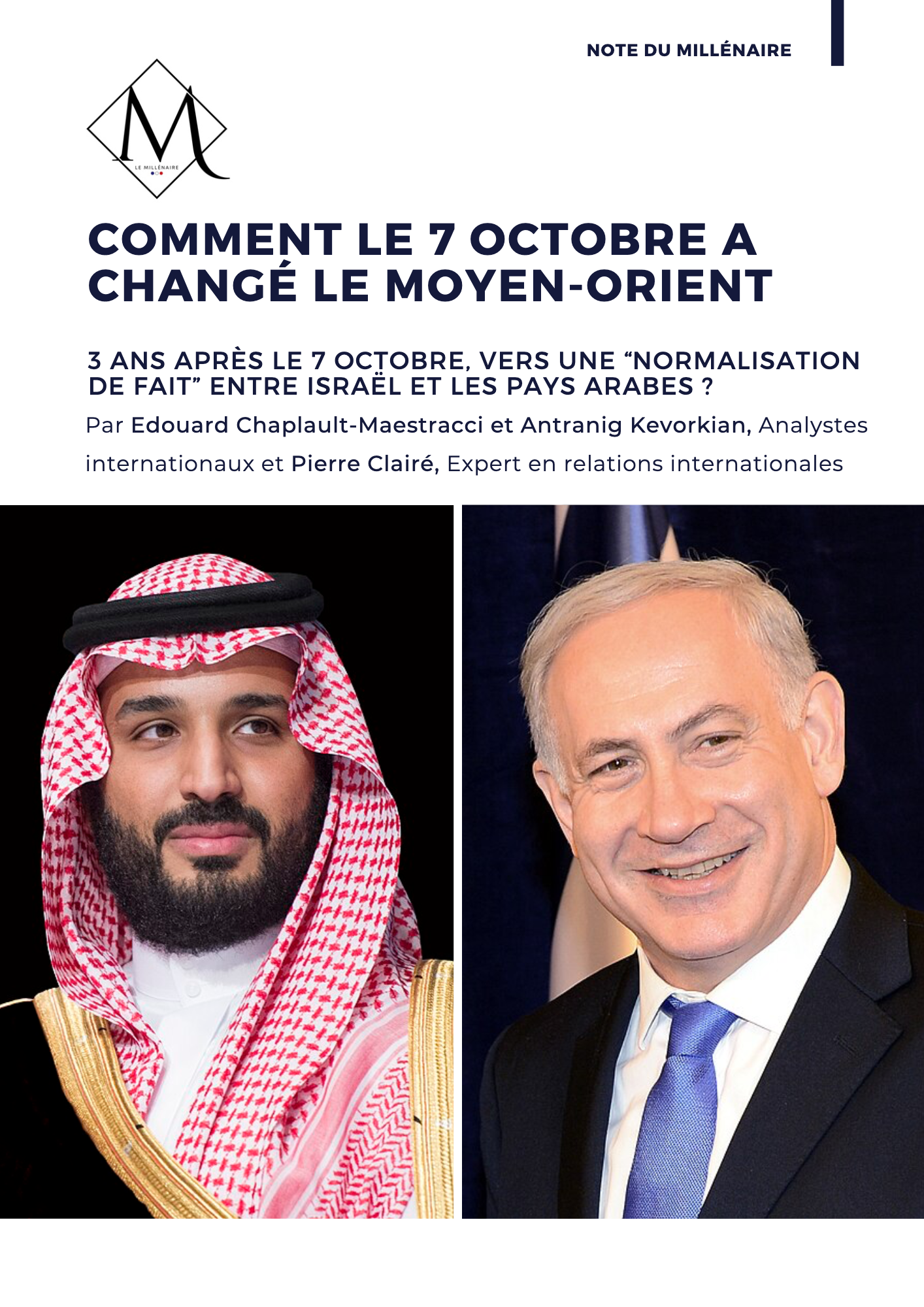 6 October 2026Comment le 7 octobre a changé le Moyen-Orient
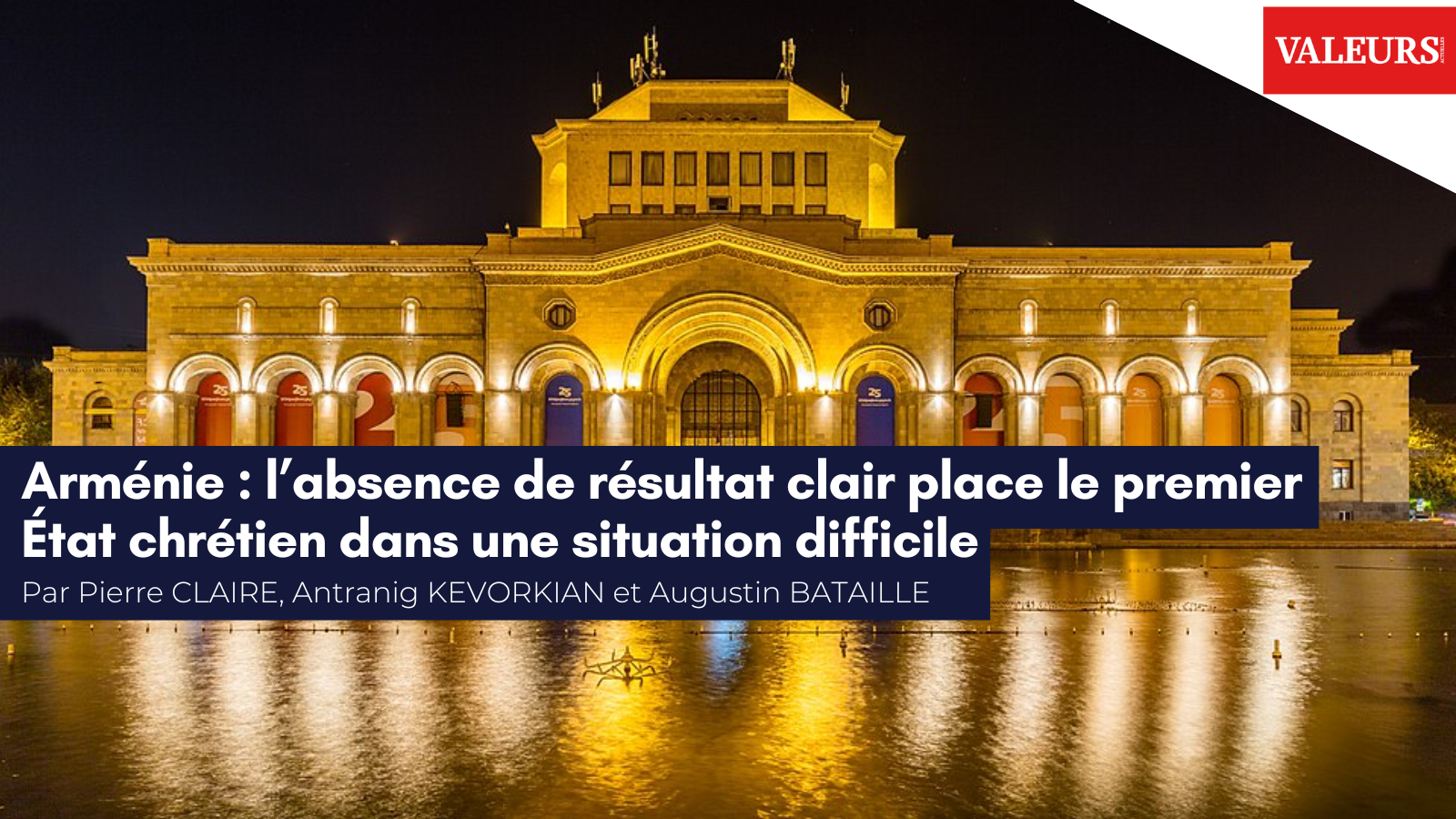 10 juin 2026Pierre Clairé, Antranig Kevorkian et Augustin Bataille pour Valeurs Actuelles : « Arménie : l’absence de résultat clair place le premier État chrétien de l’Histoire dans une situation difficile »
 3 juin 2026William Thay et Antranig Kevorkian pour l’AGEFI : « Avec un détroit d’Ormuz atrophié, les Vingt-Sept sous la menace d’une impasse énergétique »
 1er avril 2026Pierre Clairé, Sean Scull et Antranig Kevorkian pour Valeurs Actuelles : « L’escalade en Iran : sursaut ou tombeau pour Donald Trump ? »
Photo credit: Benjamin Netanyahu 2012, by U.S. Department of State, via Flickr and Wikimedia Commons, public domain building CC0 photo. الصورة الرسمية للأمير محمد بن سلمان بن عبد العزيز آل سعود, by Saudi Press Agency, via Wikimedia Commons, licensed under CC BY-SA 4.0.
