
This is a translation of the original French text: Élections au Brésil : vers une nouvelle bascule ?
Why Lula’s results do not necessarily translate into electoral gains
On 4 October 2026, 158.7 million Brazilians elect their president and nearly 1,650 other officials. Unemployment, inflation, homicides and deforestation are all falling. Yet Lula remains in a statistical tie with Flávio Bolsonaro. The note explains this paradox by the cost of living and voter weariness, then sets out the scenarios and the stakes of the election.
The finding
Despite a solid economic and social record, Lula is in a statistical tie with Flávio Bolsonaro in second-round polls.
The cause
The high cost of everyday life, weariness with polarisation and the memory of past judicial battles overshadow the record.
The consequence
The second round on 25 October will decide whether Brazil aligns with the South American right, and shape its relations with Washington and Brussels.
Foreword
On 4 October 2026, Brazilians will elect, on a single day, their president, 27 governors, 54 senators, 513 federal deputies and more than a thousand state deputies. Nearly 1,650 offices filled in one day, with the result known that same evening: few democracies are capable of such a feat. And rarely has a Brazilian election been so closely fought, or so closely followed abroad.
The outgoing president, Lula, was expected to run from a position of strength, but nothing is that simple. He does not exceed 40 % of first-round voting intentions in most polls, and his disapproval rating exceeds his approval rating. Most Brazilian polling institutes, though they name different winners, all conclude that he is in a statistical tie with Flávio Bolsonaro once margins of error are taken into account. This is a paradox, given that Lula’s economic and social record is fairly solid, and that his opponent is none other than the son of a man sentenced in September 2025 to twenty-seven years and three months in prison for attempting a coup d’état.
The 2026 election will therefore not be decided on the record or on macroeconomic improvements. It will be decided on daily life, which is not so surprising in light of other recent elections. To understand what is at stake, and to read the presidential contest of 4 and 25 October, it would be unwise to rely solely on Lula’s record. Paradoxically, Brazil is a country where every indicator is improving but voters do not see it, and that is precisely where the problem lies.
Brazil’s 2026 figures are those of a country on the mend: unemployment, inflation, homicides and poverty are all falling, and deforestation is slowing. Yet these are only figures to voters who live a very different life and run up against a harsh reality. Brazil’s debt has risen under Lula and has reached its highest level in five years. The budget deficit is one of the highest in South America, the price of two years of deliberately tight monetary policy, with the policy rate still at 13.75 % after five successive cuts. And the basic food basket rose in price in all twenty-seven state capitals between January and March 2026. Macroeconomic disinflation is real, but it has not yet reached the supermarket checkout. Lula is also rather unpopular.
A large share of voters say they are tired of, or uneasy about, the political climate in their country, and an overwhelming majority believe that polarisation directly affects the election. This weariness raises fears of abstention and of blank or spoiled ballots, which would be remarkable in a country used to high turnout and where voting remains compulsory. What would seem normal in many countries would carry particular weight in Brazil.
It would be too easy to reduce this election to a purely Brazilian affair, for its implications are far-reaching. It is taking place against a general rightward shift across Latin America, in the wake of a Donald Trump seeking to push his “Donroe Doctrine” in a region he regards as strategic. If Lula wins, Brazil would remain isolated on the subcontinent. If Bolsonaro wins, it could be drawn into the Trumpist sphere of influence. The tariffs that Washington still imposes on Brazil, in a different form since the summer, show Donald Trump’s interest in this election.
Europeans should not ignore the election either, in light of the recent agreement between the EU and MERCOSUR (which, admittedly, has yet to be ratified). Since Lula and Flávio hold different views on trade and regulation, the presidential election could have significant consequences. And then there is France, whose longest land border is with Brazil.
In the end, the polls do not point to a favourite. But by examining the state of Brazil on the eve of the election, we can better understand what is at stake.
Also available in French.
By Pierre Clairé, Deputy Director of Studies, Le Millénaire
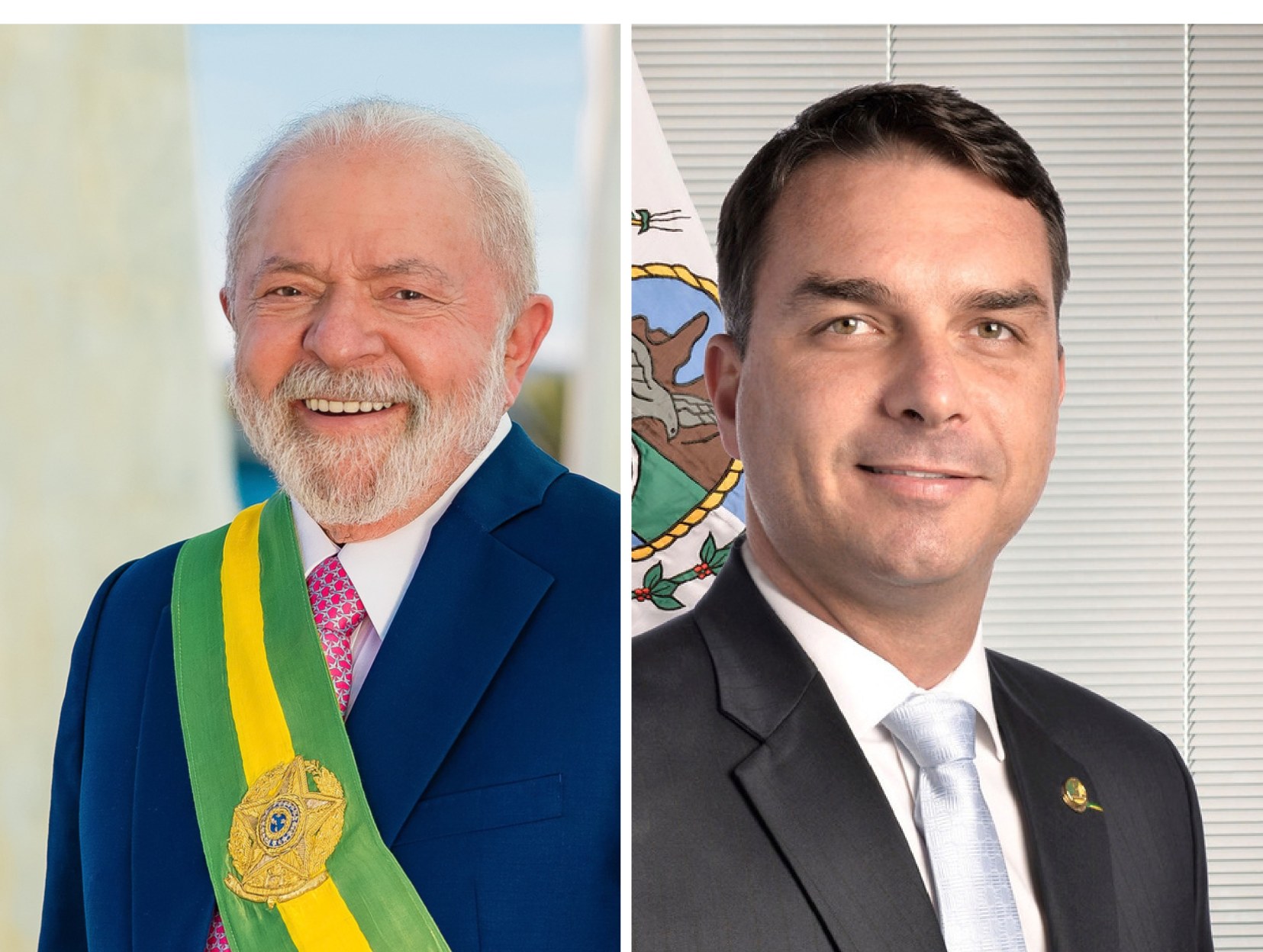
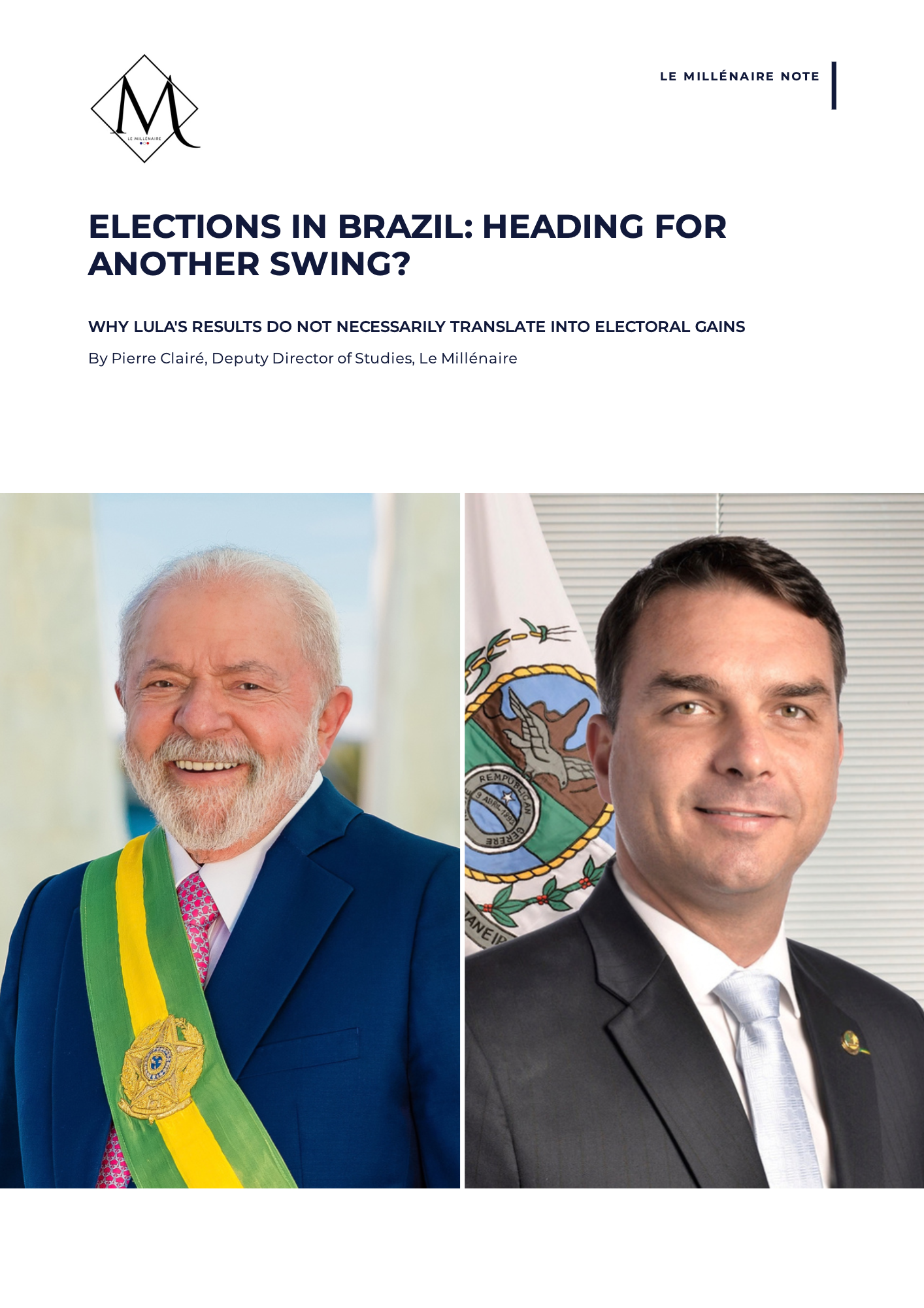
Photo credits: Flavio Bolsonaro, via Flickr by Agencia Senado, CC BY 2.0. Luis Inacio Lula da Silva, via Wikimedia Commons, CC BY 2.0.
A country doing better, voters who do not believe it
Indicators in the green. On 4 October 2026, more than 158.7 million Brazilians are called to the polls. Almost all the main indicators are improving at once: unemployment at a record low, inflation back down, homicides at their lowest since 2012, Amazon deforestation sharply down. Yet the outgoing president does not exceed 40 % of voting intentions in most polls. His disapproval rating exceeds his approval by seven points. For the author, the figures describe a country that is doing better. The voter describes a country that has had enough.
Growth running out of steam. In 2025 the economy recorded its second year of robust growth, 2.3 % according to the OECD against 3.4 % in 2024. The pace is slowing in 2026: +1.1 % in the first quarter, +0.5 % in the second, and between 1.6 % and 1.9 % expected for the year. This is the price of a monetary policy kept tight. The Selic rate, which rose as high as 15 %, has come down to 13.75 % after a fifth cut in September. Gross public debt stands at 82.5 % of GDP, up more than ten points since Lula took office. The budget deficit amounts to 9.34 % of GDP, of which 8.67 points are interest.
The supermarket rather than the statistics. Inflation is under control: 4.22 % over twelve months in August, its lowest in four years, against a target of 3 %. Food accounts for 21.5 % of the IPCA basket and tells a different story. The basic food basket rose in price in all twenty-seven state capitals between January and March 2026. In São Paulo it exceeded 906 reais in April, more than half the minimum wage, even though the latter was raised to 1,621 reais on 1 January. Unemployment fell to 5.4 % in the second quarter. The note concludes that disinflation has not yet reached the supermarket checkout.
Security and forests: successes that do not sell. The 20th Anuário Brasileiro de Segurança Pública records 40,775 intentional violent deaths in 2025, or 19.1 per 100,000 inhabitants, down 8.2 %. The same year saw a record in police misconduct, a rise in femicides and an explosion in cybercrime. Between August 2025 and July 2026, Amazon deforestation alerts fell by 36.87 %, to their lowest since 2016. Brazil showcased this result at COP30 in Belém. In a campaign dominated by purchasing power, it takes a back seat.
A weary electorate. 43 % of voters say they are tired of or uneasy about the political climate, seven points more than before. 71 % believe polarisation directly affects the election. Between 2010 and 2022, abstentions, blank and spoiled ballots accounted for between 24 % and 27.5 % of registered voters in the first round. In the Futura Inteligência poll in June, answers of “nobody”, blank or spoiled reached up to 16.4 % depending on the scenario. In a country where voting is compulsory, the author sees a fall in turnout as a political signal in itself.
of Brazilian voters say they are tired of or uneasy about the political climate, seven points more than before.
Lula’s third term and the ghosts of the past
A solid social record. In July 2025 Brazil left the FAO Hunger Map, a result first achieved in 2014. Twenty-four million people escaped severe food insecurity in the very first year of the term. Extreme poverty fell back to 4.4 % in 2023, its absolute minimum. In 2024 the Gini index reached its historic low of 0.506. Bolsa Família, the cash-transfer programme relaunched in the first days of the term, pays at least 600 reais a month to 54 million Brazilians, or 18.7 million families. For the author, the success is real. It is not enough.
Slow reforms and a global presence. The tax reform adopted in 2023, the most ambitious since the 1988 Constitution, replaces five taxes with a dual VAT, the IBS and the CBS. The Nova Indústria Brasil policy saw its budget rise from 300 billion to more than 750 billion reais between 2023 and 2026. Their benefits are not yet being felt. On the international stage, Brazil chaired the G20 in 2024 and the BRICS in 2025. It hosted COP30 in Belém, where 195 countries approved the “Belém Package”. Few Brazilian presidents have occupied the world stage for so long.
A president who cannot sell his record. According to Datafolha, Lula’s approval never exceeded 38 % in 2023, before falling to 24 % in February 2025. In March 2026, PoderData recorded a record disapproval rating of 61 %. AtlasIntel then showed Lula losing a second-round simulation against Flávio Bolsonaro for the first time, when he had been twelve points ahead three months earlier. For the author, the election layers two judgements. The first is a referendum on the incumbent, judged by the cost of living. The second, as in 2018 and 2022, is a referendum on democracy.
Ten years of judicial battles. On 31 August 2016, the Senate removed Dilma Rousseff by 61 votes to 20 over budgetary manoeuvres, the pedaladas fiscais. The Supremo Tribunal Federal (STF, Supreme Federal Court) rejected all her appeals. The left has spoken of an institutional coup ever since. Lula was arrested on 7 April 2018 and spent 580 days in a cell in Curitiba. In March 2021, the courts annulled his convictions for lack of jurisdiction. In June, the STF found that the judge who had convicted him was biased. Jair Bolsonaro then cast doubt on the reliability of the electronic voting machines, without ever producing proof of fraud.
Each camp has its martyr. One week after Lula’s inauguration, thousands of Jair Bolsonaro’s supporters stormed and ransacked Congress, the Planalto Palace and the STF building. Three years later, the STF had opened 1,745 criminal proceedings and handed down 835 convictions. On 11 September 2025, it sentenced Jair Bolsonaro to 27 years and three months in prison for attempting a coup d’état, by four votes to one. The former president has been serving his sentence at home since March 2026 and remains ineligible. 58 % of Brazilians believe polarisation weakens democracy. For the author, on 4 October they will choose between two memories.
How Brazil votes, and who votes for whom
Six choices in one day. The 1988 Constitution makes voting compulsory from 18 to 70, on pain of an almost symbolic fine of between 1.05 and 3.51 reais per round. With more than 158.7 million registered voters, 2.3 million more than in 2022, Brazil holds one of the largest elections in the world. Turnout reached 79 % in both rounds of the last two presidential elections. On 4 October, each voter makes six choices: president, governor, two senators, one federal deputy and one state deputy. Nearly 1,650 offices are at stake that day, with nearly 21,000 candidacies.
Two electoral logics. The president and governors are elected by two-round majority voting. Without an absolute majority, a second round is held on 25 October. In the Senate, the two candidates with the most votes in each state win: 54 of the 81 seats are renewed in 2026. The 513 deputies are elected by proportional representation, using a quotient calculated state by state. The electronic voting machine, introduced in 1996, is not connected to the internet, and no fraud has ever been proven. The result is known the same evening. Brazil has no midterm elections, which strengthens local incumbents.
The regional races to watch. In São Paulo, the country’s largest electorate with 34.1 million registered voters, the incumbent governor Tarcísio de Freitas (Republicanos) faces Fernando Haddad (PT), whom he had already beaten in 2022. In Rio de Janeiro, the former mayor Eduardo Paes (PSD) is well ahead of Douglas Ruas (PL) and Anthony Garotinho (Republicanos). In Minas Gerais, Mateus Simões (PSD) faces Senator Cleitinho Azevedo and Alexandre Kalil (PDT). Nine of the twenty-seven incumbent governors are seeking re-election. 437 of the 513 federal deputies, or 85.2 %, are standing again.
The Nordeste, key to the election. In 2022, Lula won 69.34 % of the valid votes there in the second round. That gap supplied most of his national victory, won by a little over 2.1 million votes. A PoderData/Aya poll from September 2026 gives him only 58.5 % in the region against Flávio Bolsonaro, nearly eleven points less. The North partly compensates, with a gain of 8.9 points since 2022. The South remains the right’s bastion: Jair Bolsonaro won 54.6 % there in the first round of 2022, against 36.8 % for Lula. In the Sudeste, the PT gained nearly 7.8 million votes between 2018 and 2022.
Religion and age. Evangelicals made up 26.9 % of the population in the 2022 census, or 47.4 million people, against 22 % in 2010. According to AtlasIntel, in May 2026 Flávio Bolsonaro had 58.6 % of voting intentions in this electorate, against 23.7 % for Lula. The evangelical parliamentary front claims 209 deputies and 26 senators. The agricultural front brings together some 343 parliamentarians. Age is becoming the most volatile divide. Lula won 61 % among 16-24-year-olds in the second round of 2022. In April 2026, several institutes put him at around 36 % in this age group in the first round, against about 35 % for Flávio Bolsonaro.
The candidates and the polls
Lula, the continuity candidate. The outgoing president, aged 80, is seeking a fourth term with the same vice-president, Geraldo Alckmin (PSB). His coalition brings together the PT and seven other parties, from the moderate wing of the PT to the PSOL. His 84-page programme has thirteen pillars, and the word sovereignty appears on 21 pages. It plans to consolidate Bolsa Família, Pé-de-Meia, the New PAC and Nova Indústria Brasil, protect strategic minerals and deepen the BRICS. If re-elected, Lula would be sworn in on 5 January 2027 at 81 years and two months. A fourth victory would put him level with Franklin Delano Roosevelt or Hugo Chávez.
Flávio Bolsonaro: security and a single term. Senator Flávio Bolsonaro, 45, the former president’s eldest son, is contesting his first presidential election. His 76-page, nine-pillar programme focuses on security: lowering the age of criminal responsibility from 18 to 16, chemical castration for repeat sex offenders, classifying criminal factions as narco-terrorists, and five high-security federal prisons. He promises tax cuts and the abolition of at least ten ministries, and proposes ending presidential re-election, including for himself. For the author, this single term reassures the centrão and opens the way in 2030 for Michelle Bolsonaro or Tarcísio de Freitas.
Four candidates in search of transfers. Ronaldo Caiado (PSD), former governor of Goiás, embodies the hard right on security and is stuck at 4-5 %. Romeu Zema (Novo), former governor of Minas Gerais and the anti-polarisation candidate, hovers around 1-1.5 %. Augusto Cury (Avante), a writer with no electoral experience, rose to 10 % after the debate of 23 August and has fallen back to between 2 % and 5 %. Renan Santos (Missão), co-founder of the Movimento Brasil Livre, defends an ultra-liberal and conservative line. According to Quaest, 41 % of Cury’s voters, 50 % of Renan Santos’s and 46 % of Caiado’s would choose Flávio Bolsonaro in the second round. Zema’s voters prefer Lula, by 38 % to 32 %.
Vice-presidents who matter. Geraldo Alckmin, 73, former governor of São Paulo and a historic rival of the PT, serves as a guarantee of moderation for the markets and the centre. The post is no formality: Itamar Franco in 1992 and Michel Temer in 2016 ended up in power after the fall of their head of ticket. Alfredo Gaspar, 56, Flávio Bolsonaro’s running mate, was a prosecutor for twenty years and twice secretary of public security of Alagoas. He was rapporteur of the parliamentary commission of inquiry into fraud at the INSS. As the note puts it, one is there to reassure, the other to arm.
Polls to be read with caution. At the end of September, Quaest has the two candidates at 42 % in the second round. Datafolha puts Lula at 47 % against 45 %. AtlasIntel gives Flávio Bolsonaro 47.7 % against 47.6 %. In all three cases, the gap lies within the margin of error. In 2022, Datafolha and Ipec gave Lula a fourteen-point lead in the first round. The result was 48.4 % against 43.2 %. A crisis that erupted at the STF on 1 September adds to the uncertainty. According to AtlasIntel, 52 % of voters think it mainly hurts Lula. According to Datafolha, 85 % say it will not change their vote.
The Brazilian election in figures
Second-round voting intentions, late September 2026
How to read: according to Datafolha (22-23 September), Lula has 47 % against 45 % for Flávio Bolsonaro. All three gaps lie within the margin of error.
Second-round transfers from minor candidates’ voters
How to read: according to Quaest (10-13 September), 50 % of Renan Santos’s voters would choose Flávio Bolsonaro in the second round, and 18 % Lula.
Seats at stake on 4 October 2026, excluding the presidency
How to read: on 4 October, 513 federal deputy seats are renewed, along with 54 Senate seats and 27 governorships.
Brazil’s economic indicators, in %
How to read: twelve-month inflation stood at 4.22 % in August 2026. Gross debt and the deficit are expressed as % of GDP.
On 4 and 25 October, more than 158 million Brazilians will not be choosing between two records. They will be choosing between two forms of weariness.
Stakes, scenarios and conclusion
A second round all but certain. Since the return of democracy, only Fernando Henrique Cardoso has won in the first round, in 1994 and 1998. Even Lula reached only 48.61 % in 2006. The latest polls put Lula between 39 % and 45 % and Flávio Bolsonaro between 34 % and 42 %. The four other candidates share 10 % to 13 % of the vote. For the author, the question on 4 October is therefore who comes first, and by how much. On 25 October, transfers will matter, and they lean clearly towards Flávio Bolsonaro. They are his main reserve of votes.
Governing a fragmented Congress. Congress has 22 parties. Flávio Bolsonaro’s PL holds 113 seats, Lula’s PT 74. Between the two, a bloc of 350 deputies and 57 senators is negotiated case by case, in posts, budget and amendments. The winner will inherit the reform of indirect taxation, in its test phase since 1 January 2026 and due to be completed in 2033. He will also inherit the file of the amnesty for those convicted over 8 January. The so-called dosimetria law, which reduces their sentences, was promulgated on 8 May 2026 and then suspended pending a ruling by the STF. Under Lula, the amnesty would remain blocked. Under Flávio Bolsonaro, it would become a priority.
A Brazil isolated in its region. Since 2023, Argentina, Bolivia, Peru and Colombia have swung to the right, as has Chile with José Antonio Kast. Brazil remains, with Uruguay, one of the last countries governed by the left. On 25 July, Javier Milei called for a vote for Flávio Bolsonaro at the PL convention, and Brasília recalled its ambassador in Buenos Aires. Lula defends a Mercosur with common rules. Milei wants to make it a mere free-trade zone. For the author, a victory for Flávio Bolsonaro would complete the regional alignment. A re-election of Lula would prolong the exception.
Washington, Brussels and Paris are watching. Since summer 2025, Brazil has been subject to US tariffs: first 50 %, explicitly linked to Jair Bolsonaro’s trial, then, since July 2026, 25 % under Section 301 and 12.5 % on forced-labour grounds. Washington sets 21 conditions, which Brazil rejects. In the first half of 2026, exports to the United States fell by $2.6 billion. Those to China rose by $10.5 billion. The EU-Mercosur agreement has applied provisionally since 1 May 2026 and could be worth 5.56 billion euros in French exports. Flávio Bolsonaro would push for its most liberal application.
Two forms of weariness. The note speaks of a Biden syndrome. Lula presents one of the most solid records of any incumbent since 1985 and yet looks vulnerable, because voters compare a till receipt with their memory. His main opponent, for the author, is weariness. Both camps campaigned on memory, each with its martyr. Voters are thinking about making ends meet. The institutes agree on a statistical tie and on nothing else. The note concludes that Brazilians will not be choosing between two records. They will be choosing between two forms of weariness.
Elections in Brazil: Heading for Another Swing?
51 pages.
Clairé P., “Elections in Brazil: Heading for Another Swing?”, Le Millénaire Note, 1 October 2026, lemillenaire.org.
Flip through the note
Request an interview
For an interview with Pierre Clairé about this note: presse@lemillenaire.org
Contact the press officeKeep our research going
Your donations and memberships fund Le Millénaire’s next notes.
Support us JoinReceive Le Millénaire’s next notes
Read also
All studies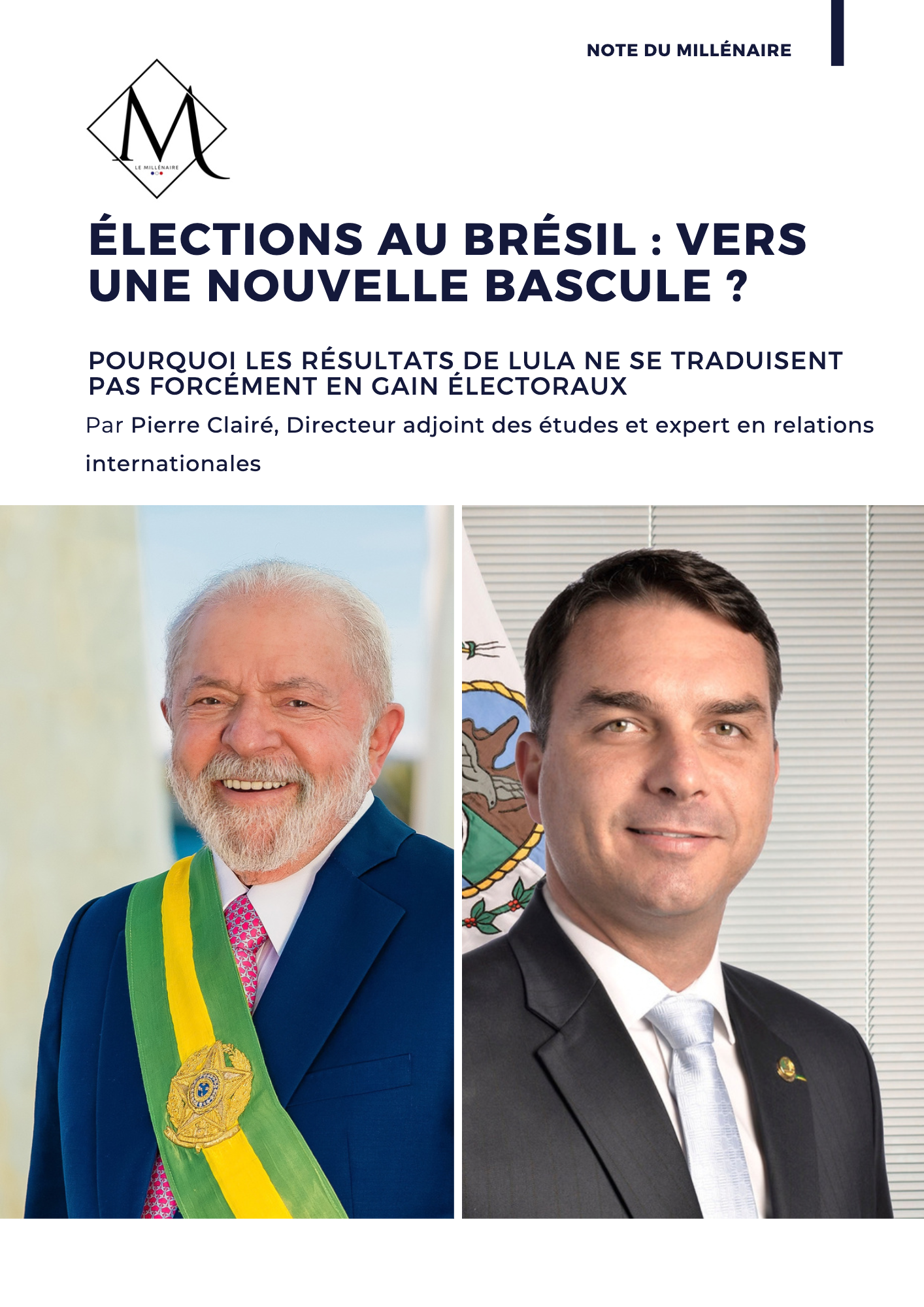 1 October 2026Élections au Brésil : vers une nouvelle bascule ?
 7 septembre 2026Article d’Europe 1 : « Elections régionales en Allemagne : Le parti du chancelier subit un séisme »
 31 juillet 2026Pierre Clairé pour Valeurs Actuelles : « Réarmement en Europe : ce que l’Europe de l’Est a compris mais pas l’Europe de l’Ouest »
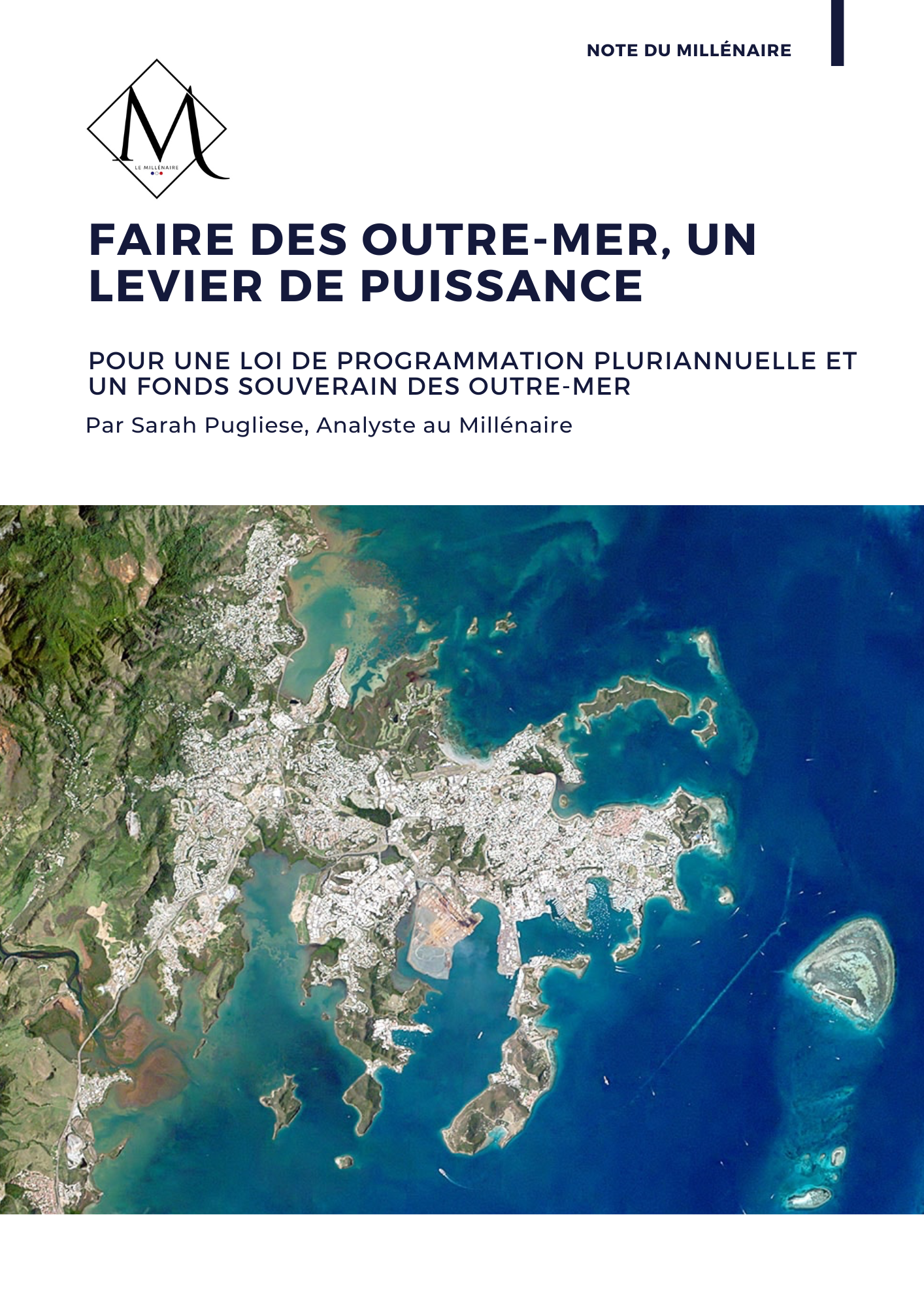 28 juin 2026Faire des Outre-Mer un levier de puissance
Photo credits: Flavio Bolsonaro, via Flickr by Agencia Senado, CC BY 2.0. Luis Inacio Lula da Silva, via Wikimedia Commons, CC BY 2.0.
