
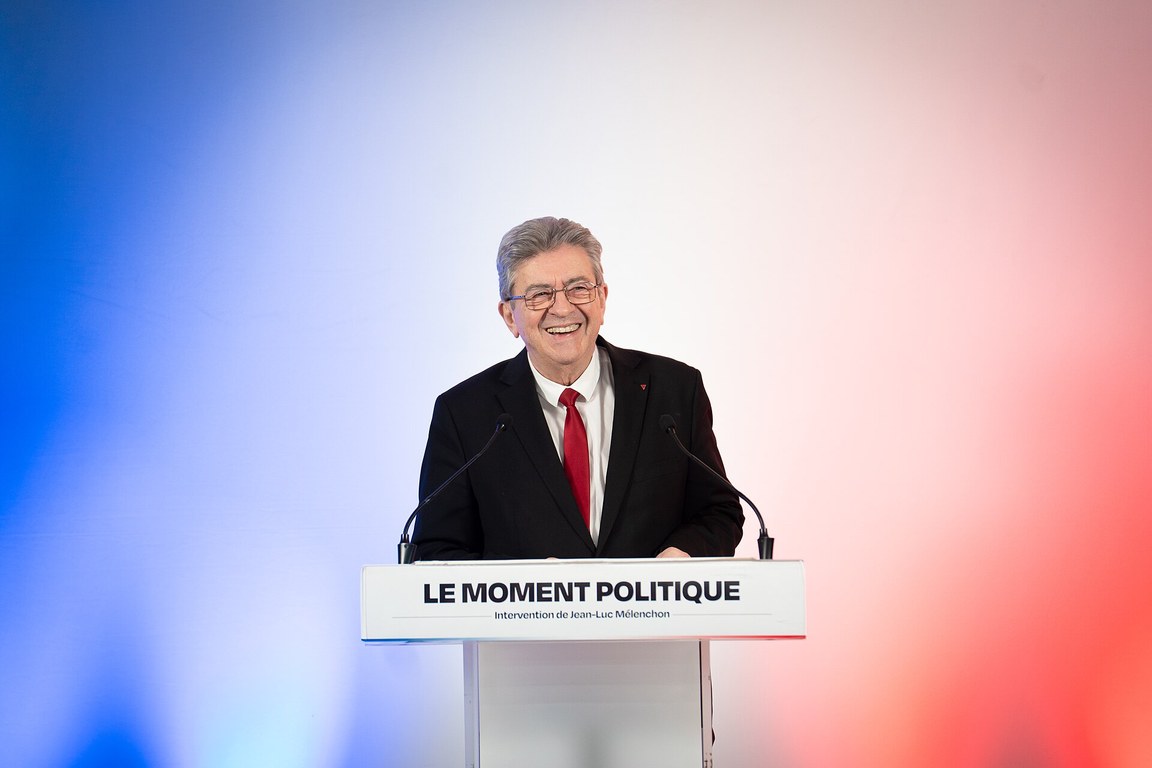
This is a translation of the original French text: Pourquoi Jean-Luc Mélenchon peut devenir président ?
Scenarios for a Mélenchon victory in 2027
Five months before the first round, Le Millénaire’s Forecast gives Jean-Luc Mélenchon 77.8 chances in 100 of reaching the second round. William Thay and Matthieu Hocque analyse his electorate, his reserves of votes and the conditions under which he could beat Marine Le Pen. His victory is not the central scenario, but it can no longer be ruled out.
The finding
With 18.1% in the November polls and 77.8 chances in 100 of reaching the second round according to the Forecast, Jean-Luc Mélenchon is the best placed to face Marine Le Pen.
The cause
A stable base, unprecedented dominance among 18-24 year-olds, a foothold in the big cities and a fragmented central bloc, in a campaign where his image nonetheless remains damaged.
The consequence
His victory is not the central scenario, but it can no longer be ruled out: it depends on the left uniting, on how the centre behaves and on turnout among young people.
Foreword
Three candidacies, three narrow defeats. In April 2022, Jean-Luc Mélenchon was 421,308 votes short of reaching the second round, with 7,712,520 votes (21.95%). He had finished 1.7 points short of the second round in 2017 and 1.2 points short in 2022.
The most likely run-off. Le Millénaire’s Forecast of 25 November 2026 gives him 77.8 chances in 100 of reaching the second round, against 28.5 for Édouard Philippe if he were the central bloc’s only candidate. Since early November, the most likely run-off has therefore pitted Marine Le Pen against Jean-Luc Mélenchon.
A question to take seriously. For many observers, he remains trapped under a “glass ceiling”. The authors argue instead that a candidate who reaches the second round always has a path to victory, however narrow. They draw on the Forecast, the maps of the Cardinal software, the 327 poll scenarios published since 2025, the Cevipof and Fractures françaises surveys, and several French and foreign precedents.
An established candidate
Steady progress. Jean-Luc Mélenchon has gained ground at each of his candidacies: 3,984,822 votes in 2012 (11.10%), 7,059,951 in 2017 (19.58%) and 7,712,520 in 2022 (21.95%), even as turnout fell. With 50.6 million registered voters expected in 2027, one point of turnout represents around 500,000 voters.
A strategy aimed at abstainers. Since 2017, he has sought to bring out those who vote little, young people, the working-class neighbourhoods of large cities and left-wing abstainers, rather than to win over the centre. This bet gives him the most stable electorate of the campaign, with a gap of 1.7 points between his scores depending on the field tested, but also the highest rejection.
A machine without equal. With the exception of the Rassemblement national, no rival has such an activist machine. The movement claims nearly 450,000 members and more than 60,000 events organised in 2024. According to the movement, it took 244 days to gather 150,000 citizen sponsorships in 2017, 4 days in 2022 and less than 24 hours in May 2026. These figures are declared and unverified.
A breakthrough in the polls. He rose from 11.9% on average in February to 18.1% in the eight November polls. No event in the campaign has dented his curve, while Édouard Philippe fell from 20.4% in March to 11.6% in November. He has never been this high five months before the vote: he stood at 12.7% in November 2016 and 9.1% in November 2021.
Yet a damaged image. According to Elabe, 17% of French people had a good image of him in September 2026, against 20% in November 2021, and 60% a very bad image, against 45%. He is gaining in voting intentions without gaining significantly in public opinion. According to Cluster17, 24% of French people nonetheless see him as the best placed to represent the left, ahead of Raphaël Glucksmann (14%).
A young and renewed electorate
An eroded 2022 base. According to the Ipsos bva-Cevipof survey of September 2026, only 53% of his 2022 voters who express a voting intention choose him again, with 18% turning to Raphaël Glucksmann. Toluna Harris Interactive measures 83% loyalty in October, taken as the lower bound of the loss.
The return of his voters. At Toluna Harris Interactive, the share of his 2022 voters who intend to vote for him again rose from 53% in March to 82% on 9 November, then 74% on 18 and 19 November. According to the authors’ calculation, nearly 10 of his 15.5 points at Ipsos come from his 2022 voters, the rest from newly registered voters and former abstainers.
The generational shift. He polls 42% among 18-24 year-olds in September 2026, compared with 31% in 2022, but only 8% among 50-59 year-olds, compared with 22%. The under-35s now make up 54% of his electorate, while they account for only 23% of voters. No other candidate has such an unbalanced age pyramid.
Unprecedented dominance among the young. In nine polls published between July and October, he wins between 36% and 45% of 18-24 year-olds, on average twice Marine Le Pen’s score. Raphaël Glucksmann wins only 4% of them at Ipsos. The sub-samples often number a few hundred people, which calls for caution.
Young people less radical than their vote. Only 18% of 18-24 year-olds want to transform society radically, against 26% of the population as a whole. For the authors, this vote reflects less an adherence to radicalism than the absence of any other offer: the social-democratic left wins only 4% of this generation in September 2026.
What foreign precedents show. Die Linke won 25% of 18-24 year-olds in Germany in 2025, but 8.8% of the vote overall. Under-30s did not exceed 20% of voters in any of the fourteen Super Tuesday states in Bernie Sanders’s 2020 campaign. Dominance among the young is not enough without progress among older voters.
An angry vote in the major cities
From class to age and place. The sharpest decline is among manual workers: 27% in 2022, 13% in September 2026, while Marine Le Pen wins 58% of them. He now wins 20% among managers and professionals. His electorate has moved from a working-class vote across all generations to a young, urban and educated vote.
Anger that changes direction with the territory. According to Odoxa, in dense areas he wins 29% of clerical, service and manual workers and 26% of managers and professionals; in sparsely populated areas, he falls to 14% and 16%, and Marine Le Pen wins 57% of clerical, service and manual workers. Overall, he wins 27% in the Paris area and 13% in rural communes.
The shock suffered by managers and professionals. According to Insee, the average net salary of private-sector managers fell by 1.2% in real terms in 2022 and then by 2.8% in 2023, the steepest fall of any category. Unemployment among 15-24 year-olds reached 21.0% in the third quarter of 2026.
The central bloc has lost the big cities. Emmanuel Macron won 34.8% in Paris in 2017 and 35.3% in 2022; Valérie Hayer’s list fell to 17.7% in 2024. Among managers and professionals, the central bloc fell from 34% in 2022 to 24% in October 2026, mainly to the benefit of Marine Le Pen (from 11% to 21%) and Raphaël Glucksmann.
Anger that qualifies but does not win. Against Marine Le Pen, he wins only 48% in the Paris area and 39% in the major cities, where Édouard Philippe would win 62% and 53%. Only school pupils and students (67%) and 18-24 year-olds (59%) give him a majority in this run-off.
A geography concentrated in the big cities
From working-class France to the major cities. In 2012, his vote still mirrored the map of the communist and working-class left. In 2022, he exceeds 30% in communes with more than 50,000 registered voters and stays below 17% in those with fewer than 2,000. His progress since 2012 has been almost entirely in cities: 18 points in the large communes, 5 in the villages.
A core of 1,323 communes. The stable strongholds account for 10.7% of voters but 19.3% of his 2022 votes, with an average score of 35.8%. Conversely, 5,629 communes form a lost base, mostly rural or working-class, where the working-class vote has often moved to the Rassemblement national.
Income, the first driver. A regression on 31,297 communes explains 73% of the differences in the vote. All else being equal, a commune whose median income is 10% higher votes 3.8 points less for him. His vote also rises with the share of university graduates, a sign of a dual base in working-class neighbourhoods and educated city centres.
A highly concentrated electorate. He came first in 154 of the 318 towns and districts of more than 30,000 inhabitants in 2022, but in only 2,792 communes, whereas Marine Le Pen came first in more than 20,000. Fifty communes and districts provide 15.3% of his votes for 9.9% of the votes cast.
The stake of the educated cities. In the 2024 European elections, the 2022 electorate largely moved to Raphaël Glucksmann’s list in the university cities of the West: 24.9% against 17.9% for the LFI list in Rennes, 23.8% against 15.4% in Nantes. The rest of the campaign will be played out with this electorate.
Mélenchon 2027 in figures
Chances in 100 according to the Forecast of 25 November, “Philippe alone” scenario
Reading: in the daily edition of the Forecast of 25 November 2026 (20,000 simulations), Jean-Luc Mélenchon has 77.8 chances in 100 of reaching the second round and 17.2 of being elected.
Mélenchon’s chances of reaching the second round, by field of candidates
Reading: Jean-Luc Mélenchon has more than one chance in two of qualifying in all ten scenarios calculated by the Forecast on 25 November 2026.
Jean-Luc Mélenchon in the first round, monthly poll average in 2026 (%)
Reading: in November 2026, the eight polls published by 25 November give Jean-Luc Mélenchon 18.1% on average, compared with 11.9% in February.
Mélenchon vote by age: voting intentions in September 2026 (and 2022 vote)
Reading: in September 2026, Jean-Luc Mélenchon has 42% of voting intentions among 18-24 year-olds, compared with 31% of their votes in 2022 (Ipsos).
Mélenchon’s 2022 score by commune profile
Reading: the 1,323 stable strongholds account for 10.7% of the votes cast in 2022 but 19.3% of Jean-Luc Mélenchon’s votes, with an average score of 35.8%.
Mélenchon against Marine Le Pen under eight readings of the second round (%)
Reading: with the vote transfers observed in the 2024 legislative elections, Jean-Luc Mélenchon would win 49.4% against Marine Le Pen; he passes 50% if the non-LFI left unites behind him.
Jean-Luc Mélenchon is today very strong in one third of the country and weak in the other two.
A stable base under a high ceiling
Unmatched rejection. According to Cluster17, 69% of registered voters rule out ever voting for him, compared with 52% for Marine Le Pen and Raphaël Glucksmann. His potential, measured by scores of 6 to 10, stands at 22.5%.
Rejection that carries over to the second round. Ifop measures him at 32% against Marine Le Pen in October 2026, while Raphaël Glucksmann is at 43% and Édouard Philippe at 44%. Only 30% of Raphaël Glucksmann’s voters would vote for him in this run-off according to Toluna Harris Interactive.
How high can he rise?
A reserve of 3 to 5 points on the left. Raphaël Glucksmann, Marine Tondelier and Fabien Roussel total 17.5 points in the polls since 1 October. Part of this reservoir is made up of his own 2022 voters: around 2 million would vote for him again in 2027.
Tactical voting less certain than in 2022. Raphaël Glucksmann stands at 12.6% on average, where Yannick Jadot finished below 5%, and he won the socialist primary. Tactical voting can therefore work for him as much as for Jean-Luc Mélenchon. He has, however, lost 54% of his primary gain within a month.
A limited abstention reserve. The reserve of abstainers in working-class neighbourhoods is real and concentrated, but it is counted in hundreds of thousands of votes, less than one point, and largely overlaps with that of young people in the major cities.
The renewal of the electorate. Around 4.2 million young people will vote for the first time in 2027. They already appear in the polls, and the authors estimate the net contribution of this renewal at around one million votes.
Polls that underestimate him. In 2022, the last polls gave him 17.8% and he won 21.95%. Declared turnout always underestimates actual turnout, by 10.8 points in 2017 and 14.7 points in 2022 according to Cevipof.
The Forecast’s favourite to qualify
A shift in November. In October 2025, he had 51 chances in 100 of reaching the second round, against 57 for Édouard Philippe. The order was reversed on 10 November 2026 and the gap widened in the edition of 25 November (77.8 against 28.5). Marine Le Pen remains the favourite, with 93.8 chances in 100 of reaching the second round and 64.5 of being elected.
A methodological caution. In the “Philippe alone” scenario, the Elabe poll of 13 November alone carries 59% of the weight of the polls in the model’s average.
The dispersion of the centre and the right. The combined total of the centre and the right remains roughly stable, from 27.8% in July to 26.3% in November, but it is split between more candidates: the dispersion costs the leading one 5.4 points. Confidence in Emmanuel Macron fell to 13% in November according to Elabe.
A field still unsettled. Depending on the field of candidates, his chances of qualifying range from 56 to 82 in 100 in the Forecast. The withdrawal of the ecologist and communist candidacies would bring him 1.5 to 3.5 points according to Ifop.
A threshold of 21% to 24% to reach
A low threshold in the polls. In the autumn polls, the second-placed candidate has around 17% and the third around 14%. One has to go back to 2002 to find such a low threshold, when 16.86% was enough for Jean-Marie Le Pen.
A matter of votes more than percentages. Nine million votes represent 24.6% of votes cast with 74% turnout, and 22.2% with 82%. High turnout helps to reach a number of votes, not a percentage.
The Forecast projection. The Forecast projects him at 24.3%, or 8.9 to 9.6 million votes, compared with 7.7 million in 2022. For the authors, his path to the second round depends above all on the return of his 2022 voters who left for other left-wing candidates, far more than on young people, who are already included in his voting intentions.
for Jean-Luc Mélenchon against Marine Le Pen with the vote transfers observed in the 2024 legislative elections, around 380,000 votes short, compared with 32.7% in second-round polls.
Can he beat Marine Le Pen?
A gap of 10 to 35 points depending on the measure. The 26 second-round polls published since May give him 32.7% on average. The Forecast, which adds the vote transfers observed in 2022 and 2024 to stated intentions, gives him 44.9% in its central estimate and 23.1 chances in 100 of winning when this run-off takes place. Édouard Philippe would beat Marine Le Pen with 51.2%.
Polls have always underestimated the FN’s and RN’s opponent. In every second round since 2002, the candidate facing the FN and then the RN gained 3 to 7 points between the last polls and the result.
A national bloc ahead. In 2022, the left bloc (31.9%) and the national bloc (32.3%) were neck and neck. The left bloc now trails by 2 to 4 points, in the polls as in the Forecast.
Rejection that has reversed. According to Fractures françaises 2026, 65% of French people consider La France insoumise a danger to democracy, against 53% for the Rassemblement national. The figures were 51% against 61% in 2020.
Vote transfers that will decide the second round
What was done and what is stated. In the 2024 legislative elections, 43% of Ensemble voters voted for an LFI candidate against the Rassemblement national. In October 2026, they state only 8% for Jean-Luc Mélenchon, against 43% for Marine Le Pen.
Counting the votes. With the transfers observed in 2024, he would win 49.4% of the vote, around 380,000 votes short, while 7.5 points’ worth of Édouard Philippe’s voters would abstain or cast a blank ballot. The second round would turn less on centrist voters who choose Marine Le Pen than on those who refuse to choose.
The levers. He reaches 50.3% if the non-LFI left unites behind him, 52.4% if the centre organises a “barrage”, and 54.6% in the best case, with additional mobilisation of his electorate.
A left that must turn out in full. If the centre and the right vote as they say they will today, he tops out at 42% whatever the left does. For the authors, the second round is decided in the centre, but it can only be won if the left has turned out in full beforehand.
Precedents showing that a gap can be closed
Nicolas Sarkozy in 2012. He stood at 42% against François Hollande in November 2011 and won 48.36% on 6 May 2012. Jean-Luc Mélenchon starts from further behind and would need a comeback almost three times as large.
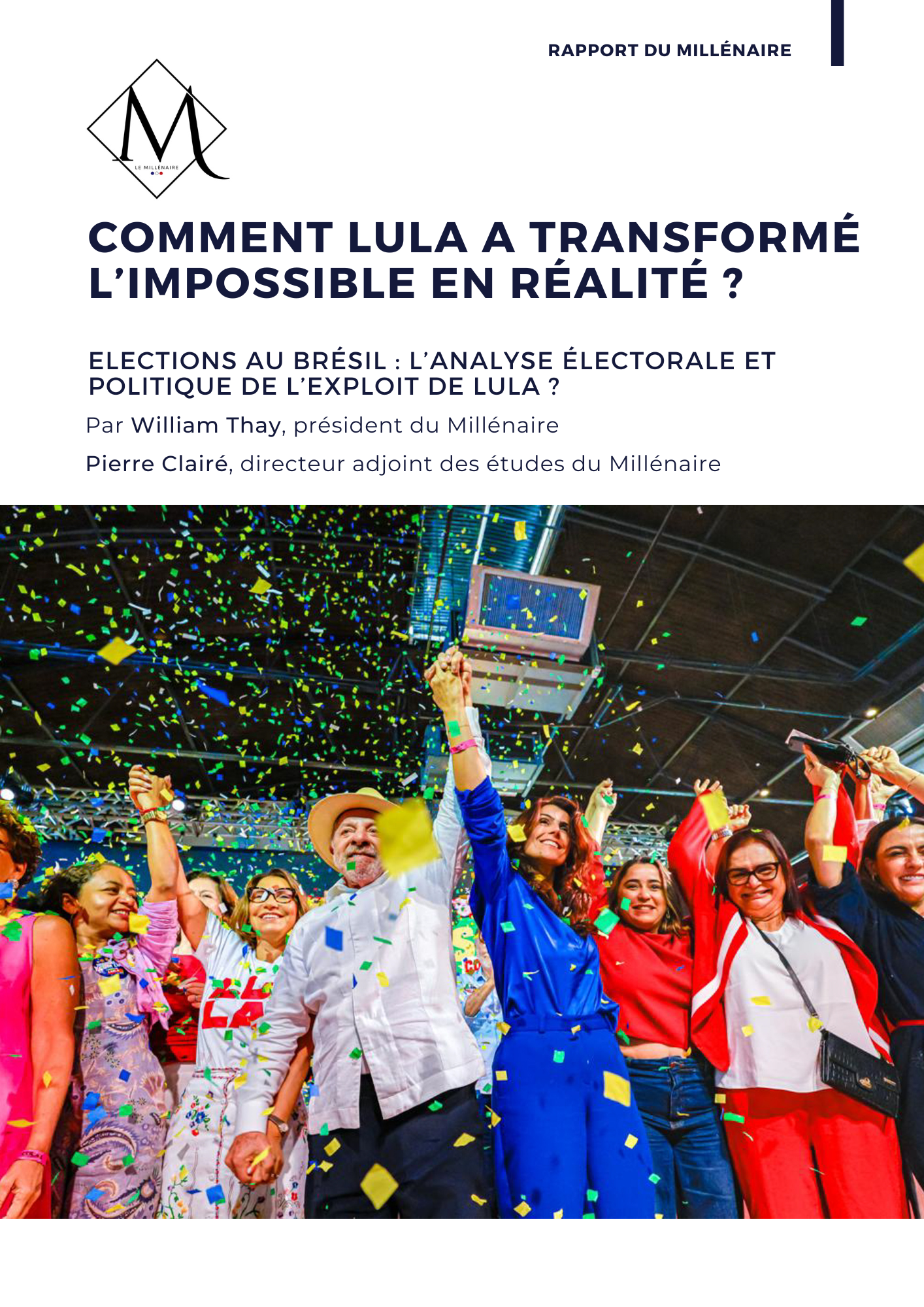
Lula in Brazil in 2026. Trailing by 2.22 million votes in the first round, Lula won three weeks later with a lead of 4.43 million votes, which neither the polls nor Le Millénaire’s model had anticipated. The case cannot be transposed as such: voting is compulsory there and Lula was the incumbent president.
Radical lefts that won. Syriza in 2015, Andrés Manuel López Obrador in 2018 and Gustavo Petro in 2022 won against governing parties worn down by power. But Jean-Luc Mélenchon’s second-round opponent would be Marine Le Pen, not the central bloc.
Conclusion: can he become president?
Possible, without being the central scenario. The Forecast of 25 November gives him 77.8 chances in 100 of qualifying and 17.2 of being elected, against 93.8 and 64.5 for Marine Le Pen and 28.5 and 18.3 for Édouard Philippe in the “Philippe alone” scenario. His strength lies in the first round; the second round remains his weak point.
Condition 1: a united non-LFI left. It must unite behind him from the first round, then without reservation in the second.
Condition 2: a central bloc that refuses to choose Marine Le Pen. He needs a net lead of 10 points among centre and right-wing voters if the left unites, and of 31 points if it votes as it says it will today.
Condition 3: higher turnout than in 2022. Turnout among young people and in working-class neighbourhoods must exceed that of 2022, when it stood at 67.2% among 18-29 year-olds.
Why Jean-Luc Mélenchon could become president
154 pages.
Thay W., Hocque M., “Why Jean-Luc Mélenchon could become president”, Le Millénaire report, 26 November 2026, lemillenaire.org (translation of “Pourquoi Jean-Luc Mélenchon peut devenir président ?”).
Flip through the report
William Thay and Matthieu Hocque
President of Le Millénaire; Director General of Le Millénaire.
William Thay Matthieu HocqueRequest an interview
For an interview with William Thay or Matthieu Hocque about this report: presse@lemillenaire.org
Contact the press officeKeep our studies alive
Your donations and memberships fund Le Millénaire’s next reports.
Support us JoinReceive Le Millénaire’s next reports
Read also
All studies 21 October 2026
 11 October 2026
 26 October 2026
 7 July 2026
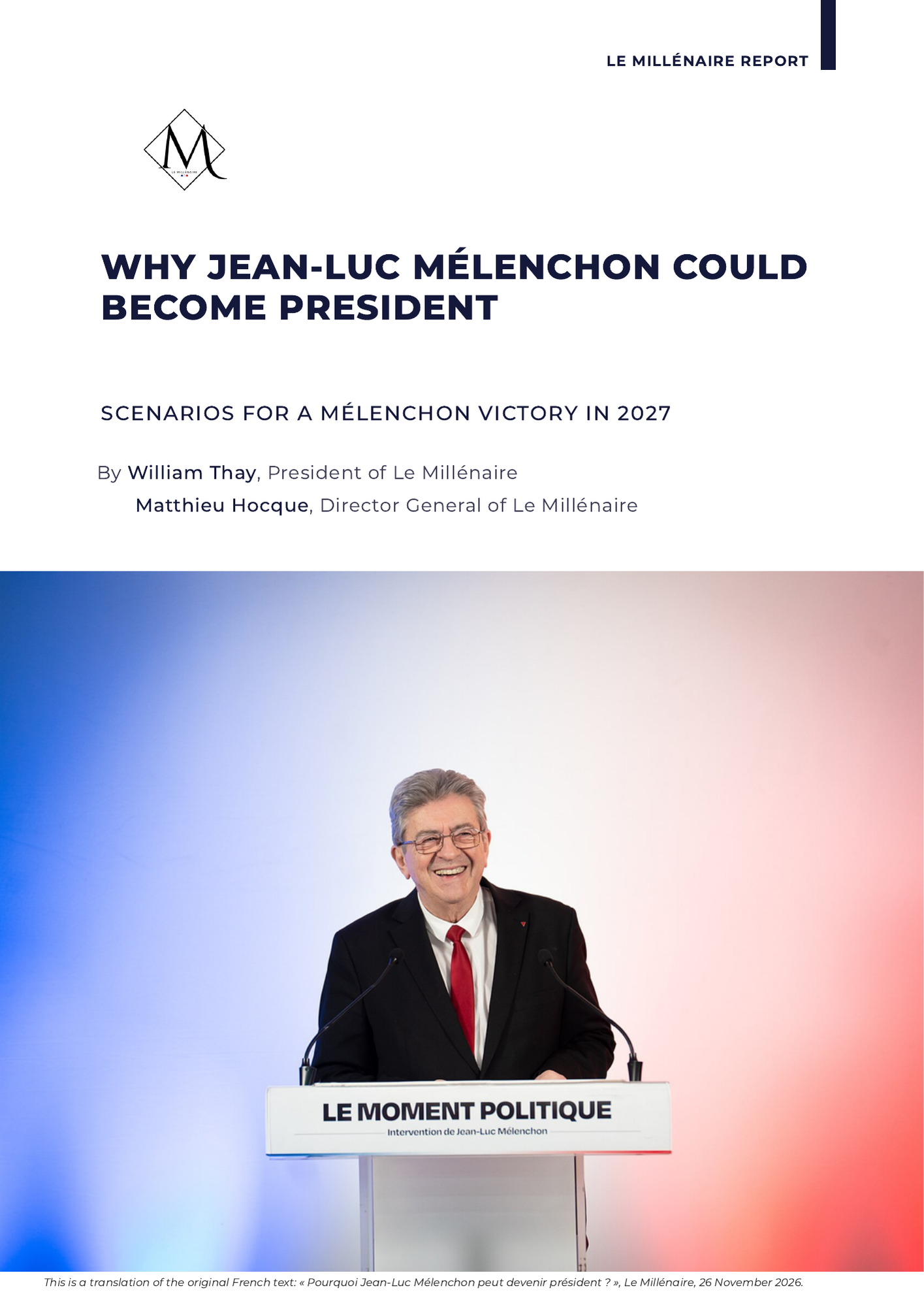
Photo credit: Jean-Luc Mélenchon via Wikimedia, CC BY 4.0 licence.
