
This is a translation of the original French text, which may contain errors; the French version is the reference text: Élections en Espagne : Pedro Sánchez vers la fin ?
Towards a new united right coalition in Europe?
On 29 November 2026, Spaniards elect their Cortes after the fall of Pedro Sánchez’s government, abandoned by Junts over housing. According to Le Millénaire’s forecast, based on 41 polls and 20,000 simulations, the PP and Vox win an absolute majority in 76 cases in 100. Pierre Clairé analyses the record of the Sánchez years, the rules of an electoral system that penalises mid-sized parties, five scenarios for election night and what a united right would change for Spain and for Europe.
The context
On 2 October 2026, the seven Junts deputies voted against Pedro Sánchez’s housing decree. Without a budget of his own since 2023, the Prime Minister dissolved the Cortes and called elections for 29 November.
The forecast
The PP remains first with a median of 125 seats, ahead of the PSOE (114) and Vox (64, against 33 in 2023). The PP and Vox together reach at least 176 seats in 76 simulations in 100, but the PSOE comes first in seats in 38.
What is at stake
A victory for the right looks likely. The real question is the balance of power between the PP and Vox, which have never governed together at national level, and its consequences in the European Council.
Foreword
A government hanging by a thread. Returned to the Moncloa in November 2023 with 179 votes thanks to the regionalist parties, Pedro Sánchez led a minority government, with no new budget since 2023. The break with Junts, complete by the end of 2025, sealed the end of the legislature.
More than an election about Vox. For the author, reducing 29 November to the likely arrival of Vox in power would be simplistic. One must also understand a PSOE that is not collapsing, a divided left of the PSOE and an internal race on the right that will determine the shape of the future government, while the PP and Vox have never governed together at national level.
The Senate, an unprecedented battleground. The PSOE and Frente Amplio are running joint lists for the Senate, without Podemos, which has led the PP and Vox to coordinate their candidacies, a first at national level.
How the legislature died
The Maricarmen affair. On 23 September 2026, the eviction in Madrid of an 87-year-old tenant, whose rent had risen from 500 to 2,600 euros, sparked a national housing movement. On 29 September, the government adopted two emergency decree-laws, which notably extended some five million leases and capped rent revisions at 2%.
The vote of 2 October. Both decrees were rejected in the Congreso, with Junts voting against and the PNV and Coalición Canaria joining the opposition on the second. On 5 October, Pedro Sánchez announced the dissolution of the Cortes and an election on 29 November, framing the choice as one between the far right and social justice.
The issues that will decide the vote
A solid economy, a burdensome cost of living. The Bank of Spain forecasts 2.6% growth in 2026 and unemployment brought down to 10%, but inflation is still expected at 3.9%. Housing is the top concern: prices rose by 12.8% year on year in the first quarter of 2026, against 5.1% in the Union.
Ceuta and migration. At the end of July 2026, the mass entry of people into Ceuta from Morocco and the handling of it by a government isolated in Brussels handed the right the ground of firmness. For the author, it is the most dangerous issue for the PSOE.
Justice, territory, the world and state competence. Convictions in the PSOE’s entourage, the amnesty law and the Catalan question, opposition to Washington over Iran and military spending, and two rail disasters that killed 115 people in 2026 complete the picture of the campaign.
The Sánchez years (2018-2026)
A master tactician. Having come to power in 2018 through the first successful constructive motion of no confidence in Spanish democracy, with 84 deputies, Pedro Sánchez governed for more than eight years: he formed the first coalition government since the Second Republic, steered the country through the pandemic and pulled off an unexpected comeback in 2023.
A mixed record. On the credit side: growth, unemployment down from 15.3% to 10%, the labour reform and a minimum wage raised from 735.90 to 1,221 euros. On the debit side: a legislature that ended without a budget of its own, a first since 1978, and a Spain the author describes as damaged and divided.
How Spain votes
Everything is decided in the provinces. The 350 deputies are elected in 52 constituencies using the D’Hondt method. The system rewards large parties and territorially concentrated parties: in 2023, the PP and the PSOE won less than 65% of the votes but 73.7% of the seats, while Vox and Sumar, at around 12% each, won only 33 and 31 seats.
Division is costly. Frente Amplio and Podemos agreed joint lists in only two autonomous communities. In the Senate, where the leading party usually takes three of the four seats per province, the union of the left and the coordination between the PP and Vox could make this chamber a central battleground.
The parties and people to watch
Four main forces. Alberto Núñez Feijóo’s PP needs Vox to reach a majority, but Vox, now the country’s third force, could sell its support dearly. Pedro Sánchez’s PSOE has run a highly mediatised campaign to bring back its abstainers. To its left, Ada Colau’s Frente Amplio and Irene Montero’s Podemos are running divided.
The players in the shadows. Isabel Díaz Ayuso, President of the Community of Madrid, is positioning herself to succeed Alberto Núñez Feijóo should he fail. Gabriel Rufián and Salvador Illa weigh on the future of the left, while the regionalist parties, from the PNV to Junts, could become decisive again if the right fell short of a majority.
The polls
Beware of 2023. In 2023, the PP had been overestimated and the PSOE underestimated by 3.4 points seven days before the vote. Replayed on the forecast, the 2023 error would bring the PP down to 117 seats and the right’s chances of a majority to 55 in 100, without reversing the forecast, but would make the PSOE the first party in seats in 59 simulations in 100.
Falling unemployment that favours the incumbent. Between 2022 and 2025, unemployment fell from 13.0% to 10.5%. At that level, Le Millénaire’s economic model expects the PSOE at 31.9%, above the 27.7% in the polls.
Le Millénaire’s forecast
41 polls, 20,000 simulations. According to the run of 19 November, the PP wins 125 seats, 12 fewer than in 2023, and the PSOE 114, seven fewer. Vox rises from 33 to 64 seats, while Frente Amplio, with 10 seats, remains far from Sumar’s 31 seats in 2023. The intervals of the two main parties overlap widely: first place remains open.
A right in retreat since October. Between 6 October and 19 November, the PP fell from 136 to 125 seats and the chances of a PP and Vox majority went from 88 to 76 in 100.
Andalusia, Extremadura, Valencia. The PP comes first in 42 of the 52 constituencies and the PSOE in 9. Eleven constituencies, which elect 75 deputies, are decided by less than 4 points. Vox’s final number of seats will be decided in rural inland Spain, where six of the nine contested constituencies elect only three deputies.
simulations of the forecast of 19 November give the PP and Vox the absolute majority of 176 seats in the Congreso, with a median total of 191 seats.
Five scenarios for 29 November
The most likely scenario. In 61 simulations in 100, the PP and Vox have a majority and the PP is the largest party. The PP dominates clearly in 16 simulations, while Vox is close behind in 11. Below 60 seats for Vox, Alberto Núñez Feijóo can govern alone with outside support; above 70, Santiago Abascal will be in a position to demand ministries.
The four other outcomes. In 18 simulations, the bloc that invested Pedro Sánchez in 2023 regains an arithmetical majority, provided that Junts votes for him again. In 15, the PSOE comes first in seats against a right-wing majority. In 3, the right reaches 176 seats only with small parties, and in 3 no bloc gets there.
Elections of 29 November: the forecast in figures
Median seats per party in the Congreso, forecast of 19 November
Reading: the PP wins a median of 125 seats, within a 90% interval ranging from 95 to 158 seats; that of the PSOE ranges from 80 to 154 seats. The absolute majority is 176 seats.
The five possible outcomes of 29 November, out of 100 simulations
Reading: in 61 simulations in 100, the PP and Vox have the absolute majority and the PP is the first party in seats.
Vox seats, out of 100 simulations
Reading: Vox wins at least 70 seats in 34 simulations in 100. Above this threshold, Santiago Abascal would be in a position to demand ministries.
Chances of a PP and Vox majority depending on the polling error replayed, out of 100
Reading: if the polls are wrong as in July 2023, the PP and Vox have a majority in only 55 simulations in 100, and the PSOE becomes the first party in seats in 59.
The alliance of the right: easier said than done
The regional precedent. Having entered several PP-led regional governments in 2023, Vox left them on 11 July 2024 over the issue of migrant minors, before returning in 2026 to four executives: Extremadura, Aragon, Castile and León and Andalusia.
Lessons from Europe. From Austria to the Netherlands, coalitions between the right and the radical right have often broken down over asylum or the allocation of ministries. Outside Italy, the most durable formula has been Sweden’s, with no portfolio for the radical right, which Vox publicly rejects.
Feijóo controls the clock. The Constitution sets no date for the first investiture vote. Alberto Núñez Feijóo will be able to negotiate at leisure or put Vox in front of its responsibilities, and on 23 December the composition of the governing boards of the chambers will be a first test.
In a negotiation, the one who can walk away sets the terms.
What is at stake
In Spain. The PP promises one million homes, a VAT cut on first homes for under-40s, a tougher migration policy and the repeal of the amnesty law. The winner will inherit the 2023 budget, extended three times.
In Europe. A victory for the right would leave the socialists with three members of the European Council out of 27, representing 2.1% of the Union’s population. The countries governed with an ECR or Patriots party would rise from 20.7% to 31.6% of that population, still below the 35% of a blocking minority.
In the world. Relations with the United States, Israel, Morocco, Algeria and Latin America would shift, but the author anticipates a gradual normalisation rather than a spectacular reversal, so strong are the geographical, energy and diplomatic constraints.
Conclusion
Fifty-one years after the death of Franco, Spaniards are voting in what some already call a historic election: since the end of the dictatorship, no force to the right of the PP has governed at national level. More than the fall of Pedro Sánchez, one of the last socialists in power in Western Europe, it is an unprecedented upheaval in Spanish politics that could be played out on 29 November.
Clairé P., “Elections in Spain: the end for Pedro Sánchez? Towards a new united right coalition in Europe?”, Le Millénaire Report, 24 November 2026, lemillenaire.org.
Browse the report
Request an interview
For an interview with Pierre Clairé about this report: presse@lemillenaire.org
Contact the press officeKeep our studies going
Your donations and memberships fund the next studies of Le Millénaire.
Support us JoinReceive the next studies of Le Millénaire
Read also
All studies 14 November 2026
 26 October 2026
 11 November 2026
 1 November 2026
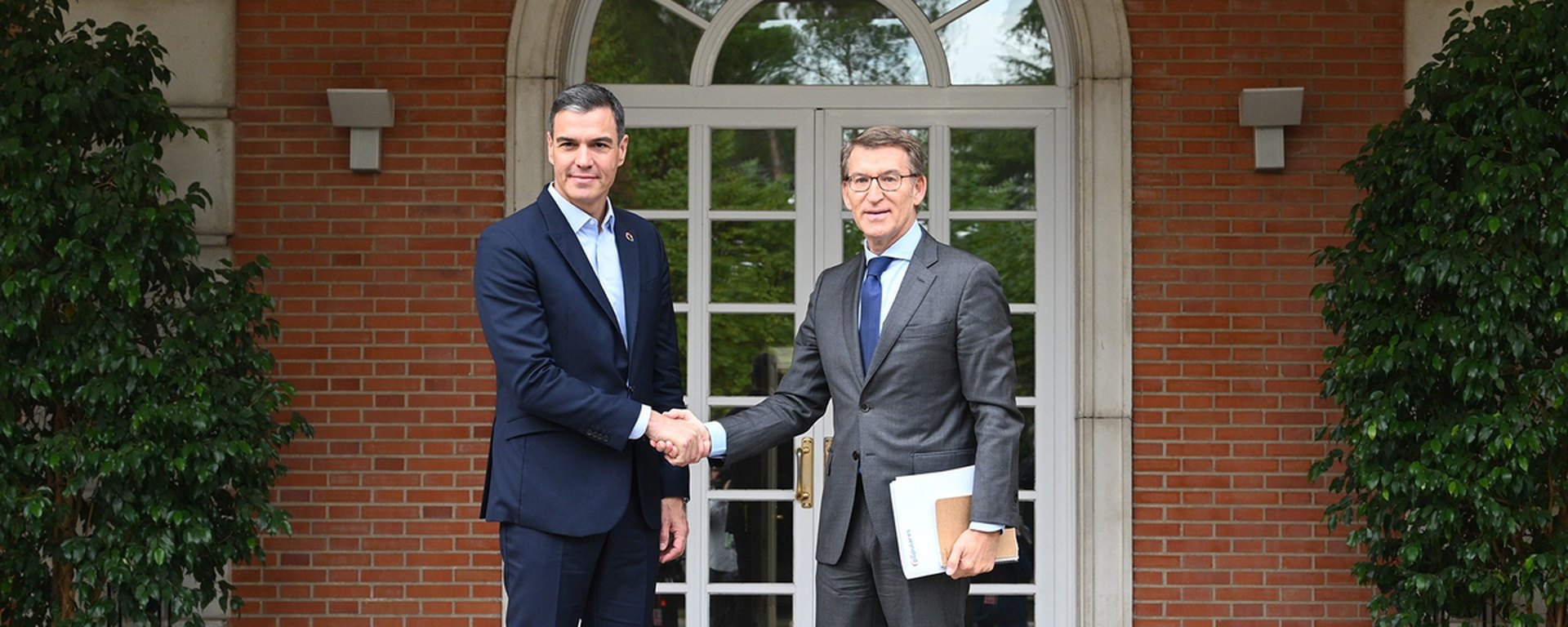
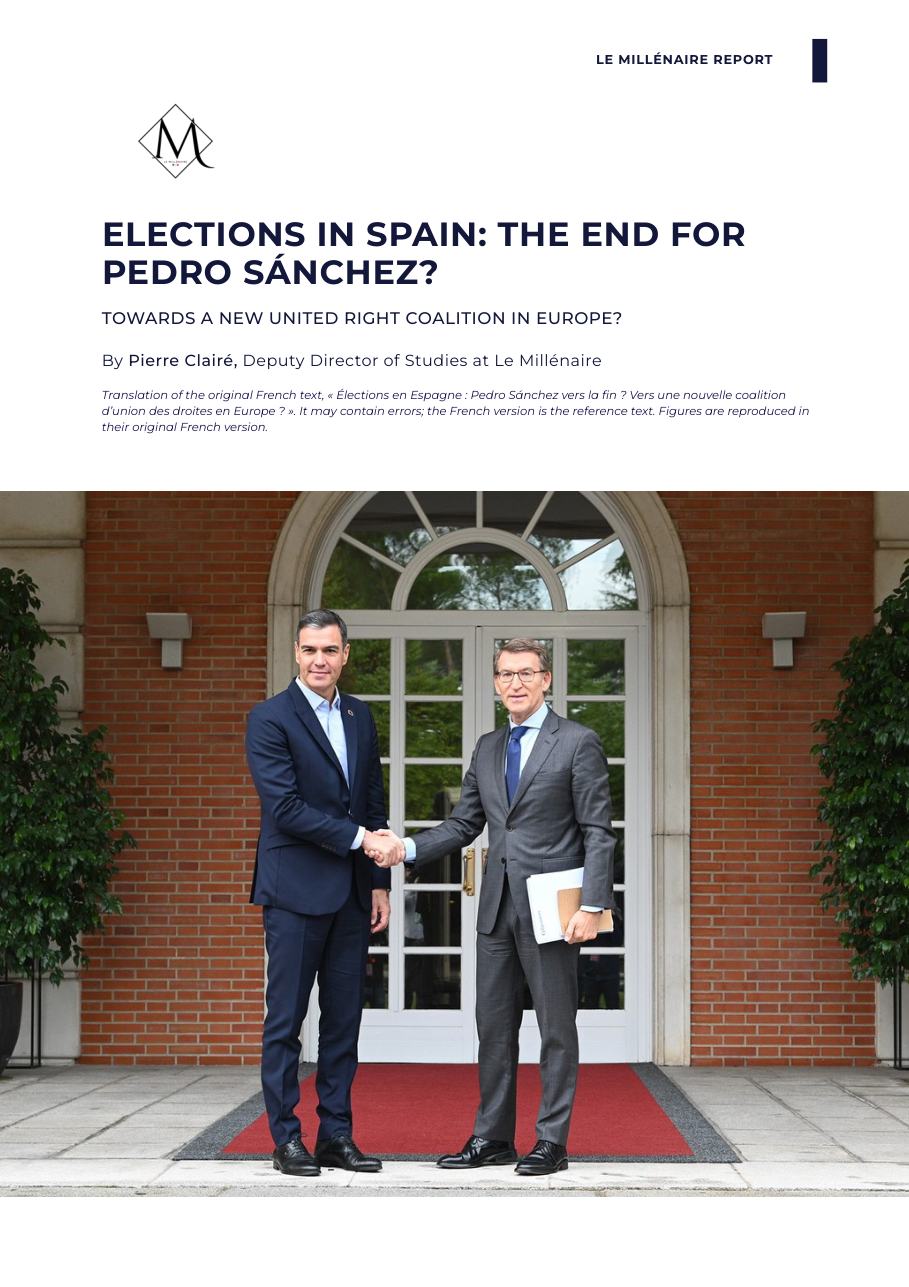
Photo credit: Pedro Sánchez with Alberto Núñez Feijóo, via Wikimedia Commons, “Ministry of the Presidency, Government of Spain”.
